I swapped my gas stove for the Philips OneChef for 1 meal everyday for a week. Here’s what surprised me
Editorial independence is core to our work. Some links may earn us a commission, without influencing our opinions.
I swapped my gas stove for the Philips OneChef for 1 meal everyday for a week. Here’s what surprised me
I decided to cook with the Philips OneChef everyday. I wanted to see if this ₹19,995 appliance could actually handle the kind of everyday cooking I normally do.
Updated on: Oct 6, 2026, 17:06:21 IST
Prefer HTon Google
Share via
Copy link
Our Picks
Our Picks
| Product | Rating | Price |
|---|---|---|
Philips Smartchoice OneChef 6L Smart All in One Device, 100% Food SafeView Details
|
||

|
Check Offers | |
| Philips Air Fryer Oven NA342/00, 7.2L with Cooking Window, 100% Food SafeView Details
|
||
|
|
Check Offers | |
| PHILIPS Air Fryer NA231/00, touch panel, 6.2L, Extra Large, 100% Food SafeView Details
|
||
|
|
Check Offers | |
| Philips NA352/00, 9L, Dual Basket Air Fryer Oven, 100% Food SafeView Details
|
||
|
|
Check Offers |

Research-Backed Choices
Every product we recommend is chosen through a combination of Primary Research and Secondary Research.
I like my gas stove. It is predictable, familiar and, after years of cooking on it, I know exactly what I’m doing. So replacing it with a countertop cooking appliance for one meal every day sounded like a slightly unnecessary experiment. But that’s exactly what I did with the Philips OneChef.
For this review, I decided to actually cook with it instead of treating it like another air fryer sitting on my kitchen counter. I tried making the kind of food I would normally cook on the stove and realised the OneChef was capable of much more than I expected. It also made me realise there are some things a gas stove still does better.
And, okay, this is probably TMI, but my parents-in-law are visiting next week. I hardly get time to cook, so I figured this was my chance to see if the OneChef could help me pull off a few impressive meals without spending half my life in the kitchen. Well, the timing seems suspiciously perfect since I had a review to write and in-laws to impress.
Check out the Philips OneChef on Amazon
1. Philips Smartchoice OneChef 6L Smart All in One Device, 100% Food Safe
Loading Suggestions…
First impressions: How does the Philips OneChef look and feel in my kitchen?
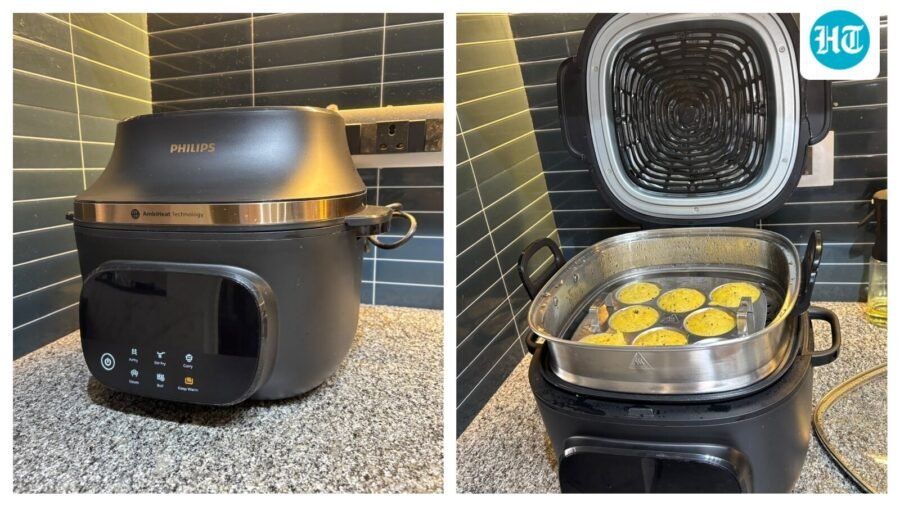
The Philips OneChef is not exactly a small countertop appliance, but it has a fairly purposeful, premium-looking design that makes its size easier to justify. The build feels solid, the cooking bowl is generously sized, and the controls are straightforward enough to use without constantly reaching for the manual. It does take up noticeable counter space, though, so you'll want to plan where it lives.
So, what did I actually cook in the Philips OneChef?
My biggest rule for this experiment was simple: I wasn't going to cook something just because the OneChef could cook it. If it was something I would normally make on my gas stove, I wanted to see if the Philips could take over that job.
Over the course of my testing, I cooked chicken steak, fish, idli, steamed rice, bread rolls, paneer tikka, aloo/sabzi and dal in the OneChef. And I deliberately picked this mix because I wanted to see how it handled more than just the usual air-fryer staples.
There was grilling and roasting with chicken, fish and paneer, steaming with idli, rice cooking, baking and crisping with bread rolls, and then the more everyday Indian cooking tests with aloo/sabzi and dal.
Some were surprisingly straightforward, while others needed a little more trial and error. But that was exactly what I wanted from this experiment. I wasn't just checking if the food could be cooked. I wanted to know how much effort it took, how much I needed to monitor it, how the food turned out and, most importantly, if I would actually choose the OneChef over my gas stove the next time I made the same thing.
Because having 33 cooking functions sounds impressive, but after using them in a real kitchen, the more useful question is much simpler: how many of them will I actually use?
The first thing that surprised me about the OneChef
The first surprise was that I didn't miss my gas stove as much as I thought I would.
I'm so used to standing in front of the stove, adjusting the flame, checking the food and figuring out when something is done that cooking without doing all of that felt strange initially. With the OneChef, a lot of the work happens after you have set things up and selected the right cooking mode.
I noticed this most while making chicken steak, fish and paneer tikka. Instead of constantly keeping an eye on a pan, I could get the food ready, put it into the OneChef and let the appliance handle the cooking.
The bigger surprise, though, was how quickly I started thinking about the OneChef as a cooking appliance rather than an air fryer.
Making idli, steaming rice and cooking dal are not the things I would normally associate with an air fryer. But the OneChef is designed to go well beyond air frying.
That doesn't mean every dish was automatically easier. There were occasions when I thought, *this would take two minutes on the gas stove*. And that, in itself, became one of the most interesting parts of the experiment: figuring out which meals actually benefited from moving away from the stove, and which ones didn't.
Can the Philips OneChef actually handle everyday Indian cooking?
This was probably the most important part of my experiment.
It is easy for a multi-function appliance to impress you with chicken, fries, roasted vegetables or anything else that traditionally goes into an oven or air fryer. But if you're going to call something an all-in-one cooking appliance for an Indian kitchen, I think it needs to answer a much more practical question:
Can I actually cook the food I eat at home?
For me, that meant testing things like dal, aloo/sabzi, rice and idli alongside the more obvious chicken, fish and paneer dishes.
And this is where the OneChef started making more sense.
The appliance isn't trying to replicate just one piece of kitchen equipment. It brings together different types of cooking, including steaming, boiling, roasting, baking and air frying. That versatility is useful when you don't want to keep switching between different appliances. But there is an important distinction here.
The OneChef can handle everyday Indian cooking, but that doesn't automatically mean it makes every Indian cooking task better than a gas stove.
There are some dishes where the ability to instantly increase, decrease or completely turn off the flame is simply more convenient. So, if you're imagining the OneChef as something that will make your gas stove completely irrelevant, I wouldn't go that far.
What worked surprisingly well during my testing?
After using it for different kinds of food, I found that the OneChef made the most sense when I wanted cooking to be a little more hands-off.
The biggest wins for me were:
Less hovering over the food: Once I had set things up, I didn't have to stand in front of the appliance in the same way I normally would with a pan on the stove.
More than air frying: Chicken steak, fish, paneer tikka, idli, rice and dal gave me a much better sense of its versatility than simply testing fries or nuggets.
One appliance for different jobs: I could move between steaming, cooking, roasting and baking without pulling out a different appliance for every task.
Useful for one-meal cooking: This is where I found the concept particularly interesting. If I wanted to make one meal without turning the kitchen into a full cooking station, the OneChef was convenient.
Less of the usual stovetop mess: Some of the dishes I made were less messy than doing the same kind of cooking directly on the stove.
And then there is the obvious advantage of having a 6-litre cooking vessel and a 2,280W appliance that is designed to handle multiple cooking methods.
But I wouldn't buy it simply because the box says "33-in-1"
After actually using it, I think the more important selling point is not the number of functions. It is the fact that those functions cover very different types of cooking.
Can you really cook dal, rice and idli in the Philips OneChef?
Yes. And this is exactly why I think calling the OneChef an air fryer undersells it.**
Dal, rice and idli were important tests for me because these are regular home-cooking jobs rather than “let's see what this fancy appliance can do” experiments.
The same goes for aloo/sabzi. These are the kinds of dishes where I wanted to know if the appliance could fit into a normal Indian kitchen routine rather than simply demonstrate a feature.
That also made me realise something about all-in-one appliances: versatility only matters if you actually use it.
A list of 33 cooking functions can look fantastic on paper. But if you only use three of them, the number doesn't mean much.
What matters is whether the appliance can cover enough of your regular cooking that you genuinely reach for it.
For me, the answer was yes, although not for every meal.
Where did the OneChef genuinely beat my gas stove?
This is where the review gets interesting because I didn't expect to say this when I started. The OneChef was better when I wanted less active involvement in cooking.
My gas stove is excellent at giving me control. But that also means I am the control system. I have to adjust the flame, stir, check and decide when something needs more or less heat.
With the OneChef, once the cooking process was set up, I could step away instead of constantly standing over it. That was particularly useful with the chicken, fish and paneer preparations I tested.
There was also something oddly satisfying about not having the usual “Is it burning? Should I turn the flame down?” conversation happening in my head every few minutes.
And then there was the convenience of having different cooking methods in one place. If I wanted to steam something, cook something, roast something or air fry something, I didn't necessarily need to bring out separate equipment.
For a kitchen where counter space is already a constant negotiation, that matters.
Is the Philips OneChef better than an air fryer?
If your only requirement is air frying, no, I wouldn't look at the OneChef that way. A dedicated air fryer is much easier to understand: you buy it to air fry. The OneChef is trying to be something much broader.
During my testing, I used it for food that wouldn't normally make it onto my air-fryer checklist, including idli, steamed rice and dal. That is what changed my perception of it.
So the more useful comparison isn't really OneChef vs air fryer.
It is: Do I want another single-purpose appliance, or do I want one countertop appliance that can take on several cooking jobs?
If you already own an air fryer that you love and use constantly, the OneChef needs to justify its place by replacing several other cooking tasks too. If you don't have multiple countertop appliances, its versatility becomes a much stronger argument.
But there were times I wanted my gas stove back
And this is the part I don't want to gloss over. There were moments during the testing when I looked at the OneChef and thought: I could have just done this on the stove.
A gas stove is incredibly uncomplicated.
You put a pan on it, turn the flame on and cook. If you need more heat, you increase it. If something is cooking too quickly, you reduce it. If you need to quickly sauté something, boil something or make a small tempering, you don't need to think about which cooking programme to select.
That immediacy is difficult to beat.
The stove also makes more sense when you're cooking several things at once. A countertop appliance works particularly well when you are asking it to handle one cooking task, but an Indian meal can very quickly turn into three pans, a tadka, something boiling and someone asking, “Is the food ready?”
That is when I appreciated my gas stove again. So no, I wouldn't say the OneChef is a replacement for a gas stove for every household.
I would say it is a very capable alternative for specific kinds of everyday cooking.
How many of the 33 cooking functions did I actually use?
Definitely not all 33. And honestly, I don't think most people will.
This is one of those specifications that sounds fantastic when you first hear it, but becomes less important once you actually live with the appliance.
What mattered more to me was having enough useful functions to cover the things I genuinely wanted to cook.
During my testing, that included
| What I cooked | What I was testing |
|---|---|
| Chicken steak | High-heat cooking and roasting |
| Fish | Cooking delicate food without a pan |
| Paneer tikka | High-heat cooking |
| Idli | Steaming |
| Steamed rice | Rice cooking |
| Dal | Everyday Indian cooking |
| Aloo/sabzi | Regular home-style cooking |
| Bread rolls | Baking and crisping |
Philips also has the HomeID app, which can help with recipes and cooking guidance. That could be useful for someone who isn't already comfortable figuring out which mode to use.
But after testing the appliance, I would still say, don't buy it because it has 33 functions. Buy it if enough of those functions overlap with the way you actually cook.
Philips OneChef: What I liked
After using it across different types of cooking, these were the things that stood out to me most:
The versatility is real: It isn't simply an air fryer with a few extra tricks.
Hands-off cooking: This was probably my favourite part of the experience.
Useful for different cooking styles: Steaming, roasting, baking, cooking and air frying make it more than a one-job appliance.
Good fit for one-meal cooking: It makes sense when you want to prepare a meal without using the entire kitchen.
The 6-litre capacity: It gives the appliance enough room to be useful for everyday cooking rather than just small snack portions.
Philips OneChef: What I didn't like
It isn't perfect, and the limitations became clearer precisely because I was using it as a replacement for my stove rather than as an occasional appliance.
It doesn't completely replace a gas stove: The flexibility of direct flame is still difficult to beat.
There is a learning curve: You need to understand which mode works best for the food you're making.
A lot of testing and manual setting is required to cook to perfection: Yes, there are preset options but you will actually need to navigate through temperature and timer to set it according to the quantity of the food.
Not every dish benefits from moving away from the stove: Some simple cooking jobs are genuinely quicker and more intuitive on a gas burner.
The 33-function claim can be distracting: The actual value lies in the functions you will use, not the number printed on the box.
Counter space is still counter space: It is one appliance doing several jobs, but it is still a sizeable appliance that needs a permanent or semi-permanent spot.
Philips OneChef vs gas stove: which one is better?
The answer depends on what you want your kitchen to do.
| Feature | Philips OneChef | Gas stove |
|---|---|---|
| Everyday cooking | Very capable | Excellent |
| Hands-off cooking | Better | Requires more monitoring |
| Flame control | Automated cooking controls | Immediate and precise |
| Steaming | Yes | Requires separate vessel/setup |
| Air frying | Yes | No |
| Baking | Yes | Limited without additional equipment |
| Multiple dishes simultaneously | Less convenient | Better |
| Quick sautéing/tempering | Less intuitive | Excellent |
| Variety of cooking methods | High | Depends on additional cookware |
| Best suited for | One-appliance convenience | Flexible everyday cooking |
For someone with a smaller kitchen or someone who wants to reduce the number of appliances doing individual jobs, the OneChef makes a strong case for itself.
For someone who cooks elaborate Indian meals every day and regularly uses multiple burners at once, the gas stove remains hard to replace.
And that distinction is important because “all-in-one” doesn't necessarily mean “better at everything.”
Is the Philips OneChef worth buying at ₹19,995?
At ₹19,995, I wouldn't call the Philips OneChef a casual impulse purchase. You need to actually want what it is offering.
If you are buying it purely for air frying, there are simpler options. If you already have an oven, air fryer, steamer and other appliances that cover most of these jobs, you may not need another one.
But if you want one countertop appliance that can handle several kinds of cooking and you like the idea of taking some of the daily work away from your gas stove, the proposition becomes much more interesting.
For me, the value came from using it as a cooking appliance, not as a fancy gadget. That is also why the testing mattered. On paper, 33 functions sounds impressive. In my kitchen, what mattered was whether I could actually use those functions to make food I wanted to eat.
So, did I actually replace my gas stove?
No. And surprisingly, I don't think that is a bad thing. I started this experiment thinking the OneChef might turn out to be another appliance that promises to do everything but ends up being used for one or two things.
Instead, I found myself using it for meals where I wanted convenience, less supervision and fewer cooking steps, while still reaching for my gas stove when I wanted instant control or was cooking something more spontaneous.
So no, the Philips OneChef didn't replace my gas stove. It just made me realise I don't need my gas stove for every meal. Hence, I can save on LPG when there's shortage next time.
And for an appliance that I initially thought might be a slightly unnecessary experiment, that's probably the biggest surprise of all.
Can you cook dal and rice in Philips OneChef?
Yes. I tested the OneChef with both dal and steamed rice as part of my everyday cooking experiment, along with idli, sabzi and other dishes.
What makes the Philips OneChef different from a regular countertop cooker?
The biggest difference is the range of cooking it is designed to handle. During my testing, I used the OneChef for everything from chicken steak, fish and paneer tikka to idli, rice and dal. So, I wasn't using it for just one type of cooking. It worked more like a compact cooking station that could take on different jobs depending on what I was making.
Does the Philips OneChef actually save time in the kitchen?
For some meals, yes. The biggest time-saving wasn't necessarily how quickly the food cooked, but how little I had to stand around and monitor it. Once I had prepared the food and selected the appropriate cooking mode, I could step away instead of constantly adjusting the flame or checking a pan. That hands-off aspect became one of my favourite things about using it.
Is the Philips OneChef easy to use if you are used to a gas stove?
There is a small adjustment period. With a gas stove, I instinctively know what to do: put the pan on, turn the flame up or down and start cooking. The OneChef requires you to think in terms of cooking modes and settings instead. Once I got used to that, it became fairly intuitive, but the gas stove still wins when I want quick, spontaneous cooking.
Does the Philips OneChef make sense for a small kitchen?
It can, particularly if you are trying to reduce the number of appliances on your counter. The OneChef can handle cooking methods such as steaming, roasting, baking and air frying, so you aren't buying separate appliances for every job. But it is still a fairly substantial countertop appliance, so it isn't exactly a space-saving gadget in itself. The advantage is what it can replace, rather than how little space it occupies.
Can the Philips OneChef handle the kind of food Indians actually cook?
This was one of the things I specifically wanted to test, and the answer is yes. I used it for dal, aloo/sabzi, steamed rice and idli, alongside chicken steak, fish, paneer tikka and bread rolls. That mix made the OneChef feel much more relevant to everyday cooking than if I had only tested fries, nuggets and other air-fryer favourites.
What do you need to know before buying the Philips OneChef?
Don't buy it simply because it says 33-in-1. The real value comes from how many of those cooking functions you will actually use. If you want one appliance that can take on several cooking jobs and reduce the amount of active monitoring, it makes a strong case for itself. But if you mainly need quick sautéing, tempering or multiple dishes at once, your gas stove will still be hard to beat.
Check out more products from Philips
Loading Suggestions…
Loading Suggestions…
Loading Suggestions…
Loading Suggestions…
Similar stories for you
I’ve tested a dozen air fryers, and these are the 5 I’d recommend without hesitation
Air fryer vs microwave oven: Which is better for Indian food, leftovers and crispy snacks?
Want to try cooking everyday snacks in an air fryer? These 5 recommendations can help you get the desired results
See Less



Your PS5 can now make games look sharper, thanks to Sony’s new QSSR tech
By Sohail Khan · 6 Oct