What does the Defence Ministry’s annual report for 2025-26 say on Operation Sindoor and the LAC situation?
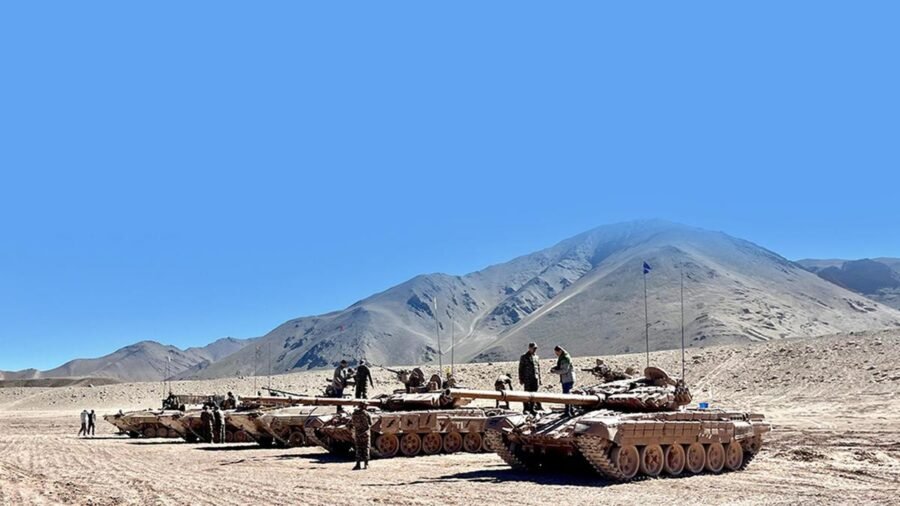
The Defence Ministry’s annual report for 2025-26 presents Operation Sindoor as a significant shift in India’s counter-terrorism and military response, while noting a parallel reduction in the deployment of Chinese People’s Liberation Army (PLA) forces along the Line of Actual Control (LAC) during 2025.
The report says the experience of the May 2025 conflict has also prompted a review of capability gaps, with greater emphasis on jointness, force restructuring and emerging technologies.
Operation Sindoor: a calibrated military response
The report describes Operation Sindoor as a bold demonstration of decisive leadership, joint operational synergy and India’s resolve to safeguard its sovereignty following the April 22, 2025 terrorist attack at Pahalgam, in which 26 tourists were killed.
On the night of May 6-7, Indian defence forces launched strikes against nine identified terrorist targets in Pakistan and Pakistan occupied Kashmir (PoK). The report says the Indian Air Force used long-range precision-guided weapons and intelligence-based targeting to hit infrastructure linked to the Lashkar-e-Taiba and Jaish-e-Mohammed at Muridke and Bahawalpur.
According to the report, the strikes were designed to avoid civilian and military targets and caused no collateral damage.
It characterises the operation as “precise, calibrated and non-escalatory”, arguing that it established a new approach under which state-sponsored terrorism would invite a targeted military response.
The operation subsequently expanded into a four-day conflict after Pakistan launched drone and missile attacks against Indian military installations. The report says India countered these attacks through an integrated air-defence network involving the IAF’s Integrated Air Command and Control System (IACCS), which brought together surveillance sensors and air-defence assets to create a common recognised air situation picture.
The report highlights the role of systems such as the S-400, Akash, Pechora and OSA-AK in countering aerial threats. It also says the IAF struck Pakistani air-defence radars, surface-to-air missile locations, command and control centres, aircraft hangars and airfield infrastructure at several locations, including Chaklala, Rahim Yar Khan, Sargodha, Jacobabad and Bholari.
A notable claim in the report is that an S-400 unit successfully engaged a Pakistani special mission aircraft at a distance of 314 km. The report presents this as an important demonstration of India’s long-range air-defence capability and a challenge to the assumption that distance could provide protection from Indian air-defence systems.
The Navy, too, played a major role. The report says frontline ships, including a Carrier Battle Group and submarines, were deployed in the North Arabian Sea in an offensive posture following the Pahalgam attack. The Navy maintained persistent maritime domain awareness and was prepared to strike targets at sea and on land. It says the threat posed by India’s naval force contributed to Pakistan seeking an urgent ceasefire on May 10.
The Army’s Counter Explosive Device Units also played a role, disposing of 220 unexploded ordnance items in the Northern Command area and 13 in the Western Command area. The report records the recovery and sanitisation of drone wreckage, including one identified as a Turkish-origin Baykar YIHA III, as well as Turkish MAM munitions and the sanitisation of two PL-15 missiles.
Lessons from Operation Sindoor
Beyond the operational account, the report says India has undertaken a comprehensive review of capability voids after Operation Sindoor. The focus areas include force restructuring, greater jointness among the three services and integration of emerging technologies.
The report therefore portrays Operation Sindoor not merely as a military response to terrorism but also as a test of India’s ability to conduct integrated, network-centric operations involving intelligence, precision strike, air defence, maritime power and unmanned systems.
What does it say about the LAC?
On the northern border, the report records a significant reduction in PLA deployment opposite the Indian Army’s positions during 2025. It says 10 Combined Arms Brigade-sized PLA forces were deployed in areas along the LAC and in traditional training areas.
At the same time, the report maintains that the Indian Army’s deployment across all sectors along the LAC remains robust, well poised and prepared to deal with any contingency.
The assessment comes against the backdrop of renewed India-China diplomatic and military engagement. The report notes the 33rd and 34th meetings of the Working Mechanism for Consultation and Coordination in March and July 2025, and the resumption of Special Representatives’ talks on the boundary question, with a round held in August 2025 following the previous round in December 2024.
It also cites Prime Minister Narendra Modi’s visit to China for the Shanghai Cooperation Organisation summit in Tianjin in August 2025 and the 23rd Corps Commander-level meeting in Eastern Ladakh on October 25-26, 2025.
The report says these political, diplomatic and military engagements contributed to stability along the northern borders. Border Personnel Meetings with the PLA, it adds, continued in all sectors in a cordial and friendly environment to resolve issues of concern.

Messi match row: Kerala police raid TV channel office
By Sohail Khan · 16 Sep
Lokesh inaugurates two P4-renovated government schools in Nellore
By Sohail Khan · 16 Sep

Leave a Reply