‘We are suffering from war, from rockets, from everything’: Palestine’s Mahmoud Daifallah
Story continues below.
Subscribe to see fewer ads.
The Israel-Palestine war erupted on October 7, 2023, as the previous Asian Games in Hangzhou were drawing to a close. By the time athletes gathered in Japan for the 2026 edition, much of the infrastructure that sustained Palestine’s sporting ambitions had been destroyed, while the conflict had claimed the lives of athletes, coaches and other members of the sporting community.
The scale of the devastation is laid out in a brochure being distributed by the Palestine Olympic Committee (POC) at the Games. According to the committee, 1,014 people involved in sport — athletes, technical staff and administrators — have been killed, most of them in the Gaza Strip. Of the 265 sporting facilities destroyed, 181 have been completely razed and 84 partially damaged. Among them is Gaza’s only athletics track. The Yarmouk Stadium, Palestine Stadium and Al-Durra Stadium have been converted into shelters for displaced people.
“These figures have left deep scars on Palestinian sports movement, affecting both its human resources and sporting infrastructure,” the POC said in the brochure.
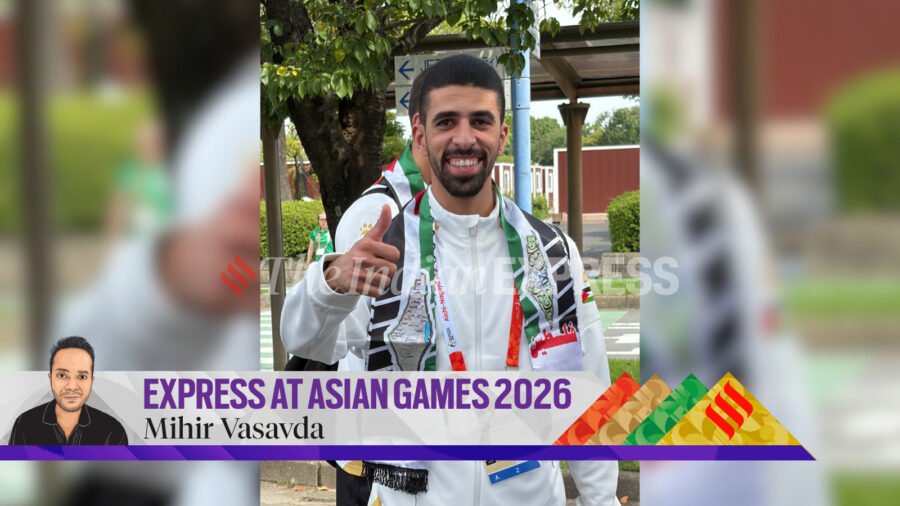
For Daifallah, those figures are not distant statistics. They describe a sporting ecosystem in which clubs have closed, young athletes have been forced to abandon training and the simple act of travelling to a competition has become a challenge in itself. “As you know, as a Palestinian athlete, nothing is easy,” Daifallah, one of 67 athletes here, tells . “We are suffering from war, from rockets, from everything.”
Story continues below this ad
Training is tough enough in those conditions. Travelling for competitions is a bigger challenge. Palestine has no airport. To compete abroad, Daifallah must travel by road from Ramallah to Jericho, cross checkpoints, transfer his baggage and take a bus to the Jordanian border, in Amman, before catching a flight. It is a journey that requires careful planning, but even that cannot guarantee he will make it to a competition. “Sometimes, the occupation authorities do not allow you to leave Palestine, and all your preparation goes to waste,” Daifallah, who competes in the -67kg kumite, says.
Difficult existence
Since the Hangzhou Games, movement restrictions in the West Bank have made an already difficult existence more uncertain. “You have to deal with uncertainty before you can even think about the competition itself,” Daifallah says.
But the damage to Palestinian sport extends far beyond the difficulties of international travel. In Gaza, sporting facilities have been destroyed. In the West Bank, Daifallah says, clubs have shut down because families can no longer afford to send their children for training. “Sometimes, the parents of a child tell me that they will not take their child to the club,” he says. “I ask them why, and they say that their financial situation does not allow them to take their child to the training club.”
Story continues below this ad
The result is a generation of young athletes whose ambitions are being squeezed by circumstances beyond their control.
For Mohammad Edweedar, a Palestinian 800m runner who competed in Hangzhou, keeping his athletic career alive has meant making do with whatever space and equipment are available. He has often had to train on the streets, far from the facilities and support systems that athletes elsewhere rely on.
Even getting the right pair of spikes, essential for a middle-distance runner, can be difficult. “Ideally, I would have them a week before a competition, or at least two or three days in advance, to get accustomed to racing in them. But that is not easy,” he says, adding that the difficulties of training and travelling have contributed to injuries, one of the reasons he couldn’t be in Nagoya.
The uncertainty follows athletes beyond the track. After the Hangzhou Games, Edweedar and his teammates were stranded in Jordan for around two weeks while trying to return to Palestine. The border had closed, leaving them unable to get home as their families waited on the other side. “It was very stressful because my family and our loved ones were back in Palestine,” he says.
Story continues below this ad
The war has also taken away people who were central to his sporting life. Edweedar speaks of losing coach Bilal Abu Saman, whom he describes as someone very special and close to him, and fellow athlete Waseem Abudib.
For Daifallah, the Palestinian uniform is a reminder of why he continues to compete, even when the circumstances make a normal sporting career seem out of reach.
“When I put on the Palestinian uniform, I feel that I am carrying something bigger than myself,” he says.
Edweedar, too, returns to the reason he first took up running, even as the losses mount and the future remains uncertain.
“I remind myself every day why I started competing and why I started running,” he says. “It was for my family and my people.”
Indian-origin British Bodhana Sivanandan becomes youngest ever Woman Grandmaster at 11
By Sohail Khan · 28 Sep
WPL 2027 retained and released players: Check out RCB, MI, DC, UPW and GG lists
By Sohail Khan · 28 Sep
Vithya Ramraj breaks PT Usha’s 42-year-old national hurdles mark
By Sohail Khan · 28 Sep
Leave a Reply