Unwinnable wars give India safer path to recovery
Synopsis
Political aspirations in Ukraine and West Asia have become counterproductive due to prolonged warfare. Recognizing this, India is proposing an alternative economic framework that embraces compromise, leading to beneficial outcomes for Russia and Iran. This strategy not only diversifies dependencies away from China but also establishes India as a potential center of economic stability during these turbulent times.
 ETCFO
ETCFOWhat happens when wars don't go according to script? They stagger until they become counterproductive to the political objective they were meant to achieve. And that's exactly what's happening with Russia's war on Ukraine and the West Asia conflict, thus allowing space to advance an alternate line – one that India is looking to own.
This subtle but significant shift in context has come about over the past few months as the downsides of both wars have overtaken any political gains for stakeholders, including domestic ones. In fact, the argument is that while the military dynamic of the conflict could continue for several more months or years, there will still not be a clear victor.
Also Read: Putin envoy warns of Russian economy going 'berserk' on war footing
In other words, these are now wars without winners. But countries like India, which have had to bear severe economic consequences of these wars, will still have to deal with the situation at hand. Yet, the increasing clarity on the impossibility of a military-led solution makes compromise a more politically viable and economically profitable option than it was even, say, a year ago.
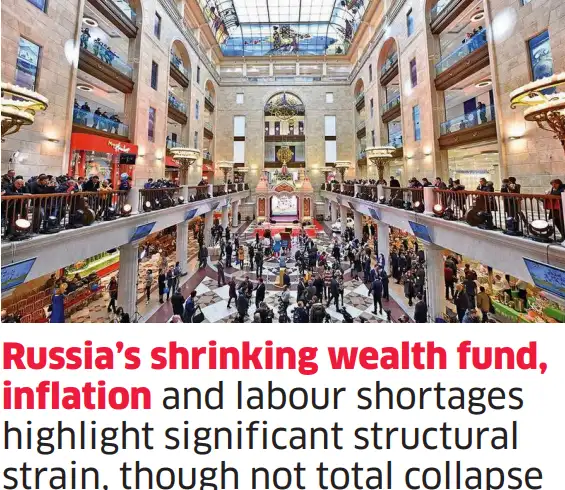
Let's take Russia. Liquid assets in its National Wealth Fund are down to 1.8% of GDP, from 6.5% before the conflict. Rising military expenditure is taking its toll, with increasing inflation and emigration of labour. But these are not problems Russia can't handle, though structural challenges are significant.
The political issue is the near-total dependence on China, which is estimated to control 33-35% of Russia's import-export volume. There is consensus that this is no longer a dependent but an asymmetric relationship, one that will politically dwarf Moscow, way more than Ukraine's European allies could ever do, in the long run.
On the other hand, a compromise solution on Ukraine will generate more viable options for Russia. It will also provide Moscow greater flexibility, as it will allow for easier diversification from China, which is constrained by Moscow-targeted Western political restrictions/sanctions. India, for instance, as a market, will be way more easily accessible, presenting a true economic alternative that is today a strategic necessity for Russia 5 yrs into this long-drawn war.
Also Read: Iran war could keep inflation high, ECB policymaker Rehn warns, FT reports
The choice, thus, for Moscow is between prolonging a military conflict to a point where there is only one victor remaining, or refocusing its economic priorities and rebuilding its political weight. Which is why as India prepares to host the BRICS Summit, these conversations are important because it's in the mutual interest of New Delhi and Moscow to not let the forum become just Beijing's agenda-setting bloc.
Similarly for Iran, its regime's political survival is at stake. Though Teheran has stood up to the US-Israel military onslaught, it's also a fact that it can ill afford a restart of the war cycle – signs of which are imminent – in full tempo.
The battle is over the control of Hormuz, and Iran, while leveraging its advantage there, has to consider that it cannot control the Strait on its terms alone. For starters, Oman, which holds the other end of the Strait, must be on board. Muscat, for its part, has weighed in favour of upholding the principle of freedom of navigation, no tolls or fees, and is in talks with Iran on opening the waterway on this basis. India, too, has supported this principle as articulated in the UNCLOS treaty.
Again, the key question is whether or not Iran stands to benefit from a compromise deal. The fact is any deal will open more energy export possibilities for Iran, restore a modicum of economic stability from the regime's perspective, and allow it time to rebuild.
Now, the Iranian government is famed for its stall-cum-drag negotiating strategy, but just like Russia, it needs to examine the alternate line, which India seems to be championing, from the perspective of strategic flexibility and benefits that will accrue post-deal by way of expanding economic options. For most energy importers, the mainstreaming of both Russian and Iranian resources will be a global economic plus.
As for the US, the either-or, us-them policy necessitated by its positions in these conflicts has brought considerable pressure to its other network of partnerships like the Quad. India, like many other partners, has had to maintain a difficult balance to ensure its supply chains are not fully choked.
The alternate line, which brings to play interests of non-participants yet affected by these conflicts, provides a way forward from this military flux. It's, thus, important that the US does not view these conversations, be it within SCO or BRICS, as targeted at Washington. On the contrary, they can become sites for the articulation of the alternate line, aimed at nudging for political settlement as fatigue and costs grow.
In fact, the longer these conflicts continue, the more they force a reordering of priorities for stakeholders. Sustaining wars, both politically and economically, with no clear win in sight is eventually a loss-making enterprise for all. But any military-based political dynamic must run its course before it bends back. What India is counting on is that both these conflicts have reached that inflexion point, at least enough to advance mutually profitable economic priorities over stalemated military campaigns.
In sum, India's advantage is that it can emerge as a good, safe economic bet for most, including war-waging countries looking to both diversify from China and rehabilitate economically – a bet that, if executed well, can position India as a secure and legitimate growth centre in uncertain times.
Add 

(Catch all the Business News, Breaking News, and Latest News Updates on The .)
…more
Elevate your knowledge and leadership skills at a cost cheaper than your daily tea.
-
Patent Cliff approaching: Can Indian pharma companies repeat past success? -
What LIC should do to remain money-spinner for govt, policyholders -
From survival to 193 mn subscribers: Is Vi finally making a comeback? -
ET Prime special series: 2013 to 2026. Not years, but evidence: Power Grid, Part 2 -
Behind the sugar price drop: Exports, imports and a non-factor called ethanol -
As IndiGo, Air India scramble for pilots, fresh headwinds hit hard -
When a CFO resigns, is ‘personal reasons’ explanation enough? -
FCNR (B) scheme garners USD65 bn, but why isn't the rupee gaining? -
ET Prime special: Bigger, Better or Both? Understanding business to figure out the mystery: Power Grid Corp – Part 1 -
US bond yield: Will it become a new pain point?
Nepal gets an 18-hour power window from India
By Sohail Khan · 14 Sep
India to Vietnam: Firms rethink China exit
By Sohail Khan · 14 Sep
After Kandahar hijack, Taliban warned bin Laden
By Sohail Khan · 14 Sep
Leave a Reply