Top 20 Private Equity Firms’ Energy Assets Emit 1.5 Billion Tonnes Of Greenhouse Gases Annually: Report

Energy assets held by the world's top 20 private equity firms generate 1.5 billion tonnes of greenhouse gas emissions annually, according to a new report. The firms manage .3 trillion in assets and hold major fossil fuel interests, including power plants, pipelines and oil and gas fields, raising concerns over their role in the energy transition.
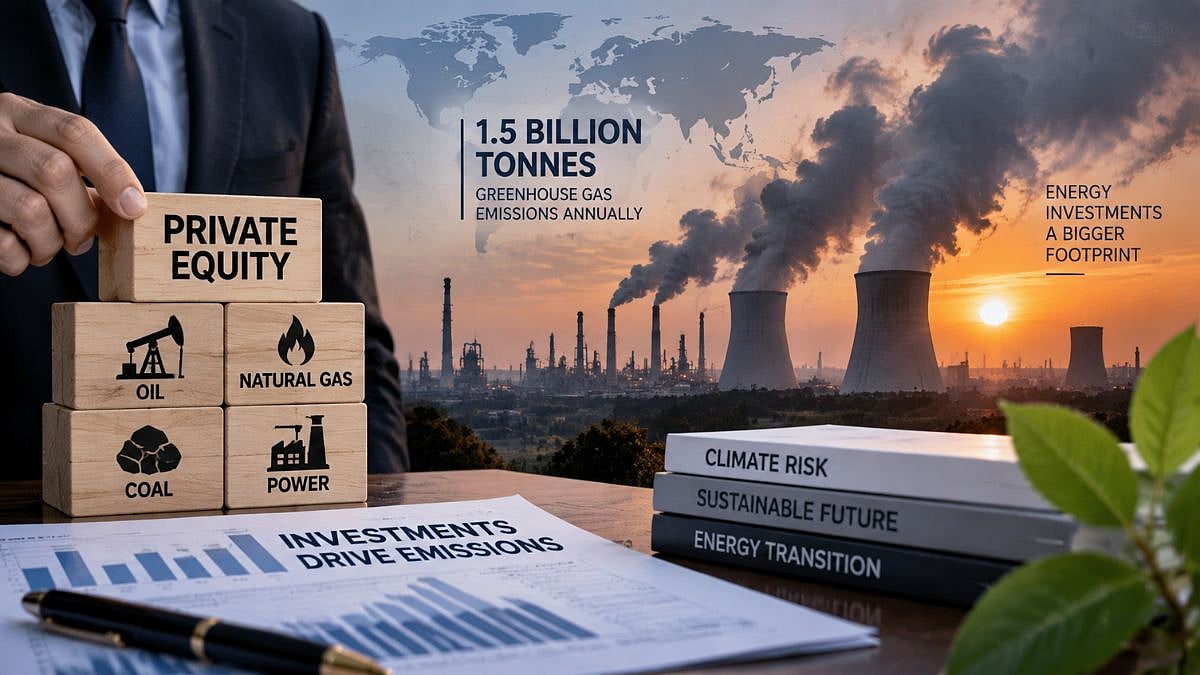
Private equity firms face scrutiny over fossil fuel holdings and their growing role in financing energy infrastructure for data centres | AI Generated Representational Image
Mumbai, September 15, 2026: The energy portfolios of the world’s top 20 private equity firms generate 1.5 billion tonnes of greenhouse gas emissions annually, exceeding the yearly emissions of every country except China, the US, India and Russia, according to a new report.
Together, the firms manage $7.3 trillion in assets, giving them considerable capacity to influence the transition away from fossil fuels. However, their energy investments continue to include significant fossil fuel assets, including natural gas and coal-fired power plants used to supply electricity to data centres.
The Private Equity Climate Risks Consortium analysed the top 20 private equity firms invested in global energy infrastructure. It found that the firms owned 15,000 miles of pipelines, 124 GW of power generation capacity across 370 fossil fuel-powered plants and hundreds of oil and gas fields, The Guardian reports.
Private Equity’s Growing Role In Energy
`;
Half of the top 10 US data centre owners are backed by private equity, according to Matt Parr, communications director for the Private Equity Stakeholder Project (PESP), one of the organisations in the consortium.
“This industry doesn’t get enough scrutiny and credit for its contribution to global emissions,” Parr said. “It’s a very opaque business model.”
The researchers examined energy holdings using private markets data provider PitchBook and drew on company websites, press releases, news reports and regulatory filings.
Data gaps prevented them from calculating how much the 20 firms had invested in fossil fuel assets. However, an earlier analysis of PitchBook data showed that private equity had funded more than $1 trillion in fossil fuel assets since 2010, according to Amanda Mendoza, senior research and campaign coordinator on the climate team at the Private Equity Stakeholder Project.
While some public-sector retirement systems have sought to limit their exposure to fossil fuel projects, BlackRock, GIP, Energy Capital Partners, EQT and Kayne Anderson increased the number of fossil fuel companies in their portfolios compared with 2024, the report found.
EQT has positioned itself as a climate-conscious investor supporting the energy transition. However, EQT, along with BlackRock’s GIP and the California Public Employees’ Retirement System, could soon acquire AES Corporation, which owns more than 20 power plants.
“It is alarming because if this deal does go through they will then be owners of a fleet of coal power and gas-powered plants,” Mendoza said. “That’s significantly going to impact their transition. It seems like they’re transitioning to fossil fuels instead of away.”
EQT did not respond to questions about its fossil fuel investments, while ArcLight declined to comment on the report’s findings.
Data Centre Boom Intersects With Fossil Fuels
Private equity firms’ growing involvement in energy infrastructure is increasingly intersecting with another major investment area: the expansion of data centres to support artificial intelligence. Private equity firms have emerged as the largest data centre owners outside big tech.
In June 2024, Blackstone invested $2.16 billion in Northern Indiana Public Service Company (NIPSCO), acquiring a 19.9% stake in the utility and a seat on its board.
NIPSCO, which serves 1.3 million customers across Indiana, subsequently announced plans for a 2,300 MW natural gas power plant to serve data centres. The plant could emit millions of tonnes of carbon dioxide annually.
Blackstone said it was a minority investor in NIPSCO, did not manage its day-to-day operations and had no control over management decisions.
The firm has also announced plans to invest more than $25 billion in data centres and energy infrastructure in Pennsylvania.
“The electricity infrastructure required to power the AI revolution requires a tremendous amount of capital. We are proud to make our latest investment in this sector – which is among our highest conviction investment themes – in Western Pennsylvania,” Blackstone managing directors Bilal Khan and Mark Zhu said in an announcement last year about the firm’s acquisition of a Pennsylvania gas plant.
Blackstone-owned QTS had planned to build a data centre in NIPSCO territory but abandoned the project following strong community opposition.
Nichole Heil, senior research and campaign coordinator on the climate team at the Private Equity Stakeholder Project, said the overlap raised questions about potential conflicts of interest when a private equity firm owns both a utility and companies dependent on utilities for electricity.
“Blackstone is buying some of the companies that utilities do business with. How do regulators manage and track all those different investments while trying to keep rates affordable to ratepayers?” she asked.
“It just shows that these private equity data centre investments are going to be keeping fossil fuel projects alive much longer,” Parr said.
Blackstone did not answer questions about concerns that private equity ownership of a regulated utility could create conflicts between investors and ratepayers. It defended its portfolio investments and cited its emissions reduction programme, which seeks to reduce emissions across some portfolio companies.
“As electricity demand rises and more sectors of the economy electrify, we see significant opportunities for private capital to help build the infrastructure needed to support the energy transition,” the company said.
Pension Funds Face Wider Risks
Private equity investments can also expose pension funds to risks beyond climate pollution.
Stonepeak Infrastructure Partners owns several liquefied natural gas (LNG) tankers that have been stuck behind the blockade in the Strait of Hormuz. Several state pension systems are invested in Stonepeak, including the Maryland State Retirement and Pension System, Virginia Retirement System and New York State Common Retirement Fund.
Stonepeak did not respond to questions about its LNG tanker investments but said in a statement: “Stonepeak invests in mission-critical energy infrastructure around the world and takes a comprehensive approach to investing across the energy value chain, from renewable energy to the infrastructure enabling cleaner fuels and mass electrification. We are committed to investing in infrastructure that supports a reliable and affordable energy transition.”
Fossil Fuel Fund Returns Questioned
Private equity firms have long maintained that fossil fuel investments deliver reliable returns. The Private Equity Climate Risks Consortium examined 145 oil and gas-focused private equity funds with available performance data that began investing between 2001 and 2016.
Also Watch:
Investors contributed a combined $190.4 billion to the funds and received $192.9 billion back, representing a return of about 1% above the amount invested.
Mendoza said the returns were far below what investors generally expect from private equity.
“We thought it was important to include this because it’s been a pretty strong selling point that oil and gas funds you’re always going to make money on them,” she said. “They’ve barely broken even overall.”
To get details on exclusive and budget-friendly property deals in Mumbai & surrounding regions, do visit: https://budgetproperties.in/

Add As a
Trusted Source 

Amazon Now Crosses $1 Billion Annualised Revenue In India, Eyes 100 Cities By Diwali
By Sohail Khan · 15 Sep
UPI Charges Explained: What Is MDR And Will Customers Pay For Transactions Above ₹2,000?
By Sohail Khan · 15 Sep

Leave a Reply