The town where a vanished sea became a tourist attraction
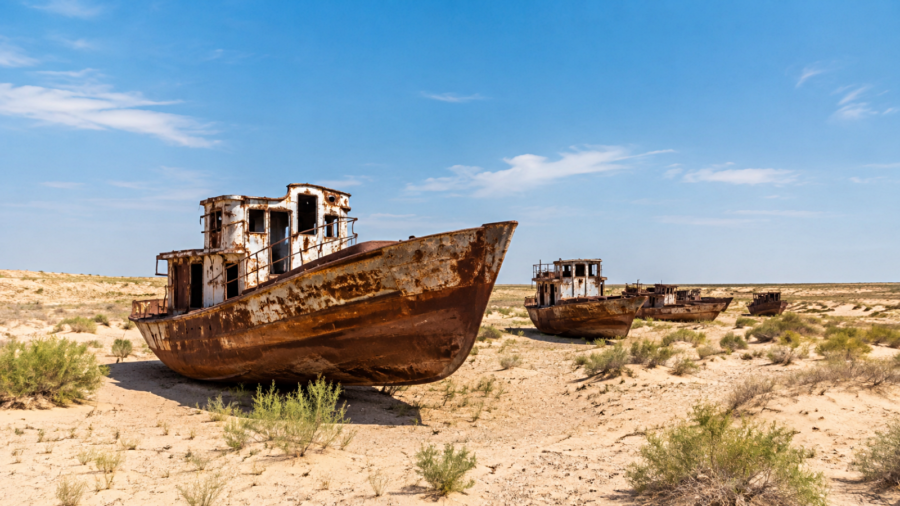
Imagine travelling to a seaside town and finding no sea. Instead, there is sand stretching into the distance, rusting fishing boats sitting where water once was, and a landscape that looks more like a desert than the coast of a giant inland sea.
That is Moynaq, a town in Karakalpakstan, Uzbekistan, and one of the most unusual tourist destinations linked to the Aral Sea disaster.
Once, Moynaq was a thriving fishing port. Today, tourists come to see what happened when the sea retreated — including the eerie remains of the town’s fishing fleet.
From fishing port to ship graveyard
The Aral Sea was once the world’s fourth-largest inland body of water. Moynaq sat on its southern shore and depended heavily on fishing, with a harbour and fish-processing industry supporting the town. Then the sea began shrinking.
From the 1960s, the Soviet Union diverted water from the Amu Darya and Syr Darya rivers to irrigate agricultural land, particularly cotton fields. With far less river water reaching the Aral Sea, its water level began falling dramatically.
By the 1980s and 1990s, the shoreline had retreated so far that Moynaq was no longer a seaside town in any meaningful sense. The fishing industry collapsed along with it.
Story continues below this ad
The boats, however, remained. Today, a cluster of rusting fishing vessels sits on what was once the seabed, forming what is popularly known as the Moynaq Ship Graveyard, or Ships Cemetery. The site has become the town’s most recognisable attraction, drawing photographers, travellers and visitors interested in the environmental disaster.
You can walk on what used to be the seabed
One of the strangest things about visiting Moynaq is the sheer contrast between its past and present.
The town’s former port is now surrounded by the Aralkum Desert, the new desert created as the Aral Sea retreated. The Aral Sea has not completely disappeared from the wider region, but the water has withdrawn enormously from Moynaq, leaving the former port far from the present shoreline.
The area now attracts what is sometimes described as disaster or extreme tourism. Visitors can see the ship graveyard, explore the dried seabed and visit museums documenting what the region looked like when the sea was still there. Uzbekistan’s tourism authorities also list the Aralkum Desert, the former seaport and Aral Sea museums among Moynaq’s attractions.
View this post on Instagram
A post shared by Conor MacNeill (@thefella)
There is even an unexpected modern addition to this bleak landscape: Stihia, an electronic music, art and science festival held around the ship graveyard. The festival uses the unusual setting to draw attention to the Aral Sea’s environmental catastrophe.
Story continues below this ad
But the attraction is ultimately a reminder of something much bigger than abandoned boats. Moynaq’s tourism exists because an ecosystem, an industry and a way of life disappeared. The town that once depended on the Aral Sea now invites visitors to stand on its former seabed and imagine what used to be there.
It is a destination where the biggest attraction is, quite literally, something that is no longer there.

Good foundation: on India’s strong industrial growth performance
By Sohail Khan · 1 Oct
Bitter pills: on Court’s intervention, drug pricing
By Sohail Khan · 1 Oct
Household debt, financing today against tomorrow
By Sohail Khan · 1 Oct