The Sonepat coach who flew to Japan alone to fix what he couldn’t explain
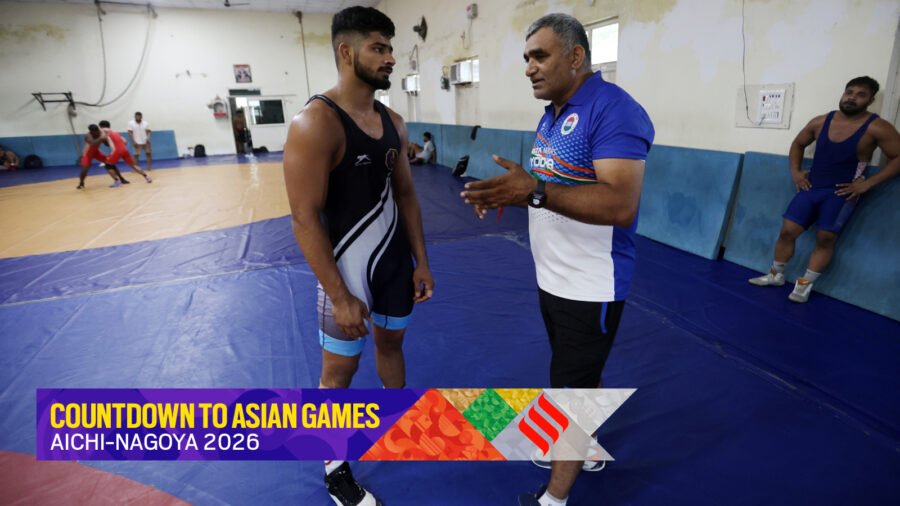
Kuldeep Singh walks around instructing coaches as four Greco-Roman wrestlers battle it out on the two mats laid at the Raipur Akhada in Sonepat, Haryana. One of the medal favourites walking these same mats towards the Asian Games, Sujeet Kalkal, was shaped here under Kuldeep’s eye. Two more of his students, Aman (77kg) and Nitesh Siwach (97kg), will make up half of India’s Greco-Roman contingent in Nagoya.
“Coaching is something that came naturally to me,” Kuldeep told . “I have been wrestling since school days, so there is nothing I know better than this. I don’t think there was anything I could have done better than preparing wrestlers.”
He started as a freestyle wrestler in 1982, won multiple national medals in the discipline, then switched to Greco-Roman after turning 28. “Once I was done with freestyle, I thought that let’s try Greco one,” he said. “Once I started it, I enjoyed it a lot. However, there comes a point when one has to take the call. I realized that I can’t play further, so I decided to do the next best thing to competing, that is coaching.”
Story continues below.
Subscribe to see fewer ads.
He now trains more than 250 wrestlers at the centre, and his own coaching record carries the name of the only Greco-Roman World Championships medallist India has produced, Sandeep Tulsi Yadav, bronze in Budapest in 2013, alongside a run of freestyle internationals. When Sunil Kumar won a Greco-Roman bronze at the 2023 Asian Games, ending a 13-year wait for the discipline, Kuldeep was in the corner.
His students describe a man still restless about his own craft after four decades in it. “Coach Sahab is like a curious child,” said Nitesh Siwach, one of two Kuldeep-trained wrestlers heading to these Asian Games. “He is still constantly finding new innovations or trying to improve how we train constantly. Everytime I play a new opponent, he has all the analysis ready for me.”
That restlessness once took him to Japan alone, in the early 2010s, with nothing but a question he couldn’t answer at home. “I did it on my own,” Kuldeep said. “There was not much technical literature here available. I wanted to understand what Japanese are doing so well. When I went there, the training processes and their routine amazed me. I came back and tried to implement it here. I always try to stay updated on what the world is doing, as that is where the competition lies for my students.”
What he brought back built toward Sandeep Tulsi Yadav’s bronze, still India’s only Greco-Roman medal at the World Championships. Since then, more Asian Championship medallists have followed, but Kuldeep believes the discipline itself hasn’t caught up. “Freestyle always had the elite status in the country,” he said, “but Greco-Roman was an afterthought, with a lot of wrestlers taking up Greco-Roman later in the career.” That late start, he explained, is the root of a deeper shortage.
Story continues below this ad
“One of the biggest problems is the lack of technical wrestlers. As wrestlers start late they are not able to become technical. The scoring areas are less in Greco, and that is why more explosive power is needed.”
Two of his students carry that fight into Nagoya. Sujeet, the reigning Asian and U23 World champion in freestyle’s 65kg, has trained under Kuldeep alongside his own father, Dayanand Kalkal. “Coach sahab is a thinking coach,” Sujeet said. “I am privileged to have my father and Kuldeep sir as the coaches. My endurance and power improved, and once it started improving, I started doing well at the senior level.”
Nitesh, silver medallist at the 2026 Asian Championships in Greco-Roman’s 97kg, has waited four years for this moment. “Kuldeep sir has been on my side throughout that,” he said. “Nobody has done well at the Asian Games in my weight category, but coach sahab has been constantly motivating me apart from the usual training we have.”
Kuldeep doesn’t separate his own learning from theirs. “If I have to train students, I have to be a student of the game,” he said. “The sport is evolving at a rapid pace and wrestling at world level is very competitive. The sport has moved leaps and bounds from what it was a decade back, and if we don’t learn everyday, we will fall behind. I want to be ready to answer all the questions my students have, as they are also becoming smart. If a coach can’t explain to his students why they are doing something, there is no point being a coach.”
Story continues below this ad
Wrestling begins on September 30 at the Inae Sports Center in Nagoya. Kuldeep won’t be on the mat. He’ll be exactly where he’s been for four decades, watching, still looking for the thing he doesn’t yet know.

Afghanistan are Asia’s second-best team but lack of enough matches hurting them
By Sohail Khan · 14 Sep
Pakistan to play Asian Champions Trophy hockey in India: Punjab CM Bhagwant Mann
By Sohail Khan · 14 Sep
Leave a Reply