The seemingly apolitical Gen Z youth
In the elections to the State Assemblies of Keralam, Tamil Nadu, West Bengal, Assam, and the Union Territory of Puducherry, one emerging pattern had been the engagement, or lack thereof, of the younger generation, the Gen Zs in particular, in the electoral process. Gen Zs are often seen as apolitical, or even anti-political, judged by the positions they take on issues, and by their preoccupation with the present rather than the past or the future.
Yet being apolitical, or claiming to be, is itself a way of falling victim to the dominant political narrative. The point here is not to pass judgment on the Gen Z youth, but to insist that politicising this generation is necessary not just for democratisation but for their own reclaiming of rights within the Indian union. One of the first steps toward that end is to ensure that every educational institution has an elected students’ council.
Gradual depoliticisation
Over the last few decades, especially since the 1990s, depoliticisation, a strategic project of neo-liberal capitalism, has been on the rise. This is primarily because depoliticisation is structurally engineered; it treats the citizen as a consumer. Individualism has become the prominent ideology, converting unemployment, housing, and other livelihood crises into personal failures.
Then there is what might be called a culture of ‘nano impulsiveness’. Every generation is new in relation to the one before it, but the terms of that newness are often contested. Neoliberalism shortens the temporal horizon itself, and this shrinking of attention is visible across commerce, psychology, and everyday behaviour. It breeds a politics of spontaneity and impulse. Thus, a depoliticised Gen Z becomes the ideal subject for personality cults and social media-manufactured consent, voting for a face or a moment rather than a programme — a tendency that hyper-nationalist, emotionally-charged messaging exploits with ease, especially in the absence of counter institutional spaces such as students’ or trade unions.
A revival
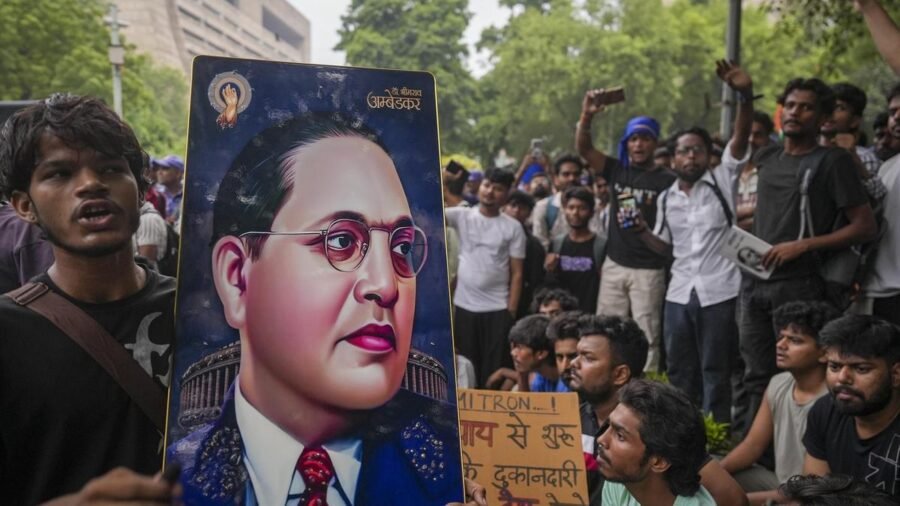
However, the summer of 2026 offered a sharp rebuttal to the thesis that Gen Z is inherently apolitical. The protests that erupted at Delhi’s Jantar Mantar over irregularities in the NEET-UG examination drew thousands of students to the capital. What was most striking was not just the scale of mobilisation but its texture — young protesters bypassed government imposed mobile Internet shutdowns using peer-to-peer Bluetooth mesh networks; ran a mobile library for fellow demonstrators; and found millennials marching alongside them, dissolving a generational divide both sides had long taken for granted. Gen Z, it turned out, was never apolitical; it was waiting for a cause that felt like its own, and a means to organise around it.
Political parties, many of whom themselves emerged out of student movements, have been the ones banning students’ unions. West Bengal banned students’ elections a decade ago. Tamil Nadu did the same decades earlier. Most Bharatiya Janata Party-ruled States do not hold elections to students’ councils.
Keralam remains the exception, with regular student union elections. These elections produce politically literate constituencies with a sustained capacity for democratic engagement — precisely what is anathema to neo-liberal capitalism. Such engagement is often the first step in shedding an identity rooted in ethnicity, religion, or caste, and acquiring one rooted in democratic demands around education and employment.
One often hears that student politics cause disruption — an argument that even parties which claim to oppose neoliberalism have adopted wholesale. But education is not a factory floor; a campus without politics produces obedient labour, not democratic citizens.
The depoliticisation of the Gen Z youth is not their own failure but the success of a system engineered to produce this outcome. If the 1970s saw large, sustained movements shaped decisively by students and their unions, today that participation matters just as much, as the Jantar Mantar protests have shown us. The task is not to instil an interest in politics in this generation; Jantar Mantar shows they already possess it but are waiting for it to take an institutional form.
The answer to depoliticisation is not to lament Gen Z’s apathy but to restore the institutional conditions under which political consciousness has always been formed — campus democracy, student unions, and the right to deliberate collectively.
Tikender Singh Panwar is an author, urban practitioner, and former Deputy Mayor, Shimla. He was also a member of the Kerala Urban Commission

Don’t buy a lab-grown diamond before checking these 7 things
By Sohail Khan · 29 Sep
Towards a gender just Uniform Civil Code
By Sohail Khan · 29 Sep
Essar eyes $18-billion US steel plant: Why Indian firms are investing in US amid tariffs
By Sohail Khan · 29 Sep