The iPad vs Android tablet debate has changed, and most buyers are still asking the wrong question
Editorial independence is core to our work. Some links may earn us a commission, without influencing our opinions.
The iPad vs Android tablet debate has changed, and most buyers are still asking the wrong question
The iPad vs Android tablet debate is changing as iPadOS 27 closes the multitasking gap, leaving buyers to focus on ecosystem, price and use cases.
Published on: Sep 30, 2026, 09:00:18 IST
Prefer HTon Google
Share via
Copy link
Our Picks
FAQs
Our Picks
| Product | Rating | Price |
|---|---|---|
Apple iPad 11″: A16 chip, 27.69 cm (11″) Model, Liquid Retina Display, 128GB, Wi-Fi 6, 12MP Front/12MP Back Camera, Touch ID, All-Day Battery Life — YellowView Details
|
||

|
Check Offers | |
| Apple iPad mini (A17 Pro): Apple Intelligence, 21.08 cm (8.3″) Liquid Retina Display, 128GB, Wi-Fi 6E, 12MP Front/12MP Back Camera, Touch ID, All-Day Battery Life — Space GreyView Details
|
||
|
|
Check Offers | |
| Apple iPad Air 27.59 cm (11″) (M4): Liquid Retina Display, 128 GB, 12MP Front/Back Camera, Wi-Fi 7 with Apple N1, Touch ID, All-Day Battery Life — StarlightView Details
|
||
|
|
Check Offers | |
| Apple iPad Pro [11″] (M5): Ultra Retina XDR Display, [256GB], 12MP Front Camera / 12MP Back Camera, LiDAR Scanner, Wi-Fi 7 with Apple N1, Face ID, All-Day Battery Life — Space BlackView Details
|
||
|
|
Check Offers | |
| Apple iPad Pro 11″ (M4): Ultra Retina XDR Display, 2TB, Landscape 12MP Front Camera / 12MP Back Camera, LiDAR Scanner, Wi-Fi 6E, All-Day Battery Life, Nano-Texture Glass — Space BlackView Details
|
||
|
|
Check Offers |
View More

Research-Backed Choices
Every product we recommend is chosen through a combination of Primary Research and Secondary Research.
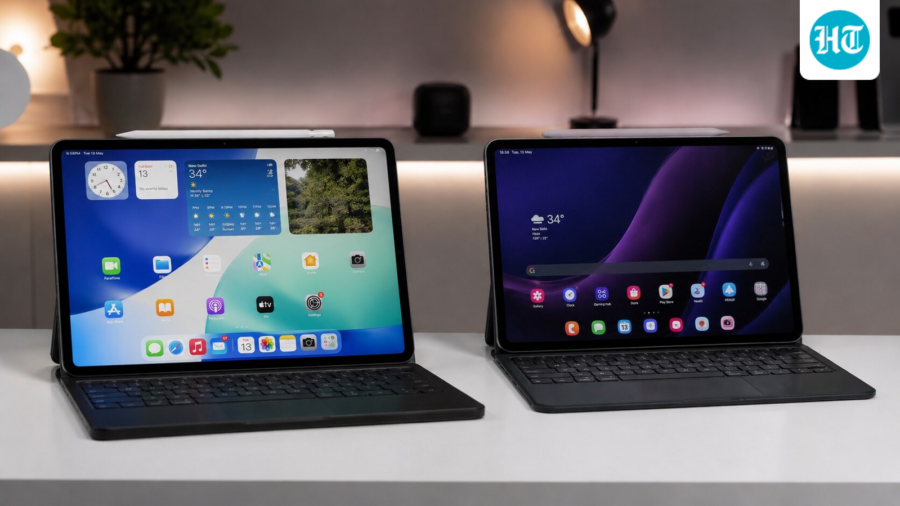
The iPad vs Android tablet debate is never-ending because there are very specific use cases and feature sets that users rely on to defend their favourite platform. Multitasking, battery life, display size and ecosystem are some of the usual arguments.
But the comparison is not really about everything these platforms offer. It is about what you actually need from your tablet.
With that in mind, this comparison looks at some of the most common arguments around Android tablets and iPads and, more importantly, which platform makes more sense depending on how you plan to use the device.
iPad vs Android tablet quick comparison
| Feature | iPad | Android tablet |
|---|---|---|
| Multitasking | Much better with iPadOS 27 | Flexible window management |
| Display choices | Good range, including large models | More variety, especially at lower prices |
| Ecosystem | Strong with iPhone and Mac | Stronger across different brands and devices |
| Accessories | Good, but compatibility needs checking | Generally wider third party compatibility |
| Battery life | Strong on modern models | Strong on modern models |
| Price range | More limited | Wider range of options |
| Best suited for | Apple users and ecosystem focused setups | Larger displays, flexibility and value |
Multitasking is no longer a reason to skip the iPad
For years, multitasking was one of the biggest arguments in favour of Android tablets. Android tablets generally offered more flexibility for running multiple apps side by side, resizing windows, and using the larger display like a desktop.
But with the release of iPadOS 27, that argument has become much weaker.
Apple has introduced more flexible window management in iPadOS 27, allowing users to resize app windows and arrange them on the screen. This means the iPad can now offer a much more desktop-like multitasking experience instead of forcing users into a more restricted layout.
More importantly, this is not limited to the latest iPads with Apple silicon. The feature is also available on supported older models, including the iPad 10th generation. This means even users with iPads powered by Apple's A-series chips can take advantage of the newer multitasking experience.
So, if multitasking was the main reason you were considering an Android tablet, it is worth reconsidering that decision. The iPad has finally caught up in this area, at least for the kind of everyday multitasking most tablet users need.
Loading Suggestions…
Loading Suggestions…
Loading Suggestions…
Loading Suggestions…
Want a large display without spending too much? Android has more options
Display size is another area where Android tablets have an advantage, particularly if you are looking for a large screen at a relatively affordable price.
Both platforms offer several screen sizes, but Android manufacturers have more flexibility when it comes to pricing and product variety. You can find Android tablets with large displays without necessarily moving into the premium price segment.
This becomes particularly useful if your tablet is going to be used for watching movies, editing documents, browsing the web or simply replacing a laptop for basic work. The iPad range does offer different screen sizes, but if your priority is getting as much display as possible for your money, Android gives you more choices to explore.
Loading Suggestions…
Loading Suggestions…
Loading Suggestions…
Loading Suggestions…
Ecosystem is where the iPad still makes a strong case
If you already use an iPhone, MacBook or other Apple devices, the iPad fits naturally into that ecosystem.
Features such as AirDrop, Handoff, iCloud and Continuity can make it easier to move between devices and access the same files, photos and other information. If you already rely heavily on Apple products, the iPad can therefore feel less like another standalone device and more like an extension of the devices you already own.
Android tablets can offer a similar connected experience, particularly if you already use a Samsung Galaxy smartphone or other compatible Android devices. However, the experience can vary depending on the brands and products in your setup.
So, if a connected ecosystem is important to you, the decision may largely come down to the devices you already own.
Accessories can be easier to figure out on Android
Another thing worth considering is accessory compatibility. Android tablets come from several manufacturers, and many support a wide range of third-party accessories. Depending on the tablet, you can have more flexibility when choosing keyboards, mice, chargers, hubs, cases and other peripherals.
With an iPad, accessory support is generally good, but you need to pay closer attention to compatibility. Different iPad generations can have different dimensions, ports and accessory requirements, so checking compatibility before buying a keyboard, case or other accessory is important.
This is not necessarily a major limitation, but it is something to keep in mind if you plan to build a complete tablet setup around your device.
Battery life is not a major deciding factor anymore
Battery life used to be another major point of comparison between iPads and Android tablets. However, I would not make the decision based on battery life alone anymore.
Most modern Android tablets offer good battery endurance, and the same is true for iPads. The actual battery life will depend on the processor, display, brightness, applications and how you use the tablet.
For everyday tasks such as browsing, watching videos, reading and taking notes, both platforms can provide enough battery life to get through a substantial part of the day.
Unless you have a very specific battery requirement, this is one area where the difference between the two platforms is no longer significant enough to make the decision by itself.
The tablet you need matters more than the tablet you prefer
The iPad vs Android tablet debate becomes much simpler when you stop looking at the platforms as competitors and start looking at them as tools for different users.
If you already own several Apple devices and want a tablet that fits seamlessly into that setup, the iPad makes a lot of sense. Multitasking is also no longer the major limitation it once was, thanks to the changes introduced with iPadOS 27.
On the other hand, Android tablets offer more variety, particularly if you want a larger display at a lower price or more flexibility when choosing devices and accessories.
There is no single feature that makes one platform universally better for every tablet user. The more useful question is what you actually expect your tablet to do. Once you know that, choosing between an iPad and an Android tablet becomes considerably easier.
Similar articles for you
Confused between Intel and AMD? This laptop processor comparison can help you decide
Still carrying a heavy laptop every day? These Samsung Galaxy Books make work and travel much easier
Still switching between your TV and monitor? These smart monitors can finally replace both
FAQs
iPadOS 27 has improved iPad multitasking with resizable and movable app windows, narrowing the gap with Android tablets.
Android offers more choices across price ranges, especially if you want a larger display without spending as much.
An iPad is a natural fit if you already use devices such as an iPhone or MacBook.
Not necessarily. Modern tablets on both platforms can offer strong battery life, depending on the model and usage.
It depends on your priorities, including ecosystem, display size, price, multitasking and accessory compatibility.
See Less

After Apple’s Beats and Sonos, Nothing launches high-end over-ear headphones
By Sohail Khan · 30 Sep
Apple Pay comes to India: How it works, where you can use it, and more
By Sohail Khan · 30 Sep
Lava Shark 2 Pro 5G launched at ₹16,699: Check specs, features and more
By Sohail Khan · 29 Sep
Leave a Reply