The election umpire must play by its own rulebook
Synopsis
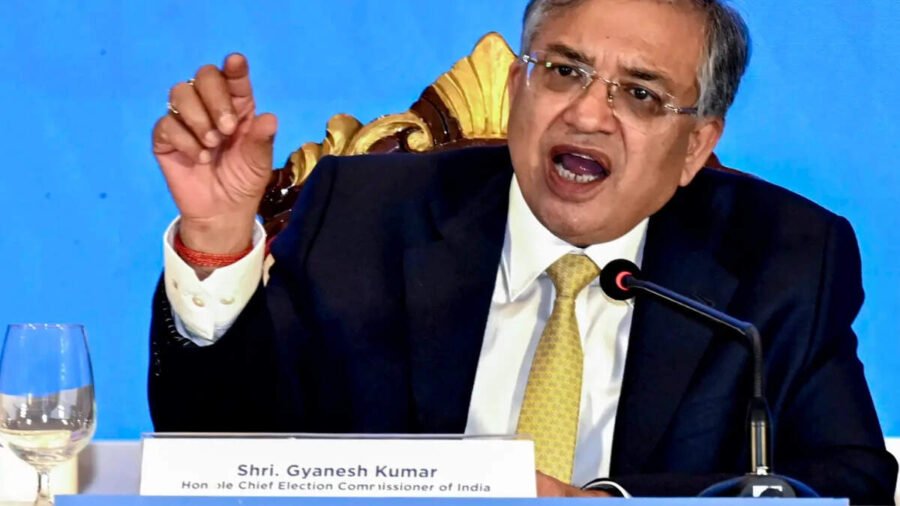
Recent allegations against Chief Election Commissioner Gyanesh Kumar suggest unilateral actions disregarding his colleagues' views. The amendments to Form 6 may not have followed proper legal procedures, raising significant concerns. Section 13B and 13CC of the Representation of the People Act 1950 define the roles of electoral registration officers. Allegations about software curbing the authority of these officers contribute to the controversy.
 PTI
PTIOn Boxing Day 1995 at Melbourne Cricket Ground, a 23-yr-old Sri Lankan off-spinner Muttiah Muralitharan came on to bowl. In 3 overs, Australian umpire Darrell Hair called him for throwing (chucking) 7 times. Muralitharan was taken off. But 10 mins later, he returned to bowl from the other end. There, New Zealander Steve Dunne, watching the same action, said nothing.
Dunne later explained that it was a conflict between law and convention. Laws of cricket permitted either umpire to make the call. But at a conference of umpires earlier that year, it had been agreed that suspect actions would not be called during play, but reported to the match referee for later review.
A similar conflict over collegiality, convention and the rules between the 'umpires' of India's electoral system spilled onto the front page of this week. Expectedly, the story has been whipped up in the political maelstrom, with the Opposition training its guns on chief election commissioner (CEC) Gyanesh Kumar. It's more useful, however, to understand the law and seek straight answers from the institution, rather than from one individual.
The report, citing notes by the two other ECs, Sukhbir Singh Sandhu and Vivek Joshi, raised 3 allegations:
That CEC acted unilaterally and against the wishes of his two fellow ECs.
That Form 6, which we fill out to register as voters, was changed without following legal procedure.
That the authority of electoral registration officers (EROs) was curtailed by EC officials.
On the first two, the law is reasonably clear.
Team game For a long time, India had only one EC, except for a short period from 1989 to 1990. Bristling under the authority claimed by the energetic and boisterous T N Seshan, the P V Narasimha Rao government in 1993 gave the body its present structure: a CEC with two ECs.
When Seshan challenged this as violative of EC's constitutional autonomy, Supreme Court affirmed GoI's position: Parliament had the authority to legislate, and CEC was to be merely the 'first among equals' in a collective decision-making process in which the majority rules. CEC and Other Election Commissioners Act 2023 broadly confirms this position of law, requiring, ordinarily, unanimous decisions, and if unanimity cannot be achieved, a majority decision.
Due process As far as Form 6 is concerned, the legal route to amendment is clear. The form is appended to Registration of Electors Rules 1960 and can, therefore, be amended only by formally amending those rules, notifying the change and placing the amended rules before Parliament.
In a landmark case in 1969, 'Maharashtra State Road Transport Corporation v. Babu Goverdhan Regular Motor Service', Supreme Court held that forms prescribed alongside rules are an integral part of the rules. Such forms can be amended only in the same manner as the rules. Government practice also supports this interpretation. Form 6 was amended through the Registration of Electors (Amendment) Rules 2022.
ERO question Section 13B of Representation of the People Act 1950, assigns EROs the task of preparing the electoral roll of a constituency, while Section 13CC of the Act places them under the control, superintendence and discipline of EC. There can be little doubt that EC is empowered to direct the use of a particular platform.
The reported allegations, however, suggest that the software effectively prevented EROs from permitting certain inclusions, which, if true, would amount to an automated curbing of their statutory authority.
In response to the report, EC on Wednesday offered only a limited reply, and in substance only to the first question, saying that dissenting views of the two ECs were merely 'notes, observations, technical suggestions', implying that CEC did not act unilaterally. No view can be taken on this until more facts come out.
As for the 'changes' to Form 6, no amendments to the 1960 Rules have been notified to insert a question asking whether the applicant's parents or grandparents were included in the electoral roll during the last Special Intensive Revision (SIR) exercise. If, as the report suggests, a prospective elector couldn't submit the form without answering this question, legal questions would arise. Citing 'operational instructions' is unlikely to be a sufficient answer.
Hard questions on software Finally, EC should provide clear answers on how EROs operate the ECINet software, and who else has access to it. EC has, over decades, built one of the world's most impressive electoral infrastructures. It should provide detailed clarifications and restore confidence in its processes and procedures. To do otherwise wouldn't be quite cricket.
The writer is senior resident fellow, Vidhi Centre for Legal Policy. Views are personal
(Disclaimer: The opinions expressed in this column are that of the writer. The facts and opinions expressed here do not reflect the views of www.economictimes.com.)
Add 

(Catch all the Business News, Breaking News, and Latest News Updates on The .)
…more
Elevate your knowledge and leadership skills at a cost cheaper than your daily tea.
-
Building recycling plants is fine. Will they get enough scrap? -
Biogas found its ethanol moment this month. Can it now find scale? -
Gold prices: Caught in a three-way tug-of-war -
Nobody's money? The fortune Indian families forgot they had -
Forget the UPI fee fight. Do we know how India pays today? -
Has the US Fed and AI created a costlier world? And has the queue got longer for India? -
Gold rush on Dalal St as regional jewellers bid to be the next Tanishq -
A different kind of buyback. Is this the beginning of these kinds of buybacks? -
Come January 2027, will India’s online platforms get their own Tukaram? -
Hormuz is a state, not a strait. There are 10 other possible chokepoints for the global economy, including India

LPG customer base dips after a decade
By Sohail Khan · 25 Sep
Print’s ad resilience gets a festive season boost
By Sohail Khan · 24 Sep
Another alcohol safety test for Air India
By Sohail Khan · 24 Sep
Leave a Reply