The ancient temples’ imprint on our culture
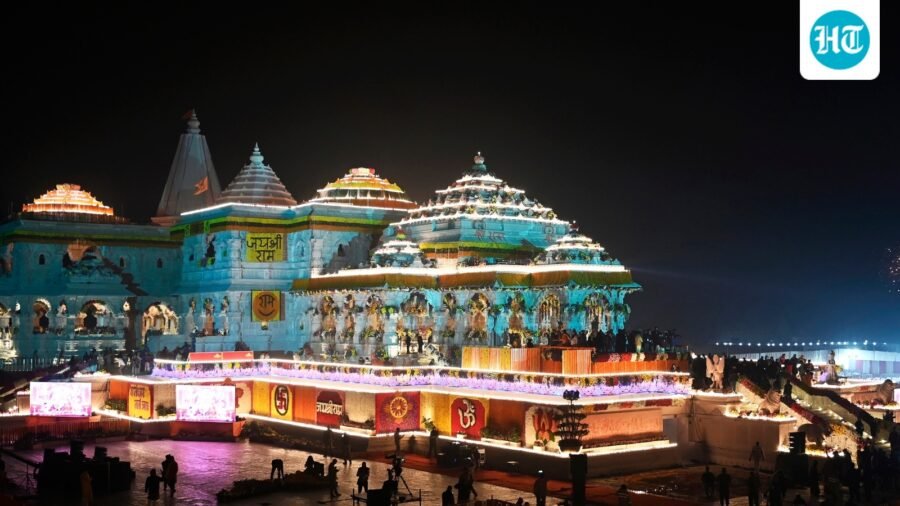
Indian intellectual traditions stress on balanced life and, as such, along with temples, they insist on realising the four pursuits of life.
Updated on: Sep 7, 2026, 06:47:15 IST
Prefer HTon Google
Share via
Copy link
The newly-appointed CEO of the Ram Mandir Trust, Air Marshal Jeetendra Mishra (retired), reached Ayodhya amid media glare and will take charge on September 8. After seeking blessings from the saints, he got down to familiarise himself with the operations and personnel of the Trust. We hope Air Marshal Mishra and his team quickly assumes charge. The team faces daunting challenges, but great resets are always preceded by greater hurdles.
You may recall Uttar Pradesh (UP) chief minister Yogi Adityanath’s struggle to clear the way for the construction of the temple complex and beautification of Ayodhya city. Many houses had to be demolished. Some structures were centuries old and included temples and other religious sites.
The marathon exercise finally succeeded, and today, Uttar Pradesh, the state government proudly claims, is the number one state in the country in terms of religious tourism. The state earns revenue from such tourism, which is ploughed back into development. The shimmering success, however, became tainted when the siphoning of donations made to the Ram Temple was unearthed, leaving millions of faithful shocked and dejected. It is now hoped that CEO Mishra will be able to put a robust system in place that will firewall devotees’ faith from threats of every kind. He will have to negotiate the constant complaints of the saints and endless administrative and legal hurdles to achieve his goals.
However, the real test for the new team will be to establish Ram Mandir’s glory.
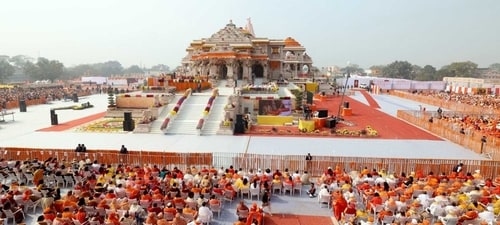
In 2003, the Archaeological Survey of India, under the orders of the Lucknow Bench of Allahabad High Court, excavated the present temple site to ascertain if a temple ever existed. During the dig, they found clinching evidence in the form of the 12th-century Vishnu Hari inscription. It says: “At the holy site of Ram’s birth place in Saket (Ayodhya), a grand temple dedicated to Vishnu Hari is built. As part of religious duties, the temple administration has established an annsatra (community feeding centre). Visitors from far away, guests, saints and travellers are regularly provided free food.”
Let me mention here that many historians, including Irfan Habib, challenged the find. They alleged the inscription was taken from the Government Museum in Lucknow and planted at the site as evidence. The allegation couldn’t be substantiated in the Supreme Court, and we all know the final result.
Skanda Purana and the 7th-century Chinese traveller Huen Tsang’s accounts also support the claims of the inscription. These accounts not only establish the legitimacy of the Ram Temple’s existence but point to the attributes that make Ayodhya an abode of virtue. Along with Ayodhya, Kashi and Mathura have their unique qualities too.
Mathura is situated on the most important Uttarapath or the north path of India. It’s part of the old Silk Route. Kushana-period inscriptions tells us that the treasury at the Krishna Janmasthan Temple acted as a bank. Local and foreign caravans would deposit their money here or seek loans for difficult trade journeys. Following in the footsteps of Krishna, the area had huge cowsheds.
The grandeur of Kashi was absolutely unique. Kashi Khand (chapter) of Skanda Purana declares it as India’s highest intellectual seat. The reason was that no new idea or principle would be universally accepted till it was debated and proved by the Kashi Vishwanath temple’s “intellectual committee”. Whether it was Shankaracharya or Ramanujacharya, every philosopher had to present, debate, and prove their hypothesis in this intellectual arena.
The city of Vishwanath wasn’t only limited to education but was also a great centre for astronomy, astrology, logic, and medicine. The Vishwanath Temple Council was also called Moksh Lakshmi Vilas. The granary of the Ma Annapoorna Temple situated close by ensured no one in Kashi would sleep hungry.
Ayodhya was the symbol of the king’s conduct and international cooperation and was considered a centre of good governance. Mathura was the centre of commercial banking, sculpting, agriculture and economics even before the advent of Christ. Kashi was the seat of education, learning, ayurveda and yoga. Temples like these have helped bring grace and sophistication to our civilisation and created a foundation to make it global. Temples in the south were making the same contribution towards our civilisation.
You may be wondering how did this glorious tradition vanish?
We get away by offering lazy arguments that put the entire blame on foreign conquerors. Many historians believe that during periods of foreign rule, security concerns forced India’s religious places into the hands of a chosen few. These people promoted very narrow visions on important issues. This was the beginning of the contraction of a great tradition. Other religious places established in India faced the same fate. Some reformed in time. For example, gurudwaras today are known to promote education, health care and public welfare along with performing religious duties.
A question arises: Is the issue limited to just the temple’s grandeur and its duties and rights? The inscriptions suggest all the three cities weren’t known just for the temples but for the entire culture and civilisation that these temples helped grow and establish. All the three holy cities were a confluence of various strands of culture and civilisations and cooperation in application of knowledge. Our temples didn’t attract foreigners with their grandeur but with their divinity. Indian intellectual traditions stress on balanced life and, as such, along with temples, they insist on realising the four pursuits of life — dharma (duty), artha (earning a living), kama (desire), and moksha (salvation). Temples provided a framework and lent strength to dharma, artha, and moksha.
Will Air Marshal Mishra and his colleagues help revive this glorious tradition?
Shashi Shekhar is editor-in-chief, Hindustan. The views expressed are personal
Get Current Updates on India News, Elections 2024, Lok sabha election 2024 voting live , Karnataka election 2024 live in Bengaluru , Election 2024 Date along with Latest News and Top Headlines from India and around the world.
See Less

Good foundation: on India’s strong industrial growth performance
By Sohail Khan · 1 Oct
Bitter pills: on Court’s intervention, drug pricing
By Sohail Khan · 1 Oct
Household debt, financing today against tomorrow
By Sohail Khan · 1 Oct