The AI age has a Tagore problem
Synopsis
San Francisco's tech boom highlights stark societal inequalities and wealth creation's dual nature. A public mural contrasts Lady Liberty's ideals with automated machines and exclusion. An Indian tourist and a friend debate national progress versus societal well-being and individual worth. The tourist champions national strength and economic growth above all else. Tech professionals discuss valuing human lives over algorithmic efficiency in simulations.
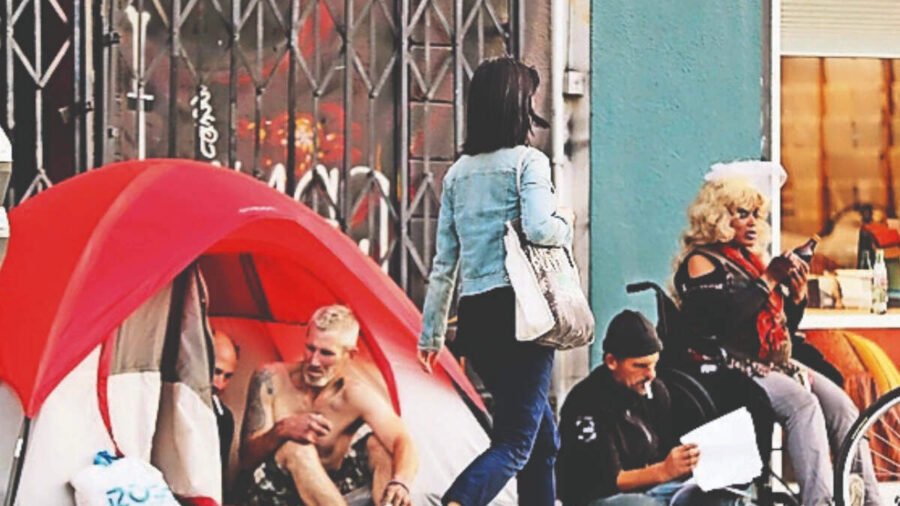
During a recent visit to San Francisco, I discovered that it takes only a small suspension of disbelief to be persuaded that the tech boom and its attendant wealth creation are equal parts curse and blessing. Nothing brings this fact home more persuasively than the growing number of homeless people in Frisco's Tenderloin district, and other parts of town.
Largely ignored or resented by the city's tax-paying residents, and lightly confined and prodded by the authorities, their hopelessness and hunger are a reminder of what happens when labour is optimised by insatiable efforts of enlightened capitalism. Efficiency, as all the AI-hijacked billboards proclaim, is a zero-sum game, which drives either conformity and profit, or redundancy and exclusion.
A public mural captures this succinctly. Above an image of a fallen Statue of Liberty, brought down in chains by automated machines, is inscribed a fragment from Emma Lazarus' 1883 poem, 'The New Colossus':
'…Give me your tired, your poor,
Your huddled masses yearning to be free,
The wretched refuse of your teeming shore.
Send these, the homeless, tempest-tost to me,
I lift my lamp beside the golden door.'
Nearby, a tableau vivant – a woman with earphones and a large grocery bag, who has just exited a driverless Waymo taxi, cocks a snook at two street-dwellers sharing a sandwich – unfolds perfectly. I made my despondent way to a meet up with a college acquaintance. Over coffee, she shared a recent experience.
The night before, she had accosted a loud tourist from India at a hotel bar telling his almost adult son that Rabindranath Tagore, on his second visit to the US and while staying at the same Palace Hotel in 1916, was nearly assassinated by the revolutionary Ghadar Party.
'Why did they want to kill him?' asked the youngster.
'Because, at that time, he was a British chamcha,' replied the man with certitude.
'But what did he do?' persisted the son.
'Nothing,' concluded the father. 'He was unprepared to support the cause of our independence struggle.'
'Not quite,' my friend found herself interjecting, 'But he was unwilling to condone violence, and put the concept of society above that of a nation state.'
His first reaction at hearing her unexpected voice was to stiffen and then, so it seemed to her, to turn and flee. But he gave her the once-over and felt more confident confronting somebody he considered a mere compatriot.
'Nation stands above society. It has taken India too long to understand this. Thankfully, it is now coming to its senses. We will do great things.'
'Yes… but a nation usually forces the marriage of politics and commerce to streamline the efforts of individuals. Then we become slaves of the system.'
'Maybe,' shrugged her interlocutor, 'But slaves are better than beggars.'
'But the system creates beggars. As one group becomes richer, another must become poorer. Just look at this city.'
'Look at India, instead,' he countered. 'Have you seen the latest growth figures? When we are great again, we will never permit filthy kangals on our streets.'
'Seriously? Do you believe…'
'Are you a leftist?' he interrupted her, mid-sentence.
'No, only an observer,' she assured him.
'Oh, a dimagi naxal, then.'
Before she could protest, he mumbled 'Jai Hind' and left.
Just as she was about to leave, she spied a pair of tech bros weaving their way unsteadily from the bar to the exit. 'We have to stop treating people like they are numbers,' said one. She felt a stirring of hope. Perhaps, Americans understood Tagore better than her own countrymen.
'Why?' asked the other.
'In FSD [full self-driving] crash test simulation, the programme chose to compromise the passenger and scrape the divider because the alternative showed four homeless people crossing the road. We've got to make it realise the relative worth of each individual. Those four had none.'
It may have been the drink, but she swore that she spied a white, bearded, South Asian apparition in a long cloak depart with the two techies through the hotel's revolving door.
The writer is MD, eTrans Solutions
(Disclaimer: The opinions expressed in this column are that of the writer. The facts and opinions expressed here do not reflect the views of www.economictimes.com.)
Add 

(Catch all the Business News, Breaking News, and Latest News Updates on The .)
…more
Elevate your knowledge and leadership skills at a cost cheaper than your daily tea.
-
ET Prime special: Know Your Company – Coal India, Part 1: One tonne of coal, two prices -
Hormuz is a state, not a strait. There are 10 other possible chokepoints for the global economy, including India -
Will the yuan become the new yen? -
Bigger or Better: One order from Power Grid Corp added $1 billion to the market cap of a company – Final part -
Banks have received a flood of money. Now comes the real test -
New aircraft order opens door for ATR assembly line in India -
An old India Inc habit: Ignore the nudge, wait for the stick -
Season of change in accounting policy: A simple AI prompt can tell you a lot -
Is crude oil becoming a financial problem? -
Can going slow on IPOs revive India’s stock market fortunes?

Watch: BRICS’ B’wood twist as Malaysian PM sings
By Sohail Khan · 12 Sep
Beyond bloc politics: BRICS bet on multipolarity
By Sohail Khan · 12 Sep
US teen’s cookie charity raises $66,331
By Sohail Khan · 12 Sep
Leave a Reply