Roshibina Devi Naorem’s third Asian Games medal: A historic hat-trick after a dramatic road to Nagoya
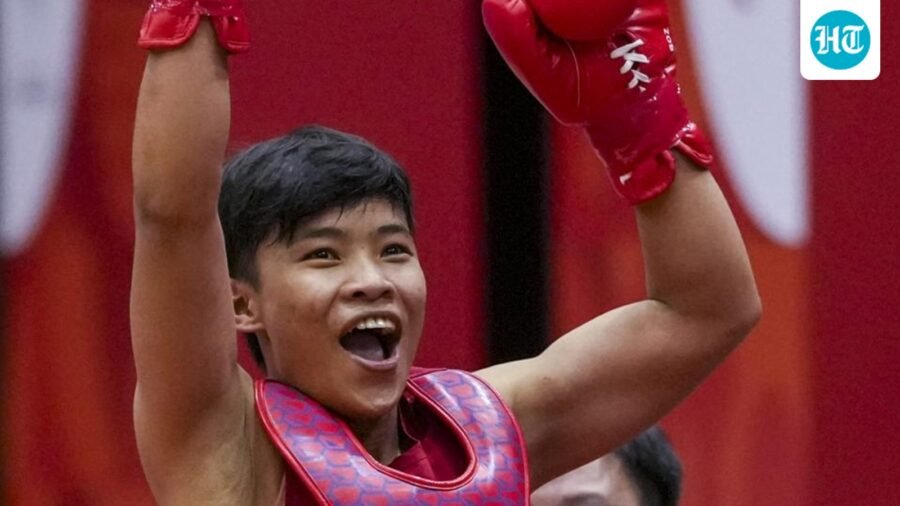
This was India's 11th medal in Wushu at the Asian Games — one gold, two silver and eight bronze.
Updated on: Sep 24, 2026, 06:45:31 IST
Prefer HTon Google
Share via
Copy link
Three consecutive Asian Games appearances, three consecutive medals. Roshibina Devi Naorem became the first Wushu player from India to win a hat-trick of Asiad medals. But this time, she had to fight just to make the squad, arriving as a last-minute injury replacement after a selection process that was itself mired in controversy, before clinching silver on Thursday at the Aichi Prefectural Martial Arts Hall in Nagoya.
At 17, Roshibina had bagged bronze at the Jakarta Games in the women's Sanda 60kg division and improved to silver at the 2022 Hangzhou Games.
Now 25, the Manipuri secured silver for the second time in the same weight division of Sanda, the combat-sport discipline of Wushu. She had earlier defeated Macao's Chu Man Sin 5-0 in the quarterfinals to assure herself of a medal. In the Sanda category of Wushu, semifinalists are guaranteed at least a bronze. But Roshibina was looking to better her 2022 performance.
Deep Dive
Powered ByAsk
She prevailed 2-0 against Indonesia's Thania Kusumaningtyas to progress to the final, but eventually succumbed 0-2 to China's Zhang Xiaoyu in the gold-medal bout.
The silver, nonetheless, has etched her name in the record books in a sport where China and Iran have remained dominant forces for years. Wushu originated in China and dates back to ancient times. It consists of two categories — Taolu, which focuses on precision and the execution of choreographed movements, including both unarmed and weapon events; and Sanda.
This was India's 11th medal in Wushu at the Asian Games — one gold, two silver and eight bronze.
The selection drama before a historic third
Out with a knee injury a year ago, Roshibina had lost to Divyanshi Choudhary in the trials and, as a result, missed the cut for India's seven-member Wushu squad approved by the Sports Ministry on August 22.
Divyanshi was picked in the women's 60kg Sanda category. However, she suffered a partial high-grade ACL tear, resulting in the Wushu Association of India (WAI) picking Roshibina as her replacement.
Divyanshi strongly protested against the decision in a highly charged video posted on social media, in which she alleged that Roshibina had mentally and physically harassed her and her family.
"I am really fed up. I have been harassed so much mentally from June, July to now, it's September, I am being harassed, because she (Roshibina) wanted to go (to the Asian Games)," she had said in the video.
Divyanshi also questioned her removal from the Wushu squad, saying doctors had cleared her to compete with her knee taped and that the decision by the WAI was taken without adequately informing her.
The WAI rejected the allegations and revealed that the selection change was made purely on medical grounds, clarifying the seriousness of Divyanshi's injury. She had sustained the injury during the 2026 SCO Wushu Sanda Championship in Hubei, China, and it worsened after she returned to the national camp following a break in August. She subsequently underwent medical tests.
The Sports Ministry eventually accepted Roshibina as the injury replacement for Divyanshi.
The silver in Wushu was India's 14th medal at the 2026 Asian Games and the second on Day 6, after Satnam Singh and Salman Khan won bronze in the men's doubles sculls.
See Less


Is Antonio Brown going to jail? Latest update on ex-NFL star’s attempted murder case
By Sohail Khan · 24 Sep

Leave a Reply