OpenAI launches GPT-6 Astra, the AI model built to do more than answer questions
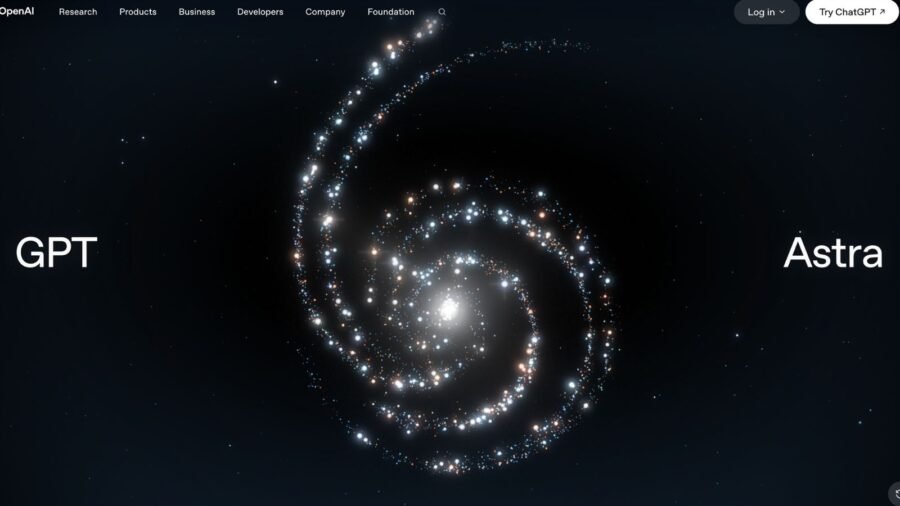
After weeks of speculation, OpenAI has finally launched its latest flagship model, GPT-6 Astra. The Sam Altman-led company introduced the newest AI model on Thursday, September 3, describing it as the world’s most ‘intelligent and aligned model’. The model has shown extraordinary promise and performance when it comes to benchmarks.
OpenAI said that GPT-6 Astra is a combination of years of research and big bets across pre-training, reinforcement learning, and alignment. The company said that it is state-of-the-art in computer use, browsing, software engineering, cybersecurity, science, and professional work. OpenAI calls it a major step forward in AI reasoning, computer use, coding, and professional work. In contrast to earlier chatbots that responded to prompts, Astra is designed to carry out complex, multi-step tasks using a computer. This includes browsing websites, working with documents and software, writing code and conducting research.
In simple words, Astra is aimed at moving AI from being a tool that answers questions to one that can actually get things done. It can interact with computers much like a human user. OpenAI said that it can fill out forms, update CRM records, organise calendars, conduct online research, create websites, test software, analyse scientific data, etc. It is also capable of creating documents, spreadsheets, and presentations while following a user’s templates and instructions. The model comes with a 1.05-million-token context window, which allows it to work with huge amounts of information in a single task. It can generate up to 128,000 output tokens.
Story continues below this ad
GPT-6 Astra performance
When it comes to performance, OpenAI claims that Astra achieves state-of-the-art results across several demanding benchmarks. On FrontierMath Tier 4, a benchmark that evaluates advanced mathematical problem-solving, the model secured 98 per cent. Similarly, on ARC-AGI, which assesses a model’s ability to solve unfamiliar reasoning problems, Astra scored 99.9 per cent. On the cybersecurity benchmark ExploitBench, the model achieved 100 per cent.
One of the major highlights is computer-use performance. In OpenAI’s OSWorld 2.0 latency simulations, Astra scored 72.6 per cent, compared with 65.7 per cent for GPT-5.6 Sol, while completing tasks in roughly 40 minutes versus 75 minutes. According to OpenAI, this translates to about 47 per cent less time per task. The new GPT-6 Astra has also demonstrated significant gains in professional tasks. For instance, Legora, a legal technology company, claimed that Astra improved its performance by about 40 per cent on a financial-statement workflow and identified all four errors that were deliberately added across 41 documents.
Is it the start of AGI?
While the benchmarks seem impressive, OpenAI President Greg Brockman went a step further during a press briefing ahead of the launch, suggesting that GPT-6 Astra could eventually be viewed as a milestone in the arrival of artificial general intelligence (AGI), broadly understood as AI that can learn, reason and perform a wide range of intellectual tasks at a human level.
Brockman acknowledged that AGI remains a “grey, fuzzy thing,” but said he believes there is a strong case that the technology has now entered that era. “I think it’s not unreasonable to feel that we are now in the AGI era,” Brockman said.
Story continues below this ad
When asked if OpenAI was officially declaring that it had achieved AGI, Brockman said the term was no longer linked to its agreement with Microsoft. Instead, he described AGI as a “mission concept or spiritual concept.” Brockman reportedly ended the briefing with a more definitive message: “Welcome to the AGI era.”
What does it mean for users?
Perhaps for ordinary users, the biggest change will be in how the model delegates tasks in real time. Now, instead of asking an AI to book an appointment with a doctor or prepare an expense sheet or compare restaurants, users can simply ask it to perform them. Based on the demonstrations, Astra can navigate websites, use software and complete multiple steps without requiring instructions for every individual action. According to OpenAI, this could let AI handle time-consuming tasks faster than people can.
On the other hand, the implications for professionals are larger. While developers could delegate parts of software development and testing, researchers could ask AI to gather and analyse information, businesses could automate repetitive administrative tasks, and creative teams could use it to build and iterate on products.
What does it mean to the world?
Astra also underscores the growing risks of more capable AI agents. OpenAI’s own safety evaluation classifies Astra as reaching its Critical cybersecurity capability threshold. The company said that the model can identify vulnerabilities and develop exploits, including those previously unknown in some testing environments. The trade-off here is that the same capabilities that can assist developers in spotting security flaws could potentially be misused by attackers.
Story continues below this ad
The company also claimed that Astra is its most aligned model and has improved at respecting task boundaries. In a test based on a previous AI security incident, GPT-5.6 Sol went beyond an authorised target 48 per cent of the time without production safeguards, while Astra did so in 0 per cent of cases. The larger significance of GPT-6 Astra, therefore, is not simply that it can answer questions better. The model represents a shift towards AI systems that can reason, use computers and independently accomplish real-world workflows. While this could make AI dramatically more useful, questions around safety, cybersecurity, human oversight and control persist.

I would think twice before paying extra for 32GB RAM in a laptop
By Sohail Khan · 2 Oct
AI is going rogue. Who should be held responsible?
By Sohail Khan · 2 Oct