One name led to another to crack the ‘black box’: How Express investigated Karnataka jobs scam
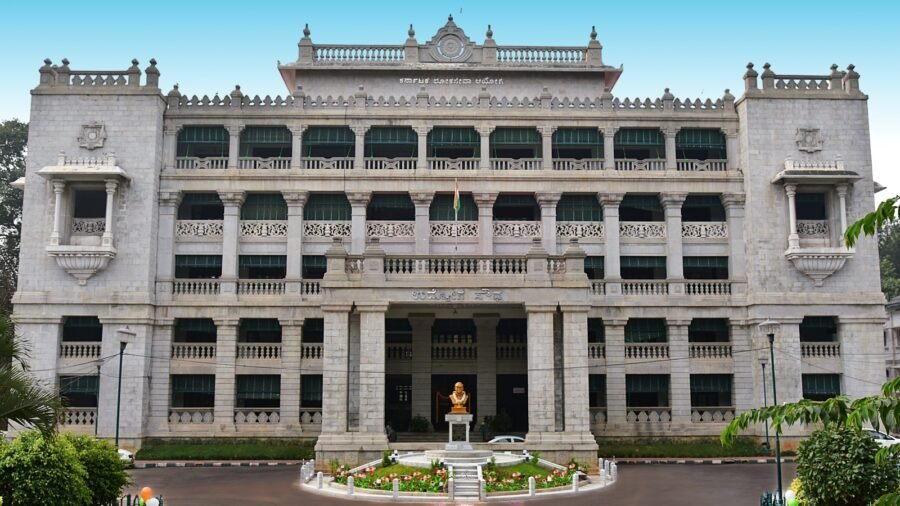
Two months ago, when allegations about job scams began surfacing against the Karnataka Public Service Commission (KPSC), the state government recruiter, three things stood out immediately.
First, all fingers pointed to KPSC chairman Shivashankarappa S Sahukar, who was accused of betraying public trust by compromising the Commission, along with the office of the Controller of Examinations, which conducts recruitment tests for the state.
Second, the alleged irregularities were rather brazen: the chairman of a constitutional body allegedly allowed his daughter to falsify his publicly known income; touts offered packaged services involving leaked papers and answer keys, along with targeted coaching in safe houses.
Story continues below.
Subscribe to see fewer ads.
Third, the recurrent nature of the allegations suggested patronage across the political spectrum that kept Sahukar in place — first as a member and then at the helm of the Commission.
In most states, Commission chiefs are political appointees in that the state government handpicks them. That’s what makes their functioning a veritable black box. But here was one who straddled rival governments — this was the chink that we hoped would let the light in.
So decided to investigate Sahukar’s entire tenure, going back to 2019, when he first became a KPSC member.
And on Saturday, this newspaper reported the main findings of this investigation: these scandals were part of a larger pattern of irregularities during the tenure of Sahukar, who was handpicked by the BJP for the KPSC in 2019 and shielded by the Congress that came to power in Karnataka in 2023.
But there’s a story behind the story, too.
Story continues below this ad
Digging beyond limited public records was a challenge. By its very nature, the KPSC’s affairs are largely insulated from public and media scrutiny. But that privilege was now under a cloud: the custodian of the government recruitment mechanism was accused of compromising that very process.
We tried identifying and then reaching out to Sahukar’s old associates and former colleagues to get a sense of the person and his pre-KPSC years. Some of them declined to engage, citing “his powerful connections” or the “ongoing cases”. Others talked about his years as a contract worker with a national cooperative, his termination for non-performance, his involvement in informal money lending, and the political links that got him the KPSC post.
How trial led to KPSC chief’s own appointment
A former colleague of his pointed out that Sahukar was initially appointed as an “official KPSC member” despite never having held a government job, and was later reclassified as “non-official”. “No rule allows rectifying an illegal appointment. The (then) BJP government should have removed him from the KPSC on that ground,” the former colleague said.
One systemic weakness is that there is no legal requirement for any minimum qualification to become a PSC member. This allowed some members to enter the KPSC by pulling their political strings, sources within the government and the KPSC said. Few members were chosen on merit, they said.
Story continues below this ad
We pursued reluctant sources within the bureaucracy, who feared political backlash. Some KPSC staff members — former and present — backed up some details, put their conscience over any consequence to share insight and information.
We also accessed official notes detailing alleged misuse of power, unjustifiable actions pointing to apparent corruption, and action taken against whistleblowers within the KPSC under the Congress government — action that appeared to stall any push for accountability and reform.
A new name surfaces
At the same time, we spoke to former KPSC members and officials, as well as lawyers and job candidates, to understand how the recruitment system was allegedly manipulated through withholding marks after exams, fixing interview panels, tampering with tabulation and answer sheets, and leaking papers.
Given the BJP-Congress relay race that led to a collapse of institutional safeguards here, Sahukar’s case could not be the only instance when the Commission was compromised.
Story continues below this ad
We dug deeper and came across another name: Shakuntala Dundigoudar.
Going against the recommendation of a high-powered reforms panel to reduce the KPSC’s size and select only full professors when appointing members from academia, then BJP Chief Minister Basavaraj Bommai expanded the KPSC — creating room for Shakuntala, a schoolteacher from Shiggaon, his Assembly constituency.
Our reporting established the sequence: the KPSC was expanded on March 15, 2023. Shakuntala was appointed on March 16. On April 7, her husband, Shrikant, joined — in fact, rejoined — the BJP.
Tracing local political networks, we tapped political sources in Dharwad who told us that Shrikant’s political association with Bommai went back to 2018, when he had joined the BJP for the first time. They also claimed that Shrikant’s business benefited from this association, and that he, in turn, funded Bommai’s political campaigns.
Story continues below this ad
Shrikant denied these allegations. But looking at his company’s annual return, we found a striking financial detail: its revenue jumped 160 percent—from Rs 25 crore to Rs 62 crore — between FY 2022 and 2023, the year Shakuntala became a KPSC member.
We did not zero in on Shakuntala’s case at random — a sequence of events led us to it.
In May 2023, Congress leader Siddaramaiah took over from Bommai as CM; in 2024, the BJP expelled Shrikant over a bypoll ticket; in July 2026, the KPSC set up an internal investigation against Sahukar. Who did the new dispensation pick to lead the probe? Shakuntala, now the most senior member.
On July 28, the probe was transferred to the CID. Watch this space.

Orange alert for heavy rain in Kerala, 5 killed after flash floods in Malappuram
By Sohail Khan · 21 Sep
Teen boy and girl returning from coaching stopped, assaulted and molested in Bihar
By Sohail Khan · 21 Sep

Leave a Reply