Nokia, Ericsson, IBM, to Blackberry: How humbled tech giants reinvented for a comeback
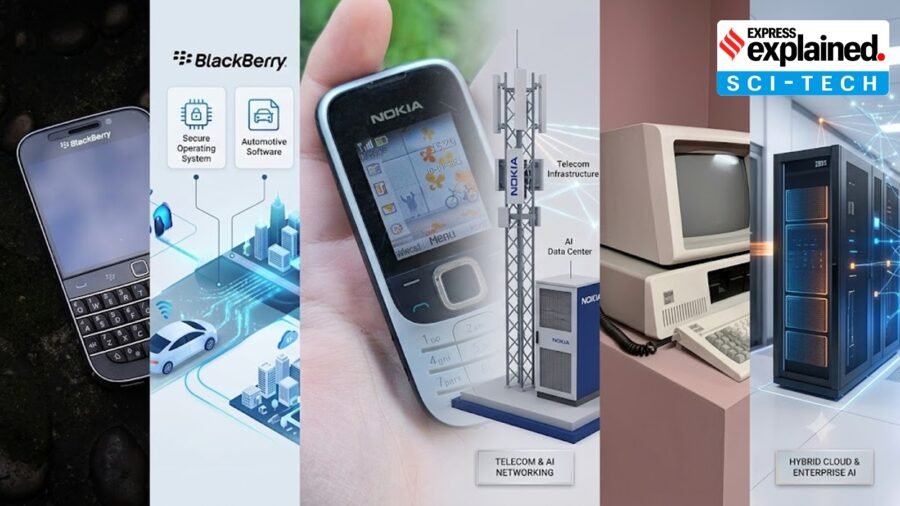
In the electronics business, brands have a track record of reinventing themselves, exiting the products that made them household names and returning in a different avatar. Canadian smartphone maker BlackBerry, once pushed to the brink by the collapse of its handset business, is now a profitable enterprise and embedded software company, with its shares gaining more than 100% over the past year.
Nokia, once the world’s biggest mobile phone maker, today makes most of its money selling telecom and networking infrastructure, and is positioning itself as a supplier to the artificial intelligence (AI) data centre boom. International Business Machines (IBM), which helped popularise the personal computer, exited PCs two decades ago and now centres its business around enterprise software, hybrid cloud, AI and high-end computing.
For these companies, the reinvention has typically followed the pattern that when a consumer hardware business is disrupted or commoditised — primarily for failing to capitalise on changing consumer trends — it forces the company to fall back on less visible technologies it developed along the way, such as software, patents, networks or enterprise infrastructure.
Such reinventions, though, are distinct from technology giants that started out in entirely different businesses before finding their eventual calling. Samsung, for instance, began as a trading company dealing in dried fish and groceries before entering electronics three decades later, while Nintendo spent much of its early history making playing cards before moving into video games and handheld gaming consoles.
Corproate turnarounds have their perils. Like people, according to Aswath Damodaran, Professor of Finance at NYU’s Stern School of Business and corporate valuations experts, companies have a life cycle and a firm’s valuation should reflect its position along the journey from startup to a declining elder.
“More value is destroyed around the world by companies not acting their age. Young companies trying to act old and old companies trying to be young again. And there’s an entire ecosystem that feeds these companies. Consultants, bankers, essentially the plastic surgeons of business… If I give you a facelift, you can be young again. And companies keep buying into this notion over and over again,” Damodaran, a comebacks sceptic, said at a Nordic Business Forum discussion on corporate makeovers.
Changing the busienss model itself, though, sometimes makes the comeback more durable.
Story continues below this ad
BlackBerry: from smartphones to software
At its peak, BlackBerry was one of the defining brands of the smartphone era, known for its physical QWERTY keyboards and secure messaging services. But the arrival of Apple’s iPhone and Android smartphones rapidly eroded its position. BlackBerry stopped making its own phones in 2016, effectively ending its life as a consumer hardware manufacturer.
The company that remains is markedly different, with BlackBerry now focusing on two areas: QNX, its operating system and software platform used in cars and other embedded systems, and secure communications software used by governments and businesses.
The transition is beginning to show up in its financial position. BlackBerry recorded a positive cash flow in the quarter ending May for the first time since 2017, and its market value has recovered sharply. The company is now worth around $5 billion, still a fraction of its roughly $83 billion peak valuation, but a significant turnaround for a business that had become synonymous with technological obsolescence.
Nokia: from handsets to the infrastructure behind AI
Nokia underwent an even more dramatic change. The Finnish company dominated global mobile phone sales in the 2000s but struggled with the transition to smartphones. In 2014, it completed the sale of substantially all its handset business to Microsoft.
Story continues below this ad
What remained was primarily a telecommunications infrastructure company. Nokia subsequently expanded that business through its acquisition of Alcatel-Lucent, and more recently bought optical networking company Infinera.
That infrastructure focus has now given Nokia an entry into the AI boom. Its networking equipment connects servers, data centres and increasingly large clusters of AI chips. Nokia has made AI and cloud services one of its strategic priorities, arguing that the rapid construction of AI data centres will increase demand for high-capacity optical and IP networks.
In the first quarter of 2026, Nokia said sales to AI and cloud customers jumped 49%from a year earlier, while its Optical Networks business grew 20%. The company has also partnered with Nvidia and invested in AI cloud infrastructure companies.
IBM: leaving the PC behind
IBM’s reinvention was more deliberate. The company introduced the IBM Personal Computer in 1981, helping establish the architecture that would dominate the PC industry. But as computers became commoditised, margins fell and IBM’s market share declined from roughly 80% in the early 1980s to about 20% a decade later.
Story continues below this ad
IBM responded by shifting towards services, software and enterprise computing. In 2005, it sold its PC division, including the ThinkPad brand, to Lenovo for $1.75 billion.
Further, its $34-billion purchase of Red Hat in 2019 placed hybrid cloud at the centre of IBM’s business, while the company has since expanded into generative AI through continued investing in mainframes, servers and quantum computing.
AI is now feeding into several parts of the company’s portfolio. In its second quarter of 2026, IBM’s Red Hat hybrid cloud revenue grew 11%, while distributed infrastructure revenue rose 37%. In August, IBM also struck a $240 million deal with Together AI to build an AI inference cluster on IBM Cloud using Nvidia Blackwell chips.
Ericsson: phones out, networks in
Sweden’s Ericsson followed a path similar to Nokia, only earlier. A major mobile phone brand in the 1990s, Ericsson’s handset business ran into heavy losses around the turn of the century.
Story continues below this ad
In 2001, it combined its phone division with Sony to form Sony Ericsson. A decade later, Sony bought Ericsson’s share of the venture. By 2014, the remaining elements of Ericsson’s mobile phone operations had been folded into other businesses, ending its 31-year run in handsets.
Ericsson instead concentrated on telecom infrastructure such as base stations, radio equipment and software that mobile networks run on. Today, its focus includes 5G and the development of 6G, making it another former handset maker that survived by moving to the infrastructure underneath consumer technology.
HTC and Toshiba: reinventions still underway
HTC, one of the earliest major Android smartphone makers, has taken a different route. As its handset market share collapsed, the Taiwanese company moved into virtual and extended reality (XR) through its Vive business. It transferred part of its smartphone engineering operation to Google in a $1.1 billion deal in 2018, and in 2025 struck another $250 million agreement under which members of its XR research team joined Google.
HTC now describes itself as entering a third transformation, focused on immersive content, XR and AI-enabled devices. Its portfolio includes Vive VR headsets, the Viverse immersive-content platform and Vive Eagle AI smart glasses. The reinvention, however, remains incomplete as HTC reported an operating loss in 2025, although asset sales and the Google transaction helped it record a net profit.
Story continues below this ad
Toshiba is a looser example because it was always a diversified industrial group. But the Japanese company, once a major global laptop and consumer electronics brand, completed its exit from personal computers in 2020 by selling its remaining stake in Dynabook to Sharp.
Its current businesses bear little resemblance to the Toshiba most consumers remember. The group is now organised around energy solutions, digital infrastructure and devices and technology, producing everything from power transmission systems and nuclear technology to power semiconductors, data-centre hard drives and semiconductor manufacturing equipment.

Good foundation: on India’s strong industrial growth performance
By Sohail Khan · 1 Oct
Bitter pills: on Court’s intervention, drug pricing
By Sohail Khan · 1 Oct
Household debt, financing today against tomorrow
By Sohail Khan · 1 Oct