News in Frames | In pursuit of salt and survival
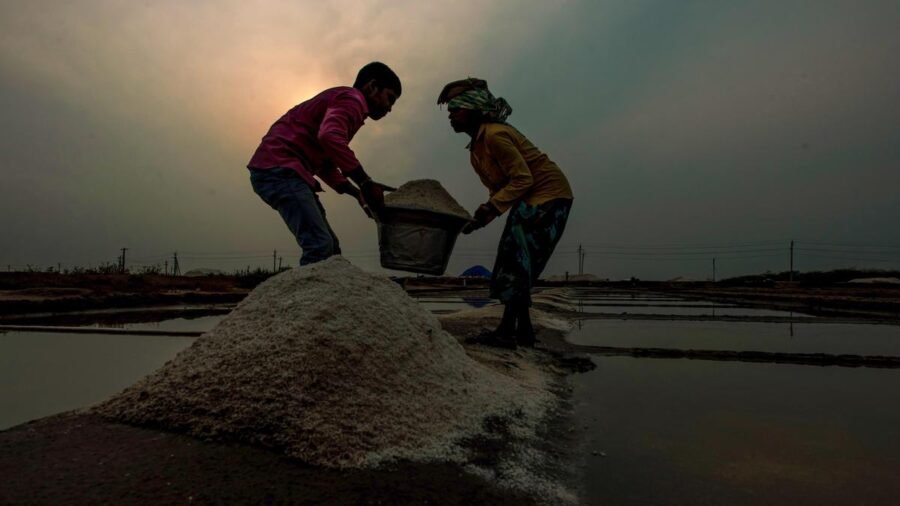
Before the sun rises over the Bay of Bengal, the salt pans near Ongole in Prakasam district of Andhra Pradesh are already stirring. In the dim light, workers walk toward the shimmering white fields to begin another day of labour — work that leaves an indelible mark on their bodies and lives. Behind the glittering mounds of salt lies a world shaped by sweat, uncertainty, and an unending struggle for survival.
Thousands of workers in the coastal mandals of Kothapatnam, Naguluppalapadu, Chinna Ganjam, Singarayakonda and Vetapalem depend on salt production for their livelihood. The salt season begins in mid-December, coinciding with the festive period leading up to Sankranti, and continues till the rains in July. However, this year, the El Niño has extended the dry season, and salt production continues. Workers repair mud bunds, pump concentrated brine into the pans and, under the scorching sun, scrape salt crystals from the surface by hand or with simple wooden tools. In remote salt fields without proper roads, they carry the harvested salt on their heads and pile it along the bunds.
The work is gruelling. Spending long hours in brine and intense heat exposes workers to skin ailments, eye irritation, and joint pain. Sunlight reflected off the white crystals places additional strain on their eyes.
This harsh occupation also affects family life. For some families, finding suitable marriage alliances for their sons outside villages where salt farming is the main occupation is usually very difficult.
Every season is a gamble. An unexpected spell of rain can wash away months of hard work, while falling salt prices can wipe out the meagre incomes of workers, as in this season. While the monsoon has made its presence felt in most districts of coastal Andhra, Prakasam remains dry. The salt prices have fallen because of overproduction.
In a normal year, once the monsoon arrives, a hush settles over the salt pans, and these salt workers turn to government employment schemes, fishing, and other temporary jobs to make ends meet.
Yet, with every new season, they return to the salt pans. Their footprints disappear beneath the crystals, but their struggle remains etched across the landscape — a reminder that behind every gleaming mound of salt is a life built on labour, hope and resilience.
Photo:
Kommuri Srinivas
Before sunrise: Workers begin their day at the salt pans near Beeramgunta coastal village, near Ongole, in Prakasam district.
Photo:
Kommuri Srinivas
White fields: Workers walk across the salt pans near Beeramgunta as the day’s work gets underway.
Photo:
Kommuri Srinivas
Manual harvest: A worker uses a simple wooden tool to rake and pull salt crystals from the surface of a pan.
Photo:
Kommuri Srinivas
Crystal ground: A worker labours in the morning light near Kothapatnam coastal village in Andhra Pradesh; for thousands of families along the coast, salt-making is a vital source of livelihood.
Photo:
Kommuri Srinivas
Back-breaking labour: Workers move between the salt pans as they begin another day; the work involves long hours in intense heat and brine
Photo:
Kommuri Srinivas
Precious stock: Workers shift harvested salt from the pans to a safer place, following a rain warning. But the rains did not come.
Photo:
Kommuri Srinivas
Daily grind: Harvested salt is collected in heaps after it is taken from the pans.
Photo:
Kommuri Srinivas
Heavy load: Women workers carry baskets of salt; in areas without proper roads, workers often transport the salt on their heads
Photo:
Kommuri Srinivas
Season’s yield: A worker heaps freshly harvested salt
Photo:
Kommuri Srinivas
Final task: Women walk through the salt pans in the evening light as the day’s work comes to an end

Hyena gave birth to two cubs at the Thiruvananthapuram Zoo
By Sohail Khan · 20 Sep
SCoR, Vijayawada division, loads first rake of wood pulp to Maharashtra
By Sohail Khan · 20 Sep

Leave a Reply