NASA spots ‘once-in-a-century’ crater on Moon’s surface after massive asteroid crash
NASA spots ‘once-in-a-century’ crater on Moon's surface after massive asteroid crash
The impact that led to the formation of the crater may have occurred sometime between April 11 and May 22, 2024, according to the researchers.
Updated on: Sep 17, 2026, 17:19:05 IST
Prefer HTon Google
Share via
Copy link
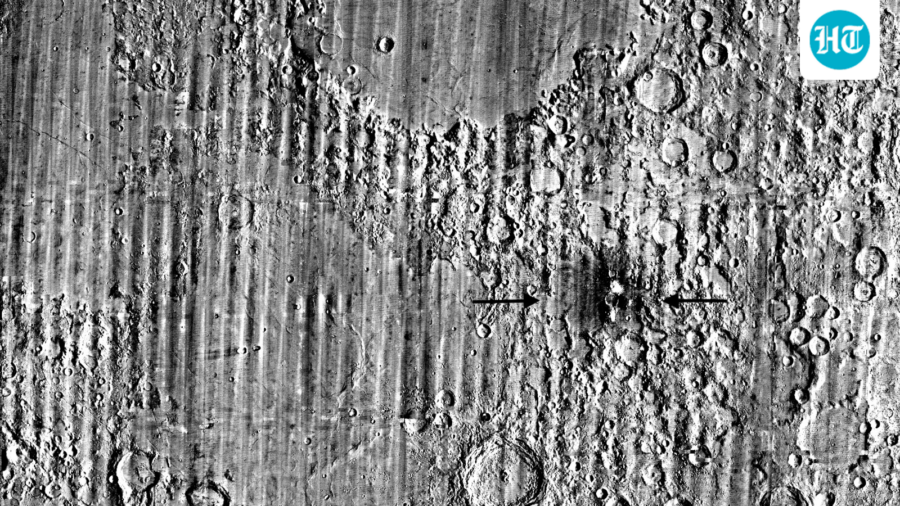
Scientists have found a big new crater on the Moon which is said to have been created by ‘once-in-a-century’ impact. The crater, named McGetchin, is 728 feet (222 meters) wide and 141 feet (43 meters) deep and was revealed by NASA’s Lunar Reconnaissance Orbiter (LRO).
The crater has been named after pioneering lunar scientist Tom McGetchin.
Scientists say it is the largest newly formed crater yet discovered anywhere in the solar system, NASA said in a statement. The impact that led to the formation of the crater may have occurred sometime between April 11 and May 22, 2024, according to the researchers who published a paper about their discovery in Science Advances.
The crater, roughly the size of two American football fields may have been created by a comet or an asteroid approximately the size of a three- to six-storey building that slammed into the moon, scientists have said.
How the discovery was made
The crater appeared as a "large bright spot circled by a dark halo" by the LRO probe, which has been studying the Moon since 2009.
The discovery was made by the scientists of NASA during ‘routine data-quality check’ during which Robert Wagner, a scientist with NASA’s LRO, scanned a giant Moon map on his computer screen. He found an unusually large bright spot circled by a dark halo caught his eye, as it implied that surface material in that area had been shaken up, NASA said in a statement.
“I just stopped, dropped everything, and started looking into what that spot was,” Wagner was quoted as saying.
Wagner then compared the before and after images of the Moon and realised he had discovered the largest, newly formed crater ever found in the solar system.
Scientists estimate that an impact of this magnitude happens on the Moon about once in a century or even longer.
While the Moon has numerous craters, many of which are far bigger than McGetchin, researching a crater's formation in real time can help build understanding of the Moon's geology.
This in turn could better prepare future crewed missions to the Moon, which are currently planned by both the United States and China.
Unlike Earth, the Moon has virtually no atmospheric layer, so space debris does not slow down or burn up before colliding with the surface.
See Less

There is too little money in British politics, not too much
By Sohail Khan · 17 Sep
What does the Fed rate hike mean for Americans as phone and utility bills rise?
By Sohail Khan · 17 Sep
Bangladesh faces gas shortages, Pakistan fuel pain as Gulf crisis worsens
By Sohail Khan · 17 Sep
Leave a Reply