My Dear Kuttichathan: How India’s first 3D film, with rotating sets, was made for Rs 40 lakh
If he could magically make every Indian watch one Malayalam movie, which one would Prithviraj Sukumaran pick? Despite being a wordsmith, the actor-director took an unusually long break when Anant Goenka, Executive Director, Group, asked him this question during the 16th edition of Expresso, held recently at Taj Lands End in Mumbai. However, he eventually named director Jijo Punnoose’s My Dear Kuttichathan (1984), the first Indian movie filmed in 3D.
Why Prithviraj picked a children’s film for every Indian to watch
“That’s tough, because we have made such great cinema over the decades. Not just because it’s a great film, but I’m a big ‘cinema nostalgia’ guy, so I would say, My Dear Kuttichathan,” Prithviraj shared. Explaining his pick, he noted, “It’s the first 3D film ever made in India, and I don’t know how many people know that Malayalam cinema did it. That way, we had amazing pioneers.”
Don’t Miss | Law and Order movie review: Ranjith turns Mammootty’s most iconic character into a joke
Story continues below.
Subscribe to see fewer ads.
Essentially a children’s fantasy film, My Dear Kuttichathan follows a mystical goblin who befriends three children after they save him from an evil sorcerer’s spell. Penned by Raghunath Paleri, the movie was bankrolled by Navodaya Studios.
It not only became a massive success in Malayalam, drawing several re-releases over the years, but its Hindi-dubbed version, Chotta Chetan (1998), featuring a few updated and new scenes to cater to the local audience, also became a big hit. One of the later versions also starred Urmila Matondkar in a key role.
My Dear Kuttichathan: The making of India’s first 3D film
Featuring Master Arvind, Master Mukesh, Master Suresh, and Kumari Sonia in the lead roles, director Steven Spielberg’s Jaws (1975) reportedly served as an inspiration for My Dear Kuttichathan. Before the filming began, Jijo travelled to the US multiple times to learn 3D technology.
The film was shot at Navodaya Studios in Kochi, using their in-house ARRI Model IIC camera, with a 35mm Mitchell on standby. The shooting was completed in about 90 days, significantly longer than is typical for Malayalam movies. The technical work was done in Madras (now Chennai), including the recording of songs and music.
Story continues below this ad
Once the movie was ready for release, Navodaya Studios had one more thing left to do: equip theatres in Kerala to screen the film in 3D. The production house selected several theatres and fixed special 3D lenses to their projectors. It then began focusing on the special glasses needed to watch the movie. Reportedly, polaroid gelatin was fixed onto the lenses and frames, with both lenses and polaroid gelatin imported from the US.
My Dear Kuttichathan box office collection
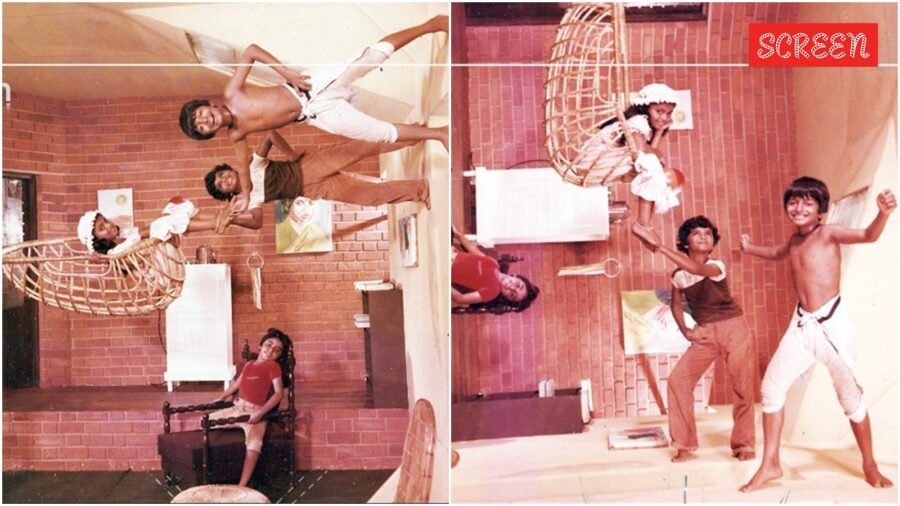
Mounted on a reported budget of Rs 40 lakh, the movie opened to rave reviews from all quarters. People flocked to theatres to watch and experience the allure of My Dear Kuttichathan. What amazed them the most was the song “Aalippazham Perukkaan,” composed by Ilaiyaraaja, where Kuttichathan and the children walked on the wall.
The team built a rotating set for this scene, similar to the one used in Stanley Kubrick’s 2001: A Space Odyssey (1968) and later popularised by Christopher Nolan in Inception (2010).
My Dear Kuttichathan ranks among Malayalam cinema’s most successful movies of all time, reportedly having grossed about Rs 2.5 crore at the box office. During its theatrical run, the film apparently had about 85,000 screenings worldwide, with a whopping 43 million 3D glasses used.
Story continues below this ad
It also won the National Film Award for Best Children’s Film.
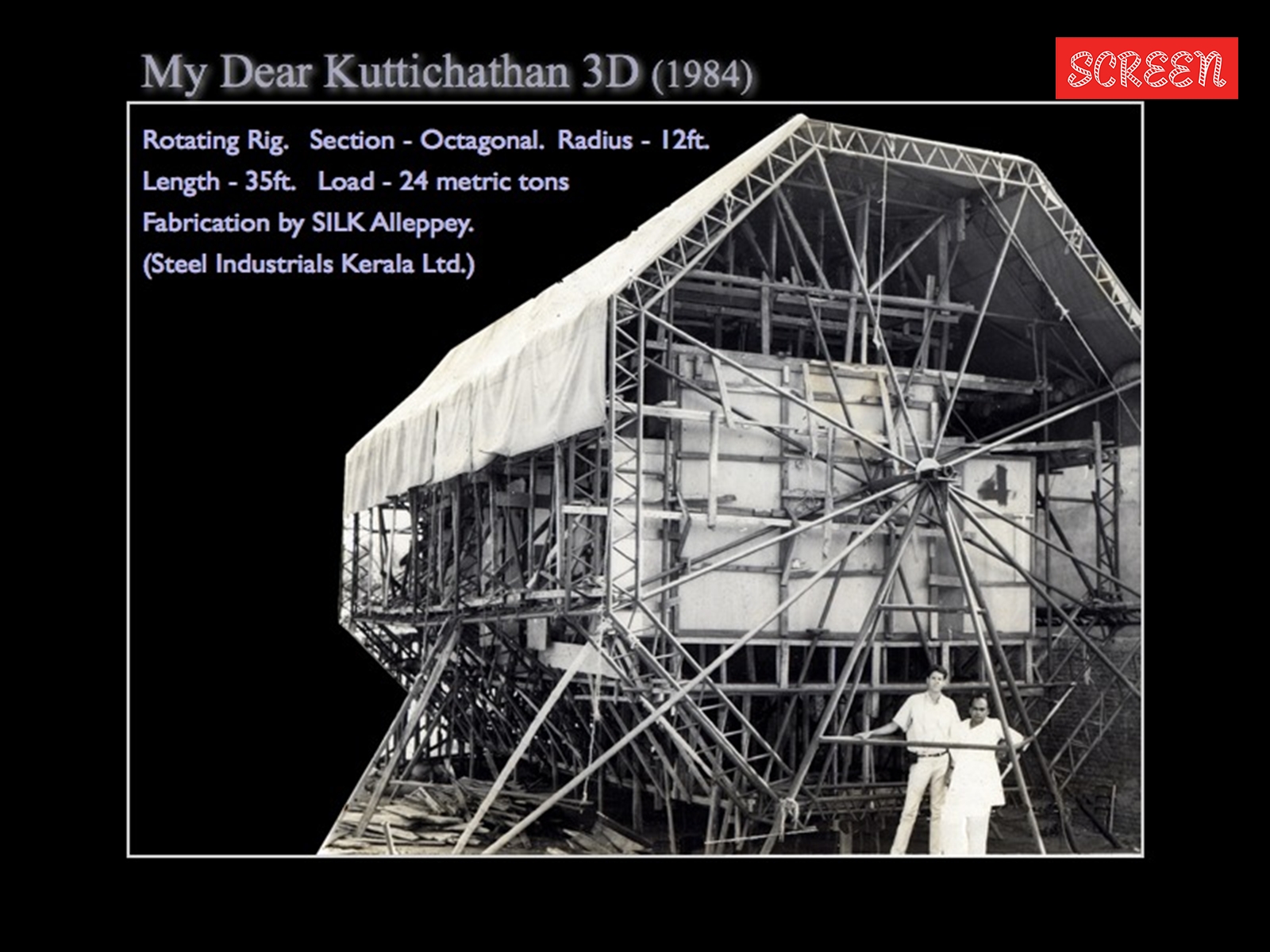 The movie’s team built a rotating set for the scene showing the children walking on the wall. (Credit: Navodaya Studio)
Discussing the difficulties of making a 3D movie, Jijo’s brother, director Jose Punnoose, who later helmed Magic Magic 3D, said in a 2003 interview, “Executing a 3D film takes a lot of time. For instance, if you are working with 100 kilowatts of light for an ordinary film, a 3D film needs at least 350 kilowatts. As a result, when a conventional movie can be completed in 50 days, a 3D movie takes a minimum of 140 days. The cost is also twice that of a conventional movie. But then, production is only 25 per cent of the job. The remaining is exhibition. This is highly labour-intensive.”
ICYMI | It’s a Medical Miracle movie review: Sangeeth, Sharaf U Dheen’s film is ambitious, engaging
He added, “Since most of the cinemas in our country are not equipped for a 3D projection, we have to deploy our staff to change the screens overnight to silver-coated plastic ones, install special lenses in projectors and align them. Besides, we have to clean and sterilise the 3D glasses after each use. (Navodaya has manufactured 1 million glasses for this purpose.) Fortunately, we have an army of people who have worked with us since the My Dear Kuttichathan days.”




Leave a Reply