Modi-Xi thaw masks widening China trade gap
Synopsis
India faces a significant trade deficit with China, importing substantially more goods than it exports. Chinese firms offer superior price and tech competitiveness, impacting Indian industries. India relies heavily on China for critical inputs like rare earths, affecting various sectors. The nation is pursuing diversification and domestic manufacturing incentives to reduce dependency. Targeted measures and tech transfer are crucial for a sustainable bilateral relationship.
 Agencies
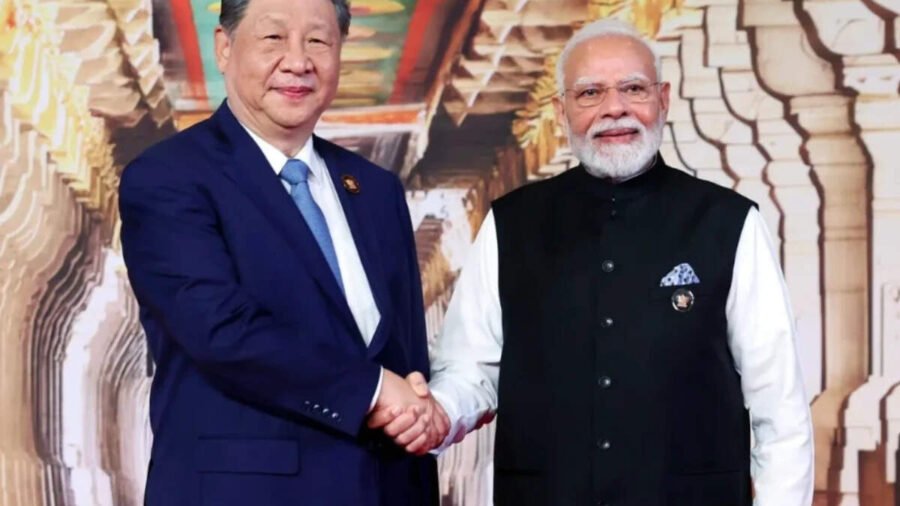
In their one-on-one at the sidelines of the New Delhi BRICS summit last weekend, Narendra Modi and Xi Jinping discussed the border issue, with the two expressing ‘commitment to a fair, reasonable, and mutually acceptable resolution’.
The other important track, economics, had little to cheer about, except for resumption of direct flights between Delhi and Guangzhou, a major sourcing hub for Indian apparel, accessories and electronics traders. In FY26, China overtook the US to become India’s largest trading partner. Bilateral merchandise trade reached about $151 bn.
Also read: Xi & Modi reached most important consensus that India-China should be partners: Wang Yi
But it’s how the trade is split that tells the real story. India imported well over $130 bn in Chinese goods, while exporting under $20 bn, leaving a deficit above $112 bn, the widest on record, and a jump from about $99 bn the year before. For every dollar of goods India sells to China, it buys back $6-7 worth. India hasn’t been able to leverage China’s $18 tn economy effectively, and the widening trade deficit is largely organic, driven by Chinese firms’ superior price and tech competitiveness.
The silver lining is that ndian consumers gain access to cheaper Chinese goods, with a larger realisation of consumer surplus. Much of what China sells India — telecom equipment, semiconductors, lithium-ion batteries, solar cells, industrial machinery, pharma ingredients — are productive inputs that Indian factories and assembly lines depend on to make their own products affordable and competitive. Cutting these imports off overnight would raise costs across Indian industry, not lower them.
Even a ‘Made in India’ smartphone, EV or solar panel carries a great deal of Chinese content inside it. India relies on China for a striking share of inputs across sensitive sectors. Nowhere is this dependence more exposed than in rare earths. China controls roughly two-thirds of global rare earth mining, some 60% of processing capacity, and close to 90% of magnet manufacturing, a dominance built deliberately since the 1990s, when Beijing designated rare earths a strategic asset while Western producers retreated from this pollution-intensive sector.
In April 2025, China restricted exports of 7 rare earth elements, primarily as retaliation against US tariffs, rather than a move aimed at India. India was caught in the crossfire regardless, given how heavily its EV, electronics, RE energy and defence sectors lean on these materials, for which substitutes such as ferrite magnets perform noticeably worse. What followed was a stop-start sequence that has made planning nearly impossible for Indian manufacturers.
China eased curbs on magnets, fertilisers and tunnelboring equipment in August 2025 after diplomatic commitments from its foreign minister Wang Yi during a visit to New Delhi — only to add 5 more elements to its control list 2 mths later, and to introduce a rule requiring approval for any product containing even trace amounts of Chinese-origin rare earths.
By December, restrictions covered 12 elements in total. India is preparing an incentive scheme worth about $73 bn for rare earth magnet manufacturing, alongside a $15 bn critical-minerals recycling initiative running through 2031.
India is also courting Australia, Japan and South Korea as alternative rare earth suppliers. Private capital has begun to follow, with companies raising fresh funds specifically to invest in rare earth metals. But domestic manufacturing capacity in electronics, batteries and critical minerals takes years to build, and will require sustained policy support well beyond current incentive schemes. Diversifying supply chains can reduce dependency without eliminating it. Indian negotiators have limited leverage to try open Chinese markets for pharma, agriculture and IT services.
Also read: India, China agree to 'properly address' economic and trade concerns in a balanced manner
So, progress there is likely to stay incremental. Unlike blanket protectionism, which risks sheltering inefficient domestic producers, targeted measures — anti-dumping duties where dumping is proven, security screening for genuinely sensitive technologies, incentives tied to measurable gains in value addition rather than mere assembly — offer a more sustainable path. With respect to China, what is emerging is not a relationship headed for imminent decoupling.
Trading in local currency will help reduce trade imbalances, mainly by lowering exchange rate volatility, reducing the need to hoard costly foreign reserves, and cutting transaction costs for cross-border trade. Also required is insistence on tech transfer. Future rounds of negotiation will require ambition, creativity and willingness on the part of Indian negotiators to make China accept on these terms.
(The writer is head, Economic Policy Centre, Mahindra University, Hyderabad)
(Disclaimer: The opinions expressed in this column are that of the writer. The facts and opinions expressed here do not reflect the views of www.economictimes.com.)
Add 

(Catch all the Business News, Breaking News, and Latest News Updates on The .)
…more
Elevate your knowledge and leadership skills at a cost cheaper than your daily tea.
-
A different kind of buyback. Is this the beginning of these kinds of buybacks? -
Come January 2027, will India’s online platforms get their own Tukaram? -
Four rules made HDFC Bank a compounder. All four have stopped. Can the new CEO rewrite them? -
Gold rush on Dalal St as regional jewellers bid to be the next Tanishq -
Hormuz is a state, not a strait. There are 10 other possible chokepoints for the global economy, including India -
Will the yuan become the new yen? -
Bigger or Better: One order from Power Grid Corp added $1 billion to the market cap of a company – Final part -
Banks have received a flood of money. Now comes the real test -
New aircraft order opens door for ATR assembly line in India -
An old India Inc habit: Ignore the nudge, wait for the stick

India crush Afghanistan by 127 runs
By Sohail Khan · 17 Sep
‘Tata model has to be saved’: Noel Tata pushes against public listing of Tata Sons
By Sohail Khan · 17 Sep
India warns US on Russia sanctions bill
By Sohail Khan · 17 Sep
Leave a Reply