Meenakshi Temple: The making of Madurai’s greatest landmark
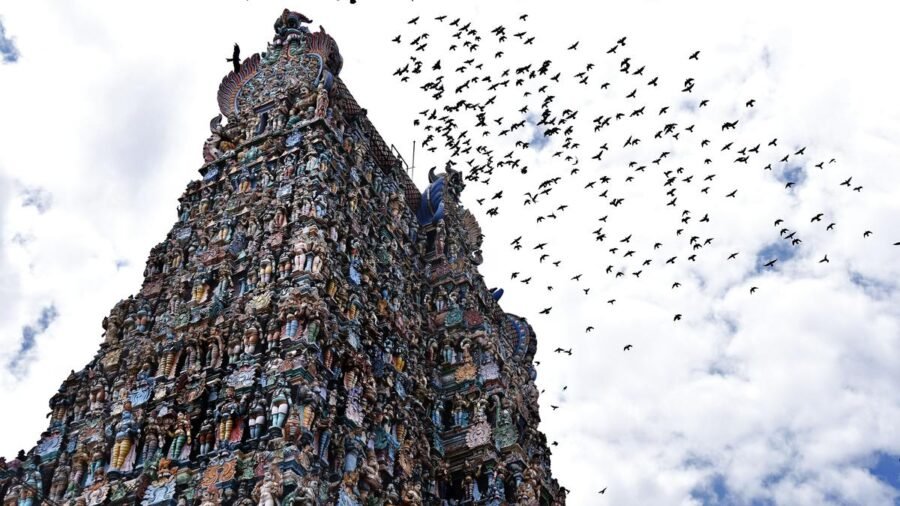
Goddess Meenakshi is revered by the people of Madurai as their queen (Maduraiyin Rani or Arasi in Tamil), but what draws thousands of devotees from across the world to the Meenakshi-Sundareswarar Temple each day is its audacious architecture. Far more than a place of worship, the sprawling complex is a marvel of sacred design. It boasts 14 gopurams, including four towering raja gopurams at its eastern, western, southern and northern entrances; gold-plated vimanas above the sanctums of Sundareswarar and Meenakshi; the famed Golden Lotus Tank; and a train of magnificent mandapams. Built of granite, these halls are grand edifices supported by massive pillars and adorned with life-size sculptures, intricate carvings, friezes, murals and, most importantly, inscriptions. Equally striking is the Indra Vimanam above Sundareswarar’s sanctum, held aloft by eight silver-coated elephant sculptures.
The Cholas, the Pandyas, the Vijayanagara rulers and the Nayaks contributed to transforming the Meenakshi-Sundareswarar Temple into the spectacular complex it is today. The Nayaks, who presided over the temple’s final great phase of architectural expansion, left the most visible imprint. Viswanatha Nayak, the dynasty’s founder, Tirumalai Nayak and Rani Mangammal renovated and extended the temple, building several mandapams and introducing the distinctive composite pillars featuring yalis and human figures. The inscriptions recording the Cholas’ contributions, however, were lost during later Nayak-era renovations. Interestingly, epigraphist and scholar C. Santhalingam points out that “none of the Chola kings are known to have entered the temple, though the reason remains unknown. There was intense hostility between the Cholas and the Pandyas for about 200 years.”
The 1000-pillared mandapam inside the Madurai Meenakshi Sundareswarar temple.
Courtesy: The Goddess’ Realm
One of the most striking features of the temple are its mandapams — Ashta Shakti, Meenakshi Nayak, Mudali Pillai, Unjal, Veerappa Nayak, Veera Vasantha Raya, Kalyana, 16-pillared, 1000-pillared, Sangathar, 63-Nayanmars, Nagara and Pudhu mandapams. Among these, the 1000-pillared and Pudhu Mandapams are renowned for their extraordinary architecture and breath-taking sculptures.
The Ashta Shakti Mandapam, located on the eastern side, serves as the main entrance to the temple. Apart from featuring the sculptures of dwarapalakis and eight forms of Shakti, it also houses sculptures of Tirumalai Nayak and his two wives, Rudrapathi Ammal and Dhoni Ammal, who built the mandapam. According to Porchelvi Jeyapraksh, a scholar on the temple, the mandapam was built when the Shakti cult was dominant in Tamizhagam. “There is no temple, other than this one, which has a mandapam dedicated to Ashta Sakti”, she says.
The sculptures of Viswanatha Nayak (left), founder of the Nayak dynasty, and Perumal in the northern corridor of the Golden Lotus Tank with the southern rajagopuram in the background.
Courtesy: The Goddess’ Realm
As you walk out of the Mudali Pillai Mandapam, the Golden Lotus Tank (Potramarai kulam) confronts you. The tank is 200 ft long and 148 ft wide, with a total water spread area of 29,600 sq ft. Who excavated the tank is a mystery. Legend has it that, the tank served as the sacred site for many of Shiva’s 64 divine games knowns as Tiruvilaiyadalgal. He enacted these to bless his devotees, test their faith and establish righteousness. Though Meenakshi translates to the fish-eyed one, the temple tank has no fish, and it is attributed to Shiva’s boon to a devoted stork.
The pillars on the northern corridor have intricate stone carvings of Sangam-age poets, holding palm leaf manuscripts and a stylus. It also features sculptures of Viswanatha Nayak, and Perumal, who built the corridor.
A series of paintings displayed on the walls of the 1000-pillared mandapam inside the Madurai Meenakshi Sundareswarar temple.
Courtesy: The Goddess’ Realm
On the western side of the tank is the Unjal Mandapam, built in 1653 by Chettiappa Nayak. Its ceiling and walls are decorated with exquisite murals, created during the rule of Rani Mangammal. Says S. Kannan, former associate professor of History, Annamalai University, Chidambaram, “the paintings are based on three themes: The wedding of Meenakshi and Sundareswarar witnessed by Rani Mangammal, her minister Ramappaiyer and grandson Vijayaranga Chokkanathar; Rani Mangammal receiving the royal sceptre from the goddess; and Parvati’s dik vijayam.
One then reaches the sanctum of Goddess Meenakshi, which, according to C. Santhalingam, was built in the 12th century CE during the reign of Kulasekhara Pandya. Until then, Meenakshi did not have a separate shrine. During the 7th century CE, when the famous Saivite saint Thirugnanasambandar visited and sang verses (Tevaram) praising the deity, Meenakshi did not have her own shrine. Instead, an idol of Angayarkanni (the one with fish-like eyes) was installed in the sanctum of Alavay Annal, as Sambandar called Chokkar or Shiva.
A sculpture inside Meenakshi temple shows how people committing crimes were punished.
Courtesy: The Goddess’ Realm
The temple is believed to be about 1,800 years old. While Sangam-age works such as Madurai Kanchi and Purananooru, as well as the post-Sangam Paripadal, refer to a Shiva temple in Madurai, none mentions the present Meenakshi-Sundareswarar Temple. (The Sangam era was extant from third century BCE to third century CE). It is Sambandar, who, in his Madurai decads (Madurai Padhigams) describes the temple’s architectual layout, its location on the southern bank of the Vaigai river, and the long compound wall (neel madhil). He also talks about the Pandya king Ninraseer Nedumaran, his queen Mangayarkarasi and his minister Kulachirayar worshipping at the shrine of Alavay Annal. Tirunavukkarasar alias Appar, another revered Saivite saint and a contemporary of Sambandar, too has sung decads about this temple.
From a simple brick structure with a couple of towers in the 7th century CE, the Meenakshi-Sundareswarar temple has today metamorphosed into a massive temple complex over 15.37 acres
Archives
From a simple brick structure with a couple of towers in the 7th century CE, the Meenakshi-Sundareswarar temple has today metamorphosed into a massive temple complex over 15.37 acres. Besides the main sanctums, it also now has separate shrines for Mukkuruni Vinayagar, Nataraja (depicted in a rare posture with his right leg raised and balancing on his left), Ellam Valla Siddhar, Bhikshatana, Saraswati and Subrahmanya.
To appreciate its grand architecture, mention should be made about the Kambathadi Mandapam, in front of Sundareswarar’s sanctum. Built by Nattukkottai Chettiars or Nagarathars in 1870, on its eight pillars are a large panel depicting the Sundareswarar-Meenakshi marriage, with Vishnu, her brother, consecrating the wedding. “There are 25 sculptures of Shiva on these pillars representing his anugraha, samhara and nritta aspects. Their iconography is distinct from Nayak-period sculptures. The Kambathadi sculptures are heavily ornamented and characterised by cleft chins, razor-sharp shin bones and bulging kneecaps,” adds Prof. Kannan.
Sculpture of Meenakshi-Sundareswarar kalyanam seen at the Maha Mandapam inside the Madurai Meenakshi temple.
Archives
The temple had faced debilitating vicissitudes from three Delhi Sultanate invasions by Malik Kafur in 1311, Khusroo Khan in 1314 and Ulugh Khan in 1323. Parakrama Pandya, who built the west raja gopuram, valiantly fought the invaders but fled to Kalaiyar Kovil during the third invasion. The invaders ransacked and looted the Madurai, Srirangam and Chidambaram temples. The Meenakshi-Sundareswar temple was shut down for 48 years from 1323 to 1371.
The Vijayanagara army commander, Kumara Kampanna, arrived in Madurai in 1378 and drove out the invaders. Madurai was liberated and worship revived in the temple, whose mahakumbabishekam was performed yesterday after a gap of 17 years.

Delhi court grants bail to U.S. national Van Dyke’s in terror-conspiracy case
By Sohail Khan · 18 Sep


Leave a Reply