‘Limits to what two of them can agree upon’: Jaishankar after Trump-Xi meet
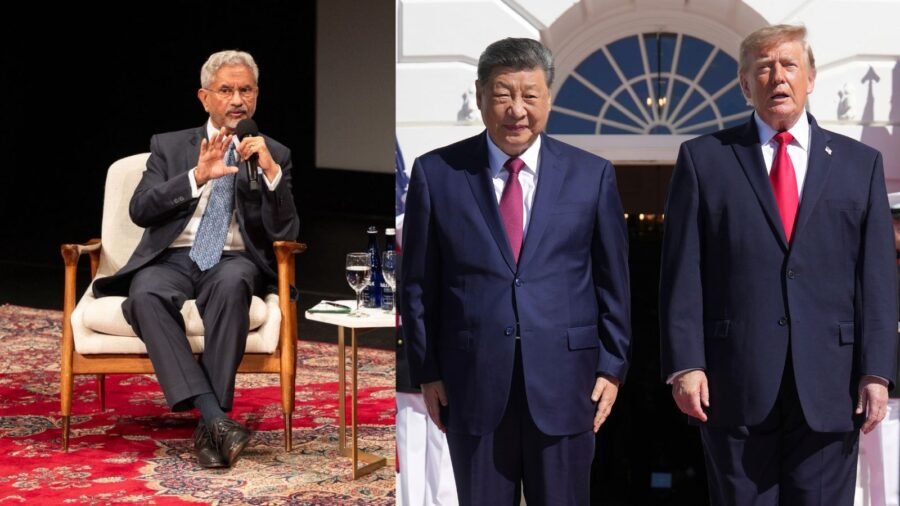
Days after the meeting between US President Donald Trump and Chinese President Xi Jinping, External Affairs Minister S Jaishankar has given his first assessment of the US-China meeting. The minister said on Monday that the two countries are in a competitive mode, and all other countries, including India, are looking to “de-risk” and “diversify” to manage ties.
Jaishankar also talked about the complex nature of the Indo-US trade deal negotiations, but said they have reached a situation where there is “more or less an understanding on the trade agreement”.
Flagging terrorism emanating from Pakistan as one of India’s key concerns, the External Affairs Minister also said that if “something which matters deeply to us” is not fully appreciated by the US, it has an impact on the relationship.
Story continues below.
Subscribe to see fewer ads.
The External Affairs Minister was speaking at the Asia Society Policy Institute in New York after a week of high-level diplomatic engagements at the UN.
Referring to the ‘G2’ meeting between US President Trump and Chinese President Xi last week in Washington, Jaishankar said that when the second-most consequential economy joins the first, “while they may have their points of convergence, overall they are in a competitive mode”.
“There are limits to what the two of them can agree upon vis-a-vis the rest of the world. And that then leaves the rest of us and the rest of us are coming to terms today with a very different America, with the fact that there is also today a certain conversation taking place between America and China,” he said, adding that the rest of the world is busy making its arrangements.
“Each one of us is looking for our optimal solutions. How do we de-risk? How do we diversify? Which are the new partners? Where do we get more value out of an existing partnership? We are really looking today at a difficult global situation. But as always, countries respond, they calculate, they adjust, they find new accommodations, they find new solutions, and that is how the international order develops, and it is that development today that I think the UN is a witness to,” he said.
Story continues below this ad
Jaishankar pointed to “stakes” and “complexity” involved in India-US trade negotiations. “Bear in mind, India is a society of small producers, small agriculture producers, small factories. Apart from the per capita gap between India and the United States, the nature of production, nature of society is very different.”
“A trade negotiation required a certain amount of… patience and detailing to see it through. The expectation that it could rapidly move forward, I think, was tested against a ground reality which was much more complex,” he said.
“Today, we have reached a situation where there is more or less an understanding on the trade agreement,” he added.
On Pakistan, Jaishankar said, “What for us in India is particularly important is the issue of terrorism. That we feel that… as a country perhaps there are very few countries which have been subjected to the kind of terrorism that we have from a neighbour as part of a deliberate, conscious policy over many, many decades.”
Story continues below this ad
“Now, if something which matters so deeply to us, there isn’t enough understanding or appreciation or empathy of that, I think that creates a problem too. That you know if… one of my primary concerns is not fully appreciated by my partner, then clearly there is an impact of that on the relationship,” he said, referring to the ties between India and the US.
In first electoral test since May win, UDF loses 3 seats in Keralam local bodies bypolls
By Sohail Khan · 29 Sep
Assam Rifles team ambushed by militants in Arunachal Pradesh; 1 jawan killed
By Sohail Khan · 29 Sep
Before Ujjain violence, some local influencers went into rumour overdrive, police say
By Sohail Khan · 29 Sep
Leave a Reply