India’s street food paradox
Benchmarks
Nifty23,346.4075.81
FEATURED FUNDS★★★★★
Motilal Oswal Midcap Fund Direct-Growth
5Y Return
22 %
Invest Now
Enter search text:
Business News›News›India›India’s street food paradox: Cleaner cities, but where do vendors go?
Read Today's Paper
India’s street food paradox: Cleaner cities, but where do vendors go?
Synopsis
India’s street-food vendors are facing tighter enforcement as cities reclaim pavements and push for cleaner public spaces. But without designated vending areas, basic infrastructure and consistent regulation, thousands of small businesses risk being pushed further into informality. From Mumbai to Singapore, the challenge is balancing hygiene, accessibility, livelihoods and urban planning.
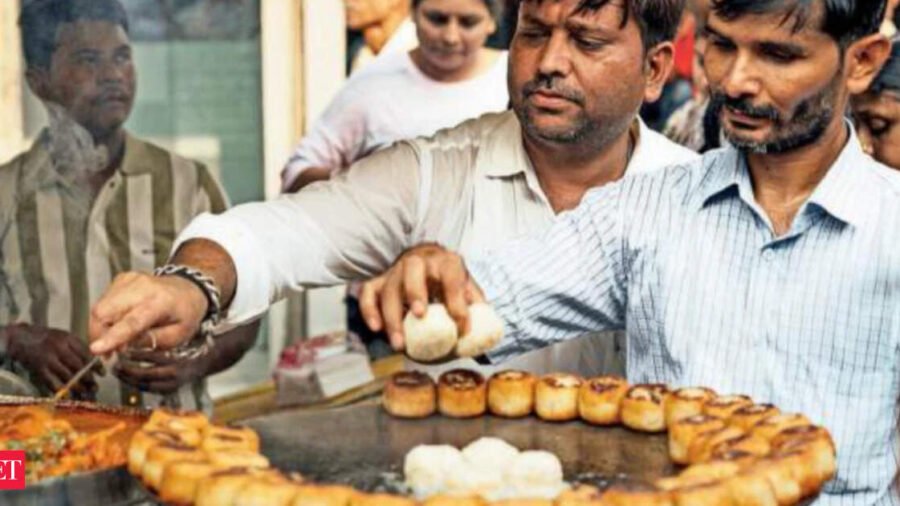
India’s street-food vendors face a growing squeeze as cities enforce cleaner public spaces without always providing the infrastructure and designated areas needed to keep their businesses viable.
Every morning at around 8:30, Vijay Raut starts selling his cutting chai in Mahim, Mumbai. Taxi drivers stop for a glass. Construction workers come for a quick cuppa before work. Over the seven years he has been selling tea here, em- ployees from a nearby bank have grown to know him well, and made him the regular supplier of tea, twice a day.
For the past month and a half, however, his biggest problem has been finding a place to sell tea. The ramshackle wooden structure from which Raut operated was taken away by the Brihanmumbai Municipal Corporation (BMC) during its recent en- forcement drive tackling illegal pavement encroachment.
“I eventually got it back after paying a fine of Rs 1,100 apart from bearing the cost of transporting it,” says Raut. But he is afraid of putting it back up. The tea, however, has not disappeared. Nor have his customers, who still need their morning chai. “Now I carry tea in a flask, serving customers for a limited period,” he says. Raut’s wife is eight months pregnant.
His father is in intensive care. He has regular customers. But the structure that housed his business is no longer secure because his business is, at the end of the day, illegal. Therein lies a bizarre paradox playing out across cities, from Mumbai to Bengaluru to Thiruvananthapuram. Street food vendors occupy an uneasy place in India’s cities: essential to everyday life, but with little clout.
They are housed on foot- paths, which are being reclaimed for pedes- trians. They also carry a reputation for being dirty, which has made them an obvious tar- get of food safety drives. The story of Raut and many like him ex- poses the weakness of a system that has allowed vendors to operate without secure spaces, basic infrastructure and consist- ent oversight. While cities are trying to make public spac- es cleaner and safer, they may be undermining small businesses and affordable food networks for millions. Solving this is critical to designing an inclusive, clean and equitable urban landscape.

Street food destinations
BIG PLATE
India has one of the world’s richest street food traditions, ranging from vada pav, medu vada and bhel to golgappa, kebabs to chaat. Street food is cheap, accessible and deeply tied to the cultural identity of cities. For millions, street food is not an occasional indulgence. It is breakfast before a train, a vada pav between shifts, dosa on the way to work, a sandwich at lunchtime, noodles after a late shift, or cutting chai between two meetings.
For workers, students, taxi drivers and commuters living on tight budgets, street food solves two problems at once—it is affordable and accessible. It is also an enormous informal economy. The National Association of Street Vendors of India (NASVI) said in 2021 that “10 million vendors in India make up a thriving street vendor market estimated to be at around Rs 8,000 crore daily”.
For comparison, Jubilant FoodWorks, one of India’s biggest restaurant companies, reported revenues of Rs 9,512 crore for FY26, which works out to around Rs 26 crore per day. While that establishes the scale of the street food market, it also underlines a key issue. The informal nature of the ecosystem means these vendors work outside the system. That has positives for those who grab grub at these joints, as prices don’t have to factor in compliance. As architect and urban planner Chandrashekhar Prabhu says, “The mo- ment you put them in the formal sector, they have to pay rent, taxes, electricity and water charges, which makes them expensive. The moment they become expensive, they will not be catering to the kind of economic strata they are supposed to cater to.”
NEEDED: CLEANLINESS
Food safety infra is rarely built into the price either.
There are genuine hygiene risks with street food. Lolly Mukesh Jain, professor in the de- partment of microbiology, KJ Somaiya College of Science and Commerce, Mumbai, says street food risks come from contamination, microbial multiplication and survival of microorganisms.
Unsafe water, raw ingredients, hands, uten- sils, insects, dust and dirty surfaces can in- troduce contamination. Cooked foods such as rice, gravies, dairy products and chutneys become particularly vulnerable when kept for long periods at room temperature. But Jain says the location of food is not what determines safety. With basic infra- structure and training, she says, a well- designed street food stall can achieve food safety standards comparable to a small restaurant.
A street food stall does not need a restau- rant-style kitchen. It needs potable water, soap-based handwashing facilities, clean utensils and surfaces, separation of raw and cooked food and temperature control. India’s food safety regulator, the Food Safety and Standards Authority of India (FSSAI), already has hygiene require- ments for small food operators and street food vendors. Its Clean Street Food pro- gramme focuses on training and capacity- building alongside regulation. From April 1 this year, FSSAI’s revised li- censing framework also raised the annual turnover threshold for basic food business registration from Rs 12 lakh to Rs 1.5 crore. In theory, this should reduce compliance costs for small businesses.
In 2025, FSSAI said it had worked with BMC to train more than 4,000 street vendors, self- help groups and mid-day meal providers, as part of an initiative targeting 10,000 vendors across Mumbai. Vendors who are registered under the Street Vendors Act through municipal corporations or town vending committees are deemed registered under the FSSAI framework, subject to hygiene and sanitary requirements. But most of this remains on paper.
WHOSE SPACE IS IT?
There is another unresolved question: Who has the legal right to oc- cupy public space? Prabhu points out, “Footpaths are for pe- destrians, not ven- dors.” He talks about spaces like Nariman Point in Mumbai which, when it was planned, did not have any space for vendors. “Then a decision was taken to keep some space behind the Air India building for peo- ple to have street food.” But such places are rare, and vendors across India end up occupying pedes-trian space.
The Street Vendors (Protection of Livelihood and Regulation of Street Vending) Act, 2014, does provide a frame- work for recognising and regulating ven- dors. “But Mumbai’s street-vending system is still struggling to fully implement it,” says a person close to vendor licensing, who didn’t want to come on the record. Queries sent to BMC and FSSAI went unanswered. Simply put, regulation without infra- structure can push vendors further into informality, not eliminate problems.
LOOK EAST FOR ANSWERS
Italian chef Adriano Baldassarre, who has a Michelin-starred restaurant, Tordomatto, in Rome, has fond memories of Indian street food. He spent nearly 12 years in India and also worked as a private chef for the Ambani family. He recalls eat- ing chaat on Delhi’s streets and ap- preciates their authentic- ity. His most vivid memory is being served samosas in a newspaper.
Hygiene remains a concern. But for Baldassarre, the answer is not to eliminate street food. Vendors, he believes, “can be better sup- ported to improve hygiene while retaining the authentic- ity and taste that make Indian street food distinctive”.
Is there a way out? Looking East would be a good starting point. Across most of Asia, from Japan and China to Taiwan, Thailand and Singapore, street food is an important part of the urban fabric. Even Singapore, with limited real estate and high cleanliness quotient, did not eliminate its hawker culture in the name of hygiene. It instead moved vendors into regu- lated, purpose-built centres with water, drainage, waste management and other ba- sic facilities.
As Andrew Tam wrote in an article in Gastronomica, “Hawking in Singapore was initially seen as a nuisance that had to be tolerated and later regulated by both the colonial administration and newly in- dependent government. The relocation of hawkers to centralized food centers marked the imposition of order and hy- giene onto a squalid industry.”
Malaysia has similarly developed hawker centres and food courts, while Vietnam has experimented with designated areas and food safety oversight. Street food in many of these cities is a legit tourist attraction. So much so that the purveyor of great grub, the Michelin Guide, has a specific recognition, Bib Gourmand, for such eateries. Michelin says the approach demonstrates that “quality is not defined by the setting, but by the food itself”, and that exceptional cuisine can be found “from street stalls and neighbourhood eateries to some of the world’s most renowned restaurants”. Singapore’s hawker culture, it says, is a strong example.
The reality is that the demand for street food is not going away. India will continue to eat on its streets. The question is whether its vendors will still have a place there, says Baldassarre. India cannot simply copy global models. Its streets are more crowded, its vending economy more informal and its history different. But the comparison raises the possibility that regulation does not necessarily have to mean disappearance.
India’s challenge is therefore larger than ensuring a chai seller, sandwich maker, or noodle vendor has a licence. “It is whether the city can create a system in which street food is safer without making the people who sell it invisible,” says Baldassarre.
SURVIVAL MODE
For now, vendors are in survival mode. Vinita Shinde once sold Chinese food from a makeshift stall in Dadar in Central Mumbai, working from morning till 11 at night. On a single stove, she prepared noodles, manchurian and fried rice, tossing vegetables and tur ning out orders. She was the only earning member in her family. Her routine has changed over the past few weeks: “I am preparing a few dishes closer home and serving customers for just two-three hours.”
Her business continues, but at a much smaller scale. Then there is Manjunath Shirodkar, a sandwich seller from Prabhadevi in south Mumbai. For years, he sat at a familiar spot facing the main road. “Now I prepare chutney and vegetables at home, carry them to the old location, serve my regular customers and leave in a jiffy,” says Shirodkar. The vendors make less money because they don’t have the space they used to. To meet household expenses, including his wife’s medical costs, Shirodkar has start- ed delivering vegetables and milk in the morning and evening.
A coconut-water seller near Dadar has found another workaround. After being moved from his regular spot, he now brings a few coconuts and sits inside a nearby shoe shop, where regular clients come looking for him. He charges a premium, but customers continue to buy. For years, say vendors, enforcement was something they negotiated around. Carts would be seized, fines paid and businesses resumed. Some say they rou- tinely paid enforcement officials to keep selling from their spots. Now, they say, it feels different.
Add 

(You can now subscribe to our WhatsApp channel)
(You can now subscribe to our WhatsApp channel)
Read More News on
vada pavstreet vendorsshirodkarfssaibmcvadamichelinbaldassarremumbaithiruvananthapuram


Enter search text:
Continue reading with one of these options:
Limited Access
Free
Login to get access to some exclusive stories
& personalised newsletters
Login Now
Unlimited Access
Starting @ Rs120/month
Get access to exclusive stories, expert opinions &
in-depth stock reports
Subscribe Now
ET
Unlock Access to All Exclusives with ETPrime FREE TRIAL
15 Days Free: Unlock All ETPrime Exclusives, Market Tools & ePapers
Trial offer expiring in00 : 05 : 00
I'd rather pay ₹2599 now


Uh-oh! This is an exclusive story available for selected readers only.
Worry not. You’re just a step away.

Prime Account Detected!
It seems like you're already an ETPrime member with
Login using your ET Prime credentials to enjoy all member benefits
Log out of your current logged-in account and log in again using your ET Prime credentials to enjoy all member benefits.
Unlock ETPrime's Exclusive Stories Today!
Subscribe to gain powerful insights on business, stock market and industry trends.
Big Price Drop! Flat 40% Off
Student Only Offer
Already a Member? Sign In now
Already a Member? Sign In now
Already a Member? Sign In now
Offer Exclusively For You
Save up to Rs. 700/-
ON ET PRIME MEMBERSHIP
Avail Offer
Offer Exclusively For You
Get 1 Year Free
With 1 and 2-Year ET prime membership
Avail Offer
Offer Exclusively For You
Get 1 Year Free
With 1 and 2-Year ET prime membership
Avail Offer
Offer Exclusively For You
Get Flat 40% Off
Then ₹ 1749 for 1 year
Avail Offer
Offer Exclusively For You
ET Prime at ₹ 49 for 1 month
Then ₹ 1749 for 1 year
Avail Offer
Special Offer
Get flat 40% off on ETPrime
Avail Offer
Avail Offer
Claim NowAlready a Member? Sign In now
Need Assistance?
Connect with an ETPrime expert for personalized support and guidance
+91 9484700004
' + h3 + '
' + h4 + '
- ' + listing + '
What’s Included with

1Exclusive Insights That Matter
Uncover the truth with our investigative stories
Make strategic moves using the real-world case studies
Read industry-specific stories to identify emerging trends
Spot opportunities with in-depth insights that matter

Trump temper on H-1B visas is forcing Indians to do these things to stay put in US

What Adani’s US indictment means for India Inc’s overseas fundraising

Why veterans like Reliance, L&T are on acquisition spree? Aswath Damodaran has an answer.

Will China’s dollar bond sale in Saudi Arabia trump the US in financial world?

Huawei launches its own OS to compete with Google and Apple. But can it win beyond China?

The problem with lab grown diamonds

Why a falling rupee is a better option for the economy

A list of top 20 momentum stocks that have delivered massive returns in one year
2Invest Wisely With Smart Market Tools & Investment Ideas
Alpha Trade

Get daily trade ideas from SEBI-registered research analysts.
Investment Ideas

Grow your wealth with stock ideas & sectoral trends.
Stock Reports Plus

All-in-one stock research with Stock Score, peer comparison & key signals.
BigBull Portfolio

Get to know where the market bulls are investing to identify the right stocks.
Stock Analyzer
Check the score based on the company's fundamentals, solvency, growth, risk & ownership to decide the right stocks.
Market Mood

Analyze the market sentiments & identify the trend reversal for strategic decisions.
Stock Talk Live at 9 AM Daily

Ask your stock queries & get assured replies by ET appointed, SEBI registered experts.
3Stay informed anytime, anywhere with ET ePaper
ePaper – Print View

Read the PDF version of ET newspaper. Download & access it offline anytime.
ePaper – Digital View

Read your daily newspaper in Digital View & get it delivered to your inbox everyday.
Wealth Edition

Manage your money efficiently with this weekly money management guide.
4Times Of India Subscription (1 Year)
ePaper

Read the PDF version of newspaper. Download & access it offline anytime.
Deep Explainers

Explore the In-depth explanation of complex topics for everyday life decisions.
Health+ Stories

Get fitter with daily health insights committed to your well-being.
Personal Finance+ Stories

Manage your wealth better with in-depth insights & updates on finance.
New York Times Exclusives

Stay globally informed with exclusive story from New York Times.
5Enjoy Complimentary Subscriptions From Top Brands
Docubay Subscription

Stream new documentaries from all across the world every day.
Stories you might be interested in

UPI’s new MDR pot gets a small merchants twist
By Sohail Khan · 20 Sep
‘Viksit Bharat depends on Viksit Rajya’: CEA
By Sohail Khan · 20 Sep
Smriti Mandhana now WT20I’s leading run-scorer
By Sohail Khan · 20 Sep
Leave a Reply