India’s cities are booming. Their governments aren’t
Synopsis
As key contributors to national economic growth, Indian cities face challenges in governance due to unfulfilled promises of devolving powers to local governments since 1992. To strengthen city management and fiscal strategies, three reforms are essential. Enhancing coordination and stabilizing state-city financial transfers are critical first steps, alongside empowering cities to independently raise funds, which is crucial for their development.
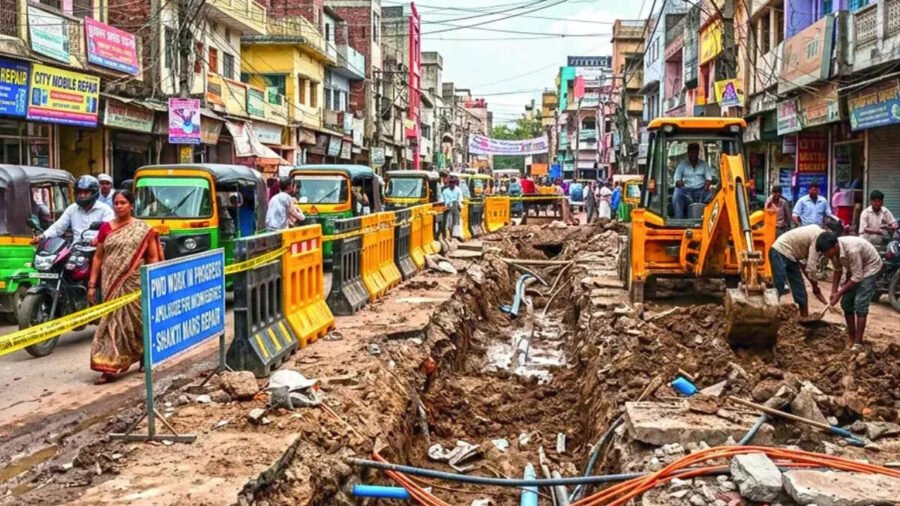
Washington DC: Every monsoon, urban residents witness a familiar scene. A road gets resurfaced. A week later, it's ripped open to lay a pipe. The agency that built the road and the one that laid the pipe answer to entirely different departments and have no coordination.
This is a symptom of a system in which states retain control over the functions cities need to operate. Devolving functions, funds and functionaries to elected city governments was the promise of the 74th Constitutional Amendment in 1992. The promise remains largely unfulfilled. Cities drive state economies, and getting states to surrender constituencies they have cultivated for decades is a tall ask.
Findings of the latest census underway should confirm what research has long suggested: India is not 'becoming' urban. It already is. Using satellite data, Economic Survey 2025-26 found India was 63% urban a decade ago, double the 2011 census figure. The census will redraw electoral boundaries, and more urban seats may yet force what voluntary devolution has not. But votes alone won't fix coordination gaps, weak fiscal transfers or thin planning capacity. Three targeted reforms can help bridge these gaps:
Fix coordination: Authority is scattered across municipal bodies, development authorities and parastatal agencies, with no single entity accountable for coordinating between them. NITI Aayog recommends a mayor-in-council system modelled on Kolkata, where states devolve functions like water and roads to department heads under a mayor who's directly elected, serves a fixed 5-yr term, and holds real executive power. Few states have moved in that direction.
Some states are finding workarounds. Karnataka's Greater Bengaluru Governance Act, in force since 2025, split Bengaluru into five corporations, each to be led by an elected mayor, placing Greater Bengaluru Authority above both corporations and parastatals. Mayoral elections are yet to be held. For the first time, agencies responsible for roads and pipes answer to the same office. But a CM-chaired authority stacked with state legislators leaves city mayors outnumbered rather than empowered.
Make state-city transfers predictable: State finance commissions (SFCs) are meant to set transparent formulas for how states share revenue with cities. But they are rarely formed, and their recommendations are consistently ignored. Only 9 out of 28 states have an active or recently constituted commission. The 16th Finance Commission has already made timely SFC formation and reporting a prerequisite for central grants. This single condition, if properly enforced, can compel fiscal devolution without requiring fresh legislation.
Give cities tools to raise their own money: Indian cities raise far less revenue than they potentially could. Property tax yields 0.12-0.15% of GDP against a developing-country average of 0.7%, largely a capacity problem according to RBI. Most cities lack GIS-based mapping, capital value-based assessments and digital collection infrastructure. This is not a separate problem from India's municipal bond market.
Property tax as a revenue stream is often the bedrock on which municipal bond markets and credit ratings for cities are based. Of roughly 500 cities rated under AMRUT, only about 35 reached A, or above. Since Sebi created the framework in 2015, just 22 municipal corporations have issued at all.
World Bank estimated in 2022 that India needs roughly $55 bn a year for urban infrastructure. The entire municipal bond market since 2015 comes to roughly $520 mn, about 1% of a single year's requirement.
Even the cities that have been able to raise the funds haven't always been able to deliver. Pune's landmark 2017 bond issuance raised funds that were unused for years because the 24×7 water project it was meant to finance didn't have the requisite land acquired. Project-readiness criteria before bonds are raised do matter. But only if cities are staffed with the planners, technical experts and debt managers to use them.
India's cities are its economic engine – and its weakest tier of government. The question is not whether they deserve to govern themselves, but whether they can begin the reforms needed without waiting for devolution that may never come.
The writer is senior fellow, Center for Strategic and International Studies (CSIS), Washington, US
(Disclaimer: The opinions expressed in this column are that of the writer. The facts and opinions expressed here do not reflect the views of www.economictimes.com.)
Add 

(Catch all the Business News, Breaking News, and Latest News Updates on The .)
…more
Elevate your knowledge and leadership skills at a cost cheaper than your daily tea.
-
Patent Cliff approaching: Can Indian pharma companies repeat past success? -
What LIC should do to remain money-spinner for govt, policyholders -
From survival to 193 mn subscribers: Is Vi finally making a comeback? -
ET Prime special series: 2013 to 2026. Not years, but evidence: Power Grid, Part 2 -
Behind the sugar price drop: Exports, imports and a non-factor called ethanol -
As IndiGo, Air India scramble for pilots, fresh headwinds hit hard -
When a CFO resigns, is ‘personal reasons’ explanation enough? -
FCNR (B) scheme garners USD65 bn, but why isn't the rupee gaining? -
ET Prime special: Bigger, Better or Both? Understanding business to figure out the mystery: Power Grid Corp – Part 1 -
US bond yield: Will it become a new pain point?

India invites bids for remaining raw sugar quota
By Sohail Khan · 2 Sep
Banks cut FCNR deposit rates by up to 310 basis pts
By Sohail Khan · 2 Sep
Ram Temple Trust to get 1st CEO on Wednesday
By Sohail Khan · 2 Sep
Leave a Reply