India rejected Indus Waters Treaty ruling. Why it still helps Pakistan
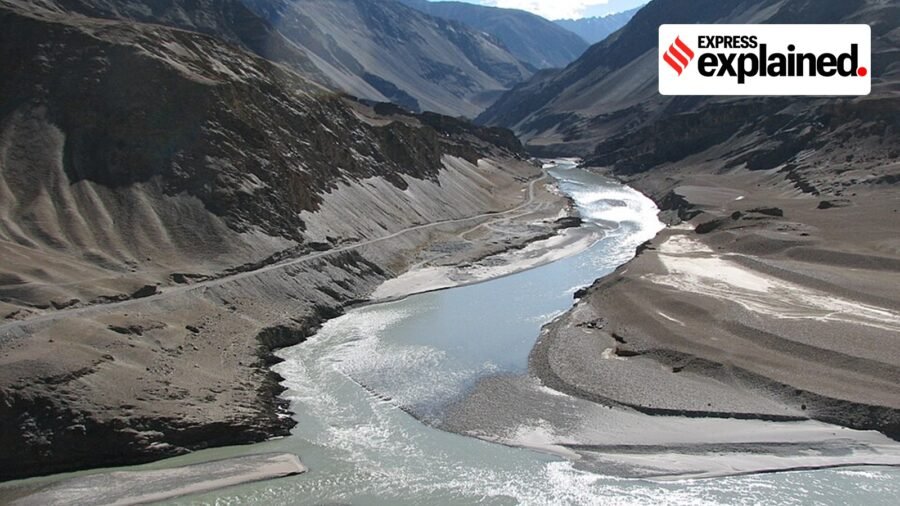
The Permanent Court of Arbitration, adjudicating on a dispute raised by Pakistan on the Indus Waters Treaty, has passed two more orders against India. It has ruled that India’s decision to put the Treaty in ‘abeyance’ was “not permissible under the Treaty or other applicable rules of international law”, and therefore the Treaty — which governs the sharing of six transboundary river waters between the two countries — remained “fully in force” and India continued to be bound by it.
Additionally, the Court also directed India to halt construction work at the Ratle Hydroelectric Project, as requested by Pakistan, till the technical dispute over it is finally settled.
The two orders were expected by the Indian government. India has not been participating in this arbitration process, underway for four years, having maintained that the Court was constituted in violation of the provisions of the Treaty.
Story continues below this ad
A neutral expert had already been appointed to adjudicate on the same issue, and the Treaty does not allow parallel resolution processes on the same dispute. As such, India said the Court lacked legitimacy and refused to recognise its existence or proceedings. It did not appoint its two arbitrators on the Court.
Nonetheless, having been constituted, the Court went ahead with its proceedings, with two arbitrators appointed by Pakistan, and three ‘umpires’ nominated by institutions mentioned in the Treaty.
India’s rejection
India’s reaction to the two orders on Monday was, therefore, on expected lines. “This so called Court was constituted by the World Bank in patent breach of the terms of the Treaty and India categorically rejects its so-called award… India has never recognised the existence in law of this illegally-constituted and so-called Court of Arbitration… India’s decision to hold the Indus Waters Treaty in abeyance remains in force,” the Ministry of External Affairs said.
The two set of rulings on Monday happened to be the fourth ‘award’ from the Court of Arbitration, all, unsurprisingly, going in favour of Pakistan.
Story continues below this ad
In its earlier ‘awards’, the Court, constituted in September 2022, has, among other things, declared itself to be competent enough to adjudicate on the matter, rejecting India’s arguments to the contrary made in a letter to the World Bank in December 2022, and also held that its decisions were final and binding upon the parties. India has rejected all the earlier ‘awards’ as and when they were made, the last one in May of this year.
With Monday’s order, the Court has likely finished its work, having addressed all the issues raised by Pakistan.
The Court has no means to get its orders enforced, and therefore, its orders will not bring about any material change in the prevailing situation on this issue, considering India’s position. For Pakistan, however, the Court orders are invaluable. It is almost sure to use these to rake up the issue at every relevant international forum, and also to drive up hysteria against India within the country. These orders are extremely important documents for it to explore further legal options at the international level.
Road ahead for Pakistan
The best case scenario for Pakistan would be to get the UN Security Council to pass a resolution against India, framing its dispute over the Treaty as a security issue. It has been working towards that aim, and is almost sure to take a shot at it during the remaining four months of its tenure as a non-permanent member of the Security Council. Another alternative would be to get the Security Council or the UN General Assembly to refer the matter to the International Court of Justice.
Story continues below this ad
These are extremely far-fetched scenarios, however, and unlikely to play out as per Pakistan’s desires. India has much greater clout at the UN, and can get such moves scuttled.
Besides these efforts, the only other option for Pakistan is to try and create a narrative, painting India as someone that does not respect international law or abide by treaty provisions. This is something that Pakistan is already indulging in, and the efforts are almost certain to intensify.
India has decided to absorb the repercussions of the decision. Besides creating a diplomatic counter-narrative, India is preparing to fight the legal battle, if it becomes necessary. It is not that India does not have a legal case, and it is confident that it can defend its decision to put the Treaty in abeyance.
Road ahead for India
But India’s main focus is on expeditious completion of the projects that will allow it to make full use of its rights on the three western rivers — Indus, Jhelum and Chenab — that have been allocated to Pakistan under the Treaty.
Story continues below this ad
The treaty provisions allow India to make limited use of these waters, but this has not been possible because of Pakistan’s repeated objections to anything that India tries to build on these rivers. India is pursuing eight infrastructure projects on these rivers in Jammu and Kashmir, worth Rs 50,000 crore. At least one of them, seeking to divert waters from the Chenab river to the Beas, goes beyond the provisions of the Treaty, which does not allow inter-basin transfer of waters.
India has made its decision. For it, the Indus Waters Treaty is as good as dead. ‘Abeyance’ is deliberately being used to keep it vague, since there is no provision to terminate or suspend the Treaty unilaterally. But as far as India is concerned, the Treaty does not exist.
That is the reason why India disengaged itself from the neutral expert process last year, which was set up on its own request. India continues to share hydrological data with Pakistan, but only through its high commission in Islamabad, and not through the Permanent Indus Commission set up under the Treaty. Continuing to participate in the neutral expert process or sharing information through the Permanent Indus Commission could be seen as utilising the provisions of the Indus Waters Treaty, which could be contrary to its position that it does not even exist.
It is also clear that the chances of the Treaty being revived in its original form are next to none. India has said the Treaty would remain in ‘abeyance’ till Pakistan continues to support cross-border terrorism.
Story continues below this ad
India has also suggested that the two countries renegotiate the Treaty, something that is likely to be unacceptable to Pakistan. Pakistan realises that it is unlikely to get a deal as good as the current one. Also, India is almost sure to insist on a strictly bilateral agreement, without the need for any third party like the World Bank, something Pakistan is unlikely to agree to.
Sharing without a Treaty
The treaty deadlock looks unresolvable in the foreseeable future. The transboundary rivers between India and Pakistan are most likely to continue flowing without any formal agreement on sharing of waters. This is not a unique situation. There are hundreds of instances across the world of transboundary rivers not governed by any water-sharing agreement. India shares rivers with each of its other neighbours — China, Bhutan, Nepal, Bangladesh and Myanmar — and most of these rivers have no formal water-sharing arrangement.
Keeping the Indus Waters Treaty in ‘abeyance’ does not mean India has stopped the flow of river waters to Pakistan. It cannot do that even if it wanted to. Pakistan is continuing to receive the river waters as it used to earlier. It would continue to get that even after India completes all the projects on the western rivers. Though the per capita water availability has gone down due to population pressures and climate change, the Indus river system still has sufficient water to cater to the needs of the people living in its basin in India and Pakistan.
The water problem in Pakistan is not because India has been stopping, or disrupting, the flows, but because of inefficient water management practices. The uncertainty injected by India’s decision to keep the treaty in ‘abeyance’ might actually force Pakistan to adopt better practices, create storage facilities, and use the water more judiciously.

Don’t buy a lab-grown diamond before checking these 7 things
By Sohail Khan · 29 Sep
Towards a gender just Uniform Civil Code
By Sohail Khan · 29 Sep
Essar eyes $18-billion US steel plant: Why Indian firms are investing in US amid tariffs
By Sohail Khan · 29 Sep