India-New Zealand FTA: Key tariff and visa rules
Benchmarks
Nifty23,414.3067.9
FEATURED FUNDS★★★★★
Motilal Oswal Midcap Fund Direct-Growth
5Y Return
22 %
Invest Now
Enter search text:
Business News›News›Economy›Foreign Trade›New Zealand route won’t help third-country goods claim India FTA benefits: Here’s what changes
Read Today's Paper
New Zealand route won’t help third-country goods claim India FTA benefits: Here’s what changes
Synopsis
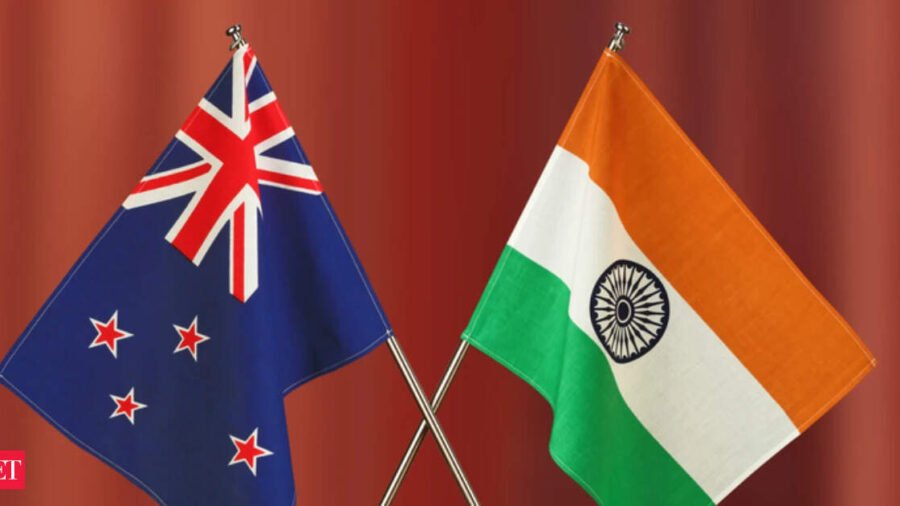
Under the India-New Zealand trade pact, goods from third countries will not be eligible for tariff concessions, with preferential treatment limited to products originating in India and New Zealand. India has protected sensitive sectors such as dairy and gems and jewellery from duty reductions. The agreement also introduces a temporary employment visa pathway for skilled Indian workers, along with provisions aimed at promoting student mobility and post-study work opportunities in New Zealand.
Third-country goods routed via New Zealand into India won't get FTA duty benefits
Goods from third countries entering the Indian market through New Zealand will not be eligible for tariff concessions under the bilateral free trade agreement between the two countries, according to the FAQs on the pact.
This ensures that the trade agreement's import duty benefits are available only to eligible India-New Zealand trade.
The FAQs said that the agreement provides only for bilateral cumulation (use of inputs from another country), which is strictly limited to originating materials and goods from India and New Zealand. Cumulation with third countries is not permitted.
On whether goods from a country other than New Zealand (that is, a third country) entering into the Indian market through New Zealand benefit from tariff concession under the FTA, the FAQs reply said "No".
"The FTA contains built-in safeguards to ensure that third-country goods cannot be routed through New Zealand to avail preferential tariff treatment in the Indian market," it said.
Under the pact, goods must satisfy stringent Rules of Origin to qualify as originating to avail preferential tariff concessions.
The pact, which was signed in April, will come into force on October 20.
EXCLUSION LIST:
India has completely protected its sensitive sectors in the FTA by not extending any duty concessions on those goods.
It included dairy products (milk, cream, whey, yoghurt, cheese); animal products (other than sheep meat); vegetables such as onions, chana, peas, corn, almonds; sugar and artificial honey; animal, vegetable or microbial fats and oils; arms and ammunition; gems and jewellery.
The list also includes copper and copper articles (cathodes, cartridges, rods, bars, coils); and aluminium and aluminium articles (ingots, billets, wire, rods, bars), among others.
TRADE REMEDIES:
The pact has provisions for the bilateral safeguard mechanism for 14 years after the customs duty elimination or reduction on a given originating good.
"This is of significance since it will protect the Indian industries, especially the MSME's, against such a sudden surge in imports from New Zealand for a long period after the customs duty elimination or reduction on a given originating good," it said.
SERVICES SECTOR:
There is a Temporary Employment Entry (TEE) visa pathway under this pact, created for qualified skilled Indian workers.
New Zealand has committed a quota of 5,000 visas at any one time, with a stay of up to three years in sectors of interest to India.
Of the 5,000 visas, 600 are for iconic Indian occupations, including Ayush practitioners (200), yoga instructors (100), music teachers (50) and Indian chefs (250).
The IT sector has a quota of 1,000 visas for software engineers, software and applications programmers and ICT project managers, while the engineering sector has another 1,000 visas for civil, mechanical, structural and environmental engineers.
The construction sector has 700 visas for construction project managers and building project managers, while the education sector has 500 visas for primary and secondary school teachers.
Similarly, the healthcare sector has the largest quota of 1,200 visas, including 900 for registered nurses across all categories and 300 for physiotherapists.
"New Zealand has committed to facilitate student mobility by maintaining no numerical limits on students' entry and locking in work rights of at least 20 hours per week for Indian students," it said, adding that Post-study work visas have been agreed for Indian students, allowing stays of up to 2 years for Bachelor's (with honours), 3 years for Bachelor's degrees in STEM and Master's degrees, and 4 years for Doctoral degrees.
New Zealand has also given a commitment that Indians granted temporary stay shall not be required to make contributions to New Zealand's directly funded social security schemes and concomitantly, they will not be eligible for associated benefits during the period of their stay.
Add 

(You can now subscribe to our WhatsApp channel)
(You can now subscribe to our WhatsApp channel)
Read More News on
India New Zealand FTAIndia New Zealand free trade agreementIndia New Zealand trade dealIndia New Zealand FTA tariff concessionsIndia New Zealand FTA Rules of OriginIndia New Zealand FTA exclusion listIndia New Zealand trade agreement October 20India New Zealand FTA third country goodsNew Zealand FTA visa quotaIndia New Zealand FTA services sector


Enter search text:
Stories you might be interested in

SC agrees to urgent listing of Mamata’s TMC plea
By Sohail Khan · 21 Sep
Fresh strikes deepen Pakistan-Afghanistan tensions
By Sohail Khan · 21 Sep
Srinagar court acquits Budgam man in UAPA case
By Sohail Khan · 21 Sep
Leave a Reply