In open letter, ex-BJP leader RK Singh drops big charge against CEC Gyanesh Kumar over SIR
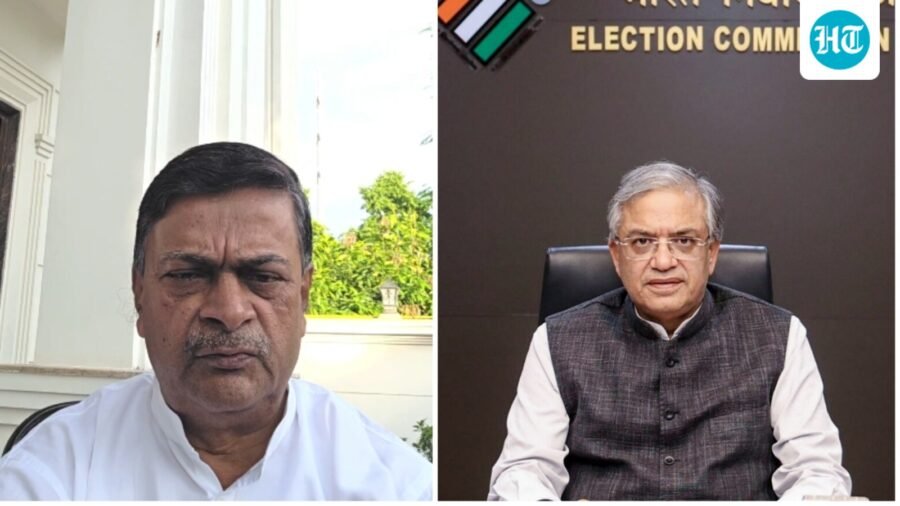
RK Singh, who served as Union power minister in Modi government, opened his letter with a blunt question on X. "Do you want India to remain a democracy?"
Updated on: Sep 29, 2026, 15:35:01 IST
Prefer HTon Google
Share via
Copy link
Former union minister Raj Kumar Singh on Monday accused Chief Election Commissioner (CEC) Gyanesh Kumar of breaking the law during the Election Commission's Special Intensive Revision (SIR) of electoral rolls, and of running a mission "to disenfranchise people".
In an open letter addressed to "all countrymen," Singh wrote that what Gyanesh Kumar "and his bosses" are doing in the so-called SIR needs to be understood
Congress leader Pawan Khera on Tuesday called it a "devastating indictment" of the poll body, giving the Opposition a new line of attack.
"When someone with his administrative experience and knowledge of the system raises these concerns, they cannot simply be dismissed as partisan rhetoric," Khera said, adding that Singh is a former BJP leader who "knows the system from the inside."
What RK Singh alleged
Singh, a retired IAS officer who served as Union power minister in the Modi government from 2017 to 2024, opened his letter with a blunt question on X. "Do you want India to remain a democracy?" he asked, before answering it himself: "They are violating the law."
In his post sharing the open letter, Singh tagged Cockroach Janta Party (CJP) founder Abhijeet Dipke and several others. The letter comes amid questions over the SIR exercise and reported disagreements within the Election Commission over electoral-roll decisions. The Supreme Court has also agreed to hear next week a plea challenging the functioning of the Election Commission under Gyanesh Kumar and the nationwide SIR.
The SIR is a door-to-door exercise in which the Election Commission of India (ECI) rechecks the eligibility of every voter on the rolls. The poll body began it in Bihar in 2025 and has since extended it to other states. The Opposition has alleged that it targets the poor, migrants and minorities, while the ECI has maintained that it is meant to clean the rolls of dead, duplicate and ineligible entries.
Singh's legal argument rests mainly on Sections 21 and 22 of the Representation of the People Act, 1950.
He said Section 21 allows a special revision only in special cases, for reasons recorded in writing, and only for a constituency or part of one. In his view, an order for the whole country was illegal. "An exception allowed for special cases cannot become the rule," he wrote.
He also questioned who took the decision. "Was it the full commission; or only Gyanesh Kumar," he asked, and said the Supreme Court order upholding the general SIR "was wrong."
Appeals pending, new rolls with deletions used anyway
Singh said Section 21 also requires the roll in force at the time of the revision notification to continue until the revision is complete, and that the revised roll is complete only after all appeals are disposed of. He argued that the new roll with deletions was used in elections while appeals were still pending. "This was illegal," he wrote.
On Section 22, Singh said only the Electoral Registration Officer (ERO) can remove a name, on limited grounds, after an inquiry, after a reasonable hearing and after appeals are disposed of. He accused Kumar of removing names "without any basis, without any enquiry, and without any show cause to the registered voters." Those removed had to reapply in Form 6 and prove their eligibility.
Singh said this goes against the Supreme Court's 1995 ruling in Lal Babu Hussain and Others v. Electoral Registration Officer and Others, which he said places the burden on the enquiry authority or the objector and not on the voter. "Here, Gyanesh Kumar has inverted the burden of proof," he wrote. He added that the mission of the Government and the ECI was earlier to enrol all eligible voters. "This is the first time in history of the country that the mission is to disenfranchise people," he said.
The letter also targets a new appendix to Form 6 that asks applicants for the serial number of their parents' entry in the 2003 roll. Singh said Kumar was not authorised to add it, as the form is mandated by statutory rules, and claimed it was added against the views of the other two Election Commissioners. "Where can an ordinary person, a young man of 18, access the 2003 roll in 2026?" he asked. He wrote that the move "stopped the registration of all young voters" and claimed that "BJP knows that young voters will not vote for it."
Singh raised a series of questions on bulk objections and appeals. On Form 7 objections, he asked: "Who filed them? How were the forms accepted and acted upon when the persons who signed it did not appear?" He said 16 lakh voters found valid by EROs in Bengal were not registered, allegedly because appeals were filed against them. "Who authorised the Commission to file appeals?" he asked, adding that two Election Commissioners say they did not do so.
He also asked how elections were allowed while lakhs of appeals were pending, saying "the ECI and the Supreme Court have to answer." He claimed that in appeals decided so far, 90% of the voters left out were found to be valid. In Goa, he said, 97 electors found fit by the ERO have still not been added to the roll.
Singh described the "logical discrepancy" test, under which a gap of under 15 years between father and child flags a record, as "ridiculous." He argued that poor children are often not born in hospitals and lack birth certificates, so they gave estimated years of birth. "They do not have calendars in their homes," he wrote. Names flagged this way were excluded without inquiry, he said, contrary to Section 21.
'Illegal immigrants not affected'
He rejected the argument that SIR is aimed at illegal immigrants. "The illegal immigrants are not affected," Singh wrote, saying they secure Aadhaar and ration cards soon after arriving. Poor citizens working away from home cannot spend a month getting registered. "Why should they sacrifice their daily wages for a vote?" he asked.
On centralisation, Singh said the digital roll was empowered to refuse additions and that revision was done centrally, though only the ERO is designated by law to add or delete names. He said two Election Commissioners pointed out that the ERO, the District Election Officer and the Chief Electoral Officer were not being allowed to access the voter list. "The centralisation of the voter list amendment is dangerous," he wrote, asking whether it could be used to cut voters from booths that vote against the NDA. He also called deleting names before verification "a heinous offence."
The numbers he cites are large. Singh said 13 crore names have been deleted so far, which he put at 13 per cent of voters, and that SIR is not over. The 13 per cent figure implies an electorate of about 100 crore. He noted that the gap between the NDA and the INDIA bloc in the 2024 elections was only 3%, which means the deletions are more than four times that margin.
Singh dismissed impeachment of the CEC as "an exercise in futility" because the Opposition lacks the numbers, and urged criminal cases instead. He called on all Opposition parties to refuse to take part in elections until the CEC and Election Commissioners resign and successors are picked by a panel of the Prime Minister, the Leader of the Opposition and a sitting Supreme Court judge. He also demanded fresh polls in states where appeals were pending, and a return to ballot papers "because no electronic system has yet been invented which cannot be hacked."
Question on SC
Singh was also sharply critical of the Supreme Court. He wrote that its judgment on SIR has "besmirched" its reputation and is "at par in infamy" with the ruling upholding the Emergency. He said the delay in hearing the challenge to the law on selecting Election Commissioners "is also sending a bad message," as it is "an open and shut case."
He ended with a call to action. "If we want to preserve our democracy the whole country will need to be made aware and united," he wrote.
Responding to the letter, Khera said its significance lies in who wrote it and how far its concerns reach. "His warning goes far beyond the mechanics of electoral rolls," he said, pointing to the threat to universal adult franchise that he said Singh has flagged. He said the Opposition's concerns about SIR are now being echoed by someone who knows the system from the inside.
The Congress eight concerns that he said Singh has flagged. These include a threat to universal adult franchise, violation of electoral law and procedure, centralisation of electoral power, and denial of natural justice through arbitrary procedures. He said the letter also points to barriers that can disenfranchise young voters, technical criteria weaponised against the poor, a disproportionate impact on migrants and marginalised citizens, and serious questions over the ECI's institutional independence and political interference.
See Less

Veli-Kadinamkulam solar boat service to begin from September 30
By Sohail Khan · 29 Sep
No takers for 218 posts in Bihar govt’s Science & Technology department: BPSC
By Sohail Khan · 29 Sep
10 military-grade drones seized from three Indian passengers at Delhi airport
By Sohail Khan · 29 Sep
Leave a Reply