In great powers’ AI race, New Delhi’s place will depend on capabilities built at home
Advertisement
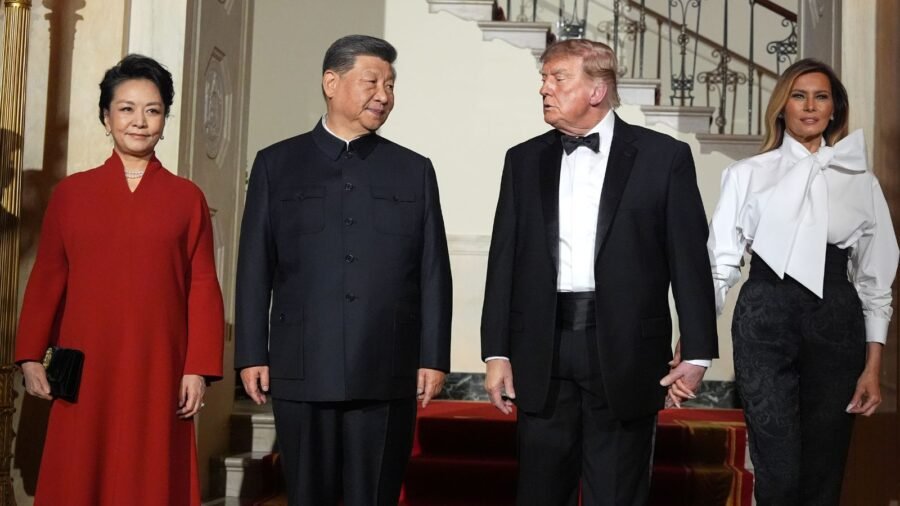
The difference reflects two outlooks, apart from Donald Trump’s idiosyncrasy. At the UN, Trump said he would “only encourage super intelligence… not rein it in”, watching it “through the Department of Justice”. His language is of a race to be won. Xi’s is one of control. At the White House, he urged the two countries to “ensure that the development of AI is always under human control”.
Xi also told Trump the two should “play to their strengths rather than guard against each other”, a clear shot at American export controls. He offered a new framing of the relationship: Cooperation as the mainstay, competition within limits, differences under control, peace within reach. He called the rivalry “a race of catching up with one another, not a wrestle in which one either wins or loses”. Beijing now accepts competition, but as a race in which China is closing the gap.
For all the talk of risk, neither government wants to slow the frontier, though for different reasons. Trump calls the case for a slowdown a “hoax”. For him, frontier AI is a race with China, to be policed afterwards by prosecutors, not in advance by regulators. Beijing reads the American safety debate as containment in disguise. Global Times called Amodei’s essay a “Cold War script” from America’s “tech right”: Widen the gap by restricting China, then negotiate a mutual slowdown from strength. Yuyuan Tantian, a China Central Television-affiliated outlet, accused Anthropic of using “safety” to capture rule-setting and of recasting distillation as a security threat to curb China’s open-source models. The foreign ministry dismissed the warnings as “fear-mongering”.
Advertisement
Beijing is not indifferent to risk, but its list of risks is its own. Writing in China Cyberspace, Minister of State Security Chen Yixin calls AI “the main battlefield” of global scientific and technological competition and “a new arena for strategic rivalry among major powers”. First on his list of dangers is AI’s “systemic” effect on the “political security environment”, Party shorthand for regime security. Its brakes are political, applied through Party control over labs. They restrain what models may say, not how fast capability grows.
The missed opportunity is on nuclear weapons. At Lima in November 2024, Joe Biden and Xi “affirmed the need to maintain human control over the decision to use nuclear weapons”. Never formalised, it found no mention in either factsheet this week. The one security outcome, a military memorandum on crisis communication, appears only in China’s list.
The reality is competition, and it will not change. Washington will guard its narrow lead through chip controls, action against distillation and Pax Silica supply chains. Beijing will push for self-reliance in chips and spread its open-weight models worldwide. Tsinghua’s Da Wei concedes that neither side can build an “iron shirt” against the other. Dialogue may manage the edges of this rivalry, not its core.
For India, three concerns follow. The first is a G2 overlay. Rules on frontier risk may be shaped by the two powers holding most of the world’s frontier compute. The nuclear order shows how risk reduction between leading powers can become the basis for discriminatory controls on others.
The second is competing pressure in a split universe of “two AI systems, two sets of standards”. Washington expects trusted partners to keep their AI ecosystems free of China. Beijing is pressing its agenda through BRICS and other platforms. At the New Delhi summit, Xi proposed an open-source AI community for the grouping, to be taken forward at the next summit in China. India is unlikely to join Xi’s World Artificial Intelligence Cooperation Organisation (WAICO), which, like the Belt and Road Initiative, is a unilateral initiative to advance a China-centric agenda.
The third is harder to handle. China’s open-weight, open-source models hold a seductive attraction: Competitive, cheap and adaptable. Alibaba’s Qwen has spawned more than 150,000 derivative models, and Singapore, Malaysia and Brazil are building on Chinese models or partners. The appeal extends to Western and Indian companies with an eye on cost.
India’s response should rest on five elements. First, welcome any US-China step that reduces risk, but insist that norms on frontier AI be multilateral, and seek inclusion in incident-notification arrangements.
Second, with the Lima understanding not followed up, India should make human control over nuclear-use decisions part of its nuclear discourse and press all nuclear powers to affirm it.
Third, apply dual and differentiated de-risking to AI. Keep Chinese models out of government systems, critical infrastructure and sensitive data. Stopping private firms from building low-risk commercial applications on Chinese open-weight models will be difficult; security testing and local hosting should be the minimum condition. Equally, avoid over-dependence on the American stack; June’s brief cut-off of foreign access to top American models showed how quickly access can vanish.
Fourth, build capability at home: Compute, chips, models, datasets, talent and the ability to test frontier systems independently.
Fifth, shape BRICS rather than cede space there, insisting that AI initiatives be consensus-based and technology-neutral. The challenge, however, is developing an alternative to the Chinese offering.
Washington and Beijing cannot yet agree on what to call the technology, let alone how to govern it. India’s weight in the AI order will depend less on declarations of technological sovereignty than on capabilities it develops at home.
A former ambassador of India to China, the author is Subhas Chandra Bose Chair Professor of International Relations at Chanakya University and a distinguished fellow with Vivekananda International Foundation

Woman wears same T-shirt after 7 years, shows 65-kg weight-loss transformation: ‘Baby Nonu…’
By Sohail Khan · 28 Sep
The paradox of atmanirbharta in our defence strategy
By Sohail Khan · 28 Sep

Leave a Reply