In conflict-torn Manipur, why Congress and BJP have both sought NRC before Census
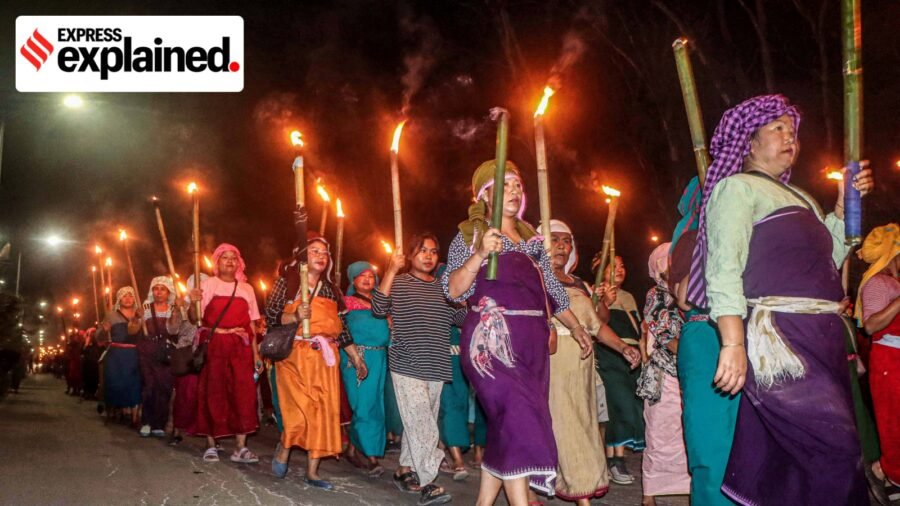
The Union government Monday (September 1) decided to defer the 2027 Census in Manipur after a meeting of Union Home Minister Amit Shah, Manipur Governor Ajay Kumar Bhalla, Chief Minister Yumnam Khemchand Singh and Union Home Secretary Govind Mohan.
The Manipur government said the decision followed discussions on the demand that the Census be held only after implementation of the National Register of Citizens (NRC). The decision has brought into focus a demand that has been building in the state for several years.
Why is the Census being opposed?
There are three overlapping concerns.
The first is citizenship and demographic change. Civil society groups in the valley and the hill districts dominated by Nagas have long alleged that migration from Myanmar and elsewhere has altered Manipur’s demographic composition. They want an exercise to distinguish Indian citizens from illegal immigrants before population figures are recorded.
Story continues below this ad
The second is displacement caused by the ethnic conflict since May 2023. More than three years after the violence began, thousands remain displaced. Meitei groups argue that a Census conducted while people are living away from their original homes could record the demographic consequences of displacement rather than the state’s underlying population pattern. The Meitei Alliance, for instance, has said the Census should wait until internally displaced people return home.
The third is political representation. Population figures from the Census will eventually be important for delimitation, and Manipur has not had a fresh delimitation implemented since the 1970s. Given the gap, it has the potential to change equations in the Manipur Assembly.
Is the NRC demand new?
No. The demand predates the May 2023 violence, although the influx of people from Myanmar and the conflict subsequently gave it a sharper political and security dimension.
In June 2022, the Coordinating Committee on Manipur Integrity (COCOMI), representing Meitei civil society, and the United Naga Council (UNC) submitted a joint memorandum demanding an NRC and a State Population Commission, citing concerns over immigration and demographic change. On August 5 that year, the Manipur Assembly adopted a resolution seeking both. The resolution was reaffirmed on March 1, 2024.
Story continues below this ad
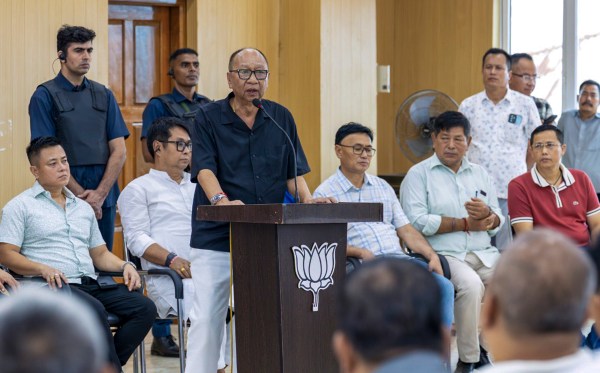 Manipur Chief Minister Yumnam Khemchand Singh at the Manipur BJP office in Imphal. PTI
The 2022 resolution, moved by JD(U) MLA Kh Joykisan, cited population growth of 153.3% between 1971 and 2001 and 250.9% between 2001 and 2011 in the hill districts, compared with 94.8% and 125.4% respectively in the valley. Though these figures do not by themselves establish illegal immigration, they underlined demographic anxieties that predated the 2023 conflict.
The Biren Singh government gave the demand an institutional push, constituting the Manipur State Population Commission in February 2023. A month later, Singh said the commission would identify “illegal immigrants” and that Manipur was ready for an NRC but needed the Centre’s approval.
The Myanmar crisis intensified these concerns. After the 2021 military coup, fighting in Myanmar’s Chin State and adjoining areas drove thousands across the border into India. Many belonged to Chin and related communities with ethnic and familial links to the Kuki-Zomi population in Manipur. The Manipur government increasingly linked the influx to new settlements, poppy cultivation, encroachment and demographic change. Kuki organisations disputed this, arguing that legitimate Indian citizens were being conflated with recent arrivals from Myanmar.
The Centre’s decision in February 2024 to scrap the Free Movement Regime with Myanmar, citing internal security and demographic concerns, added another layer to the debate.
Story continues below this ad
Naga voices pushing for NRC have also become more strident amid the ongoing conflict with Kukis. The UNC has linked the demand explicitly to Census and delimitation. On August 18, it said: “NRC first: No Census, No Delimitation Before Implementation of NRC in Manipur.” It demanded an NRC with 1951 as the base year, followed by the Census and then delimitation. On August 31, it instructed its village organisations not to cooperate with Census officials.
The issue has also produced unusual political convergence, with the BJP and Congress broadly on the same side. On August 19-20, former chief minister and Manipur Congress president Okram Ibobi Singh supported the demand for an NRC before the Census.
What are the Kuki-Zo groups saying?
The Kuki-Zo position is almost the opposite. The Kuki-Zo Council has opposed an NRC before the Census, calling it “premature and unjustified”.
“Regarding the NRC, KZC reiterates that it is a national exercise and that there is no provision for any community or state government to unilaterally initiate or conduct a separate NRC in a particular state at its own discretion,” it said in a statement on August 23.
Story continues below this ad
It has argued that the demand is based largely on unsubstantiated allegations concerning the Kuki-Zo community and that such claims should instead be tested against credible demographic data. Since the Census is the appropriate source for such data, it says, an NRC before Census 2027 is premature. It has also supported delimitation based on verified demographic data.
This reflects a fundamental Kuki-Zo concern: because Kuki, Zomi and Chin communities straddle the India-Myanmar border, an NRC based on an old documentary cut-off could raise questions about people whose families have lived in Manipur for generations.
Why does delimitation matter?
Manipur has 60 Assembly seats: 40 in the valley and 20 in the hills. The valley is predominantly Meitei, while the hills are predominantly inhabited by Naga and Kuki-Zomi communities. The present political map goes back to the 1973 delimitation, based on the 1971 Census.
A delimitation exercise based on the 2001 Census was undertaken nationally between 2002 and 2008, but Manipur, along with Assam, Arunachal Pradesh and Nagaland, was excluded after the Centre deferred the exercise in 2008 citing security concerns and amid challenges to the credibility of the 2001 Census data in the region.
Story continues below this ad
The 2001 Census had generated particular controversy in Manipur because several hill subdivisions showed very high population growth. In nine subdivisions, the increase between 1991 and 2001 was over 40%; in four, it exceeded 100%.
The fear among sections of the valley political class is that a new Census followed by delimitation could reduce the valley’s longstanding political advantage. The 40:20 distribution could change. Fears expressed by some sources among the political class in the valley project it to change to the tune of 35:25 or 30:30.
This is why NRC, Census and delimitation have become politically linked.
Can an NRC be conducted in Manipur when there is no NRC elsewhere?
Story continues below this ad
The general understanding is that a nationwide NRC is supposed to follow an exercise of updating the National Population Register (NPR). The government, however, has not notified NPR to be taken up in the 2027 Census.
There is nothing in law that bars the government from conducting a state-specific exercise. Under Section 14A of the Citizenship Act, 1955, the power to compulsorily register citizens and maintain the National Register of Indian Citizens (NRIC) rests with the Centre. There is no statutory requirement that an NRC must be deployed simultaneously nationwide.
The Centre could therefore, in principle, issue a specific notification for a particular state or border region. At the end of the day, however, this is a political call.
NRC is also not the only way to address demographic anxieties, central government sources said. The Centre has created a High-Level Committee on Demographic Change, announced in May this year, to examine demographic changes arising from illegal immigration and other abnormal causes and recommend policy, legislative and administrative measures.
Story continues below this ad
Its findings could provide the basis for a policy specific to Manipur.
The government has also undertaken electoral-roll verification exercises such as the Special Intensive Revision in states where it has concerns about voter lists. Other tools include tighter border management, regulation of cross-border movement, biometric registration of migrants, identification and deportation of foreigners found to be illegally present, verification of village recognition and demographic studies.

Don’t buy a lab-grown diamond before checking these 7 things
By Sohail Khan · 29 Sep
Towards a gender just Uniform Civil Code
By Sohail Khan · 29 Sep
Essar eyes $18-billion US steel plant: Why Indian firms are investing in US amid tariffs
By Sohail Khan · 29 Sep