How India taught its shooters to slow their hearts
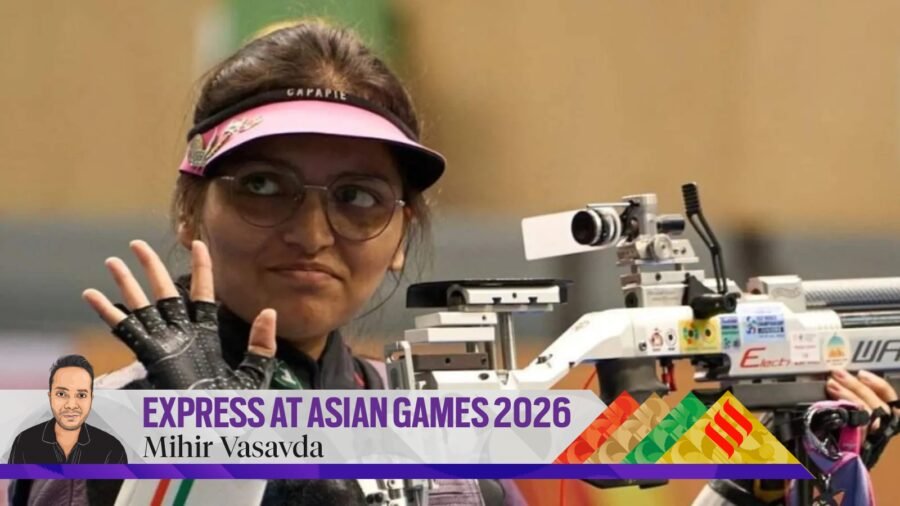
Hold your breath. India’s shooters are doing just that, learning how to slow their breathing, settle their heartbeat and find the few seconds of stillness that could help them produce another big medal haul at the Asian Games.
When Sonam Maskar began the final preparations for her Asian Games debut at a camp in Bhopal, the 23-year-old rifle shooter had a belt strapped around her chest and sensors attached to her finger. The chest strap measured her heart rate in real time; the sensors tracked her body temperature, giving the coaches an indication of stress.
“If the heart rate is 100 or more, then the task is to bring it lower and shoot only after that,” Maskar, who competes in the 10m event on Sunday, tells .
Story continues below.
Subscribe to see fewer ads.
Like Maskar, many in the Indian shooting squad are entering new territory in Nagoya. Ten of the 18 rifle and pistol shooters are making their Asian Games debuts. Their preparation, therefore, has gone well beyond putting bullets and pellets through targets.
At the Bhopal camp over the last few weeks, some of the training looked more like a laboratory experiment. Gadgets were attached to their bodies, an app was open on their phones and, while aiming at the target, the shooters could see their breathing, heartbeat and skin temperature changing in real time.
“We are trying to gather more information about the shooters,” India’s rifle coach Thomas Farnik says. “Some shooters react a little bit too much. All these biofeedback systems that we have, we are trying to make them learn to use their body to react in situations when it is necessary.”
Pierre Beauchamp, Indian shooting’s high performance director, and the sport psychologists have been working with the rifle and pistol coaches on self-regulation, teaching shooters to deliberately bring their bodies and minds into the state required to execute a shot. Rather than plainly being told to relax, they were being shown what relaxation looked and felt like, so they could learn to find that zone without the gadgets when the competition began.
Story continues below this ad
At one assessment, one shooter was breathing around 10 times a minute during the preparation phase of the shot. The coaches felt that was on the higher side and worked with the shooter to gradually bring it down towards four to six breaths a minute through different breathing techniques.
The reason, pistol shooting high performance coach Ronak Pandit says, is not simply to make the shooter calmer. “Breathing affects movement. So does the heartbeat. So when you are trying to hit a target from a distance, even movements that are invisible to the naked eye can matter,” Pandit says.
As breathing becomes more controlled, the heart rate can slow too. In one case, a shooter’s heart rate fell from around 80 beats per minute to 60, what Beauchamp calls heart-rate deceleration. Some of India’s top shooters can produce a 30-to-40 beat drop during their individual shot cycles. The aim, however, is not to chase the biggest number. “It is important that it is synchronised with the aiming and triggering process, and that they can do it repeatedly,” Pandit says.
That last word, repeatedly, is crucial. A training range in Bhopal is one thing. An Asian Games final is another. So the Bhopal camp tried to recreate some of that pressure too. Trainees from the Madhya Pradesh shooting academy were brought in and asked to make noise around the shooters as they went through simulated final situations. The idea was to force the athletes to shoot through distractions, the sort of noise and commotion that can turn a familiar routine into an uncomfortable one on competition day. The shooters had to learn to return to the same sequence: control the breathing, settle the heartbeat, find the sight picture and pull the trigger.
Story continues below this ad
Nagoya will bring another layer of pressure. The shooters have already experienced some of the uncertainty of a multi-discipline event, with landing and check-in troubles affecting the Indian contingent. Those troubles continued into Friday, when pistol shooter Rahi Sarnobat reportedly faced the same delays as several of her teammates.
At the range, though, the target will look the same. The rifle will feel the same. The mechanics of the shot will not suddenly change. However, the expectations will.
Shooting produced 22 medals for India at the previous Asian Games, including seven gold, and, along with athletics, was one of the two biggest contributors to the country’s record 106-medal haul in Hangzhou. If India is to cross 100 medals again in Nagoya, shooting is expected to carry a substantial part of the load. Which is why so much of the preparation has been about mastering what the eye cannot see.
There will be no belt around Maskar’s chest when she steps onto the range on Sunday. No sensors on her finger. No phone screen showing her heartbeat. No graph telling her whether she has found the right zone. Just a shooter, a target and a final breath.
Then the trigger.
Ramesh Powar tipped to chair BCCI’s junior national selection committee
By Sohail Khan · 19 Sep
Indian men, women shuttlers likely to run into Japan in quarters
By Sohail Khan · 19 Sep

Leave a Reply