How Harmanpreet Singh plans to plug defensive leaks at Asian Games
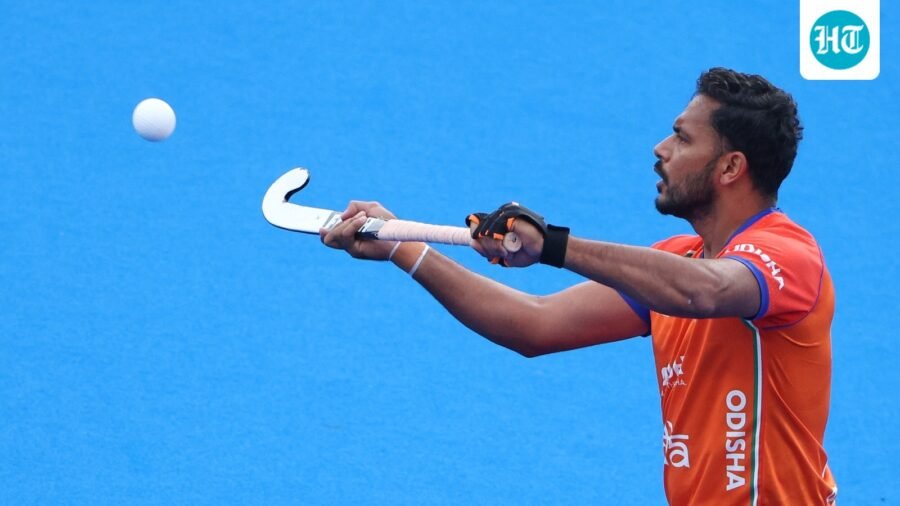
This Asian Games campaign is not just about retaining a title, it is about redemption and direct qualification for the Olympics too.
Updated on: Sep 19, 2026, 14:11:47 IST
Prefer HTon Google
Share via
Copy link
The Indian men’s hockey team will begin their campaign at the Asian Games as the undisputed powerhouse of the continent, but with a distinct point to prove. Having secured gold at Hangzhou in 2023, along with triumphs in last year's Asia Cup and the last two Asian Champions Trophy tournaments, their regional dominance is unquestioned.
However, the sting of a premature exit at the World Cup in August, where they failed to reach the semi-finals despite being the only team to podium at the last two Olympics, still lingers.
For skipper Harmanpreet Singh and his squad, this campaign is about much more than just retaining a title; it is about redemption and securing a direct berth to the 2028 Los Angeles Olympics. The internal mandate is uncompromising: return with nothing less than gold.
The post-mortem of the World Cup disappointment points directly to defensive lapses, a flaw Harmanpreet is keenly aware of and determined to correct.
The 30-year-old defender acknowledges that conceding “silly goals” proved to be their undoing at the quadrennial showpiece. The breakdown was not isolated to the backline but was a symptom of broader structural inconsistencies.
“The structure was a bit on-and-off, and when we were on-and-off, all the opponents scored,” Harmanpreet told from Kakamigahara, emphasising that players occasionally drifting out of position compromised the team’s entire shape.
With Asian opponents relying heavily on rapid passing and inside hitting, maintaining a disciplined structure and keeping constant pressure on the ball for the full 60 minutes will be India’s primary defensive objective.
India conceded 19 goals in six matches—an alarming average of 3.16 goals per match. But the fact that 14 of those were open field goals laid bare the frailties of India’s defensive structure. In modern hockey, where fast transitions and 3D skills dictate the pace, relying on a leaky backline is a death sentence.
The defence failed not necessarily due to a radical change in style but because of a breakdown in basic fundamentals—man-to-man marking, positional awareness and communication.
Defending is a collective responsibility that starts from the front. However, when the initial press was bypassed, the Indian defence was frequently caught ball-watching, allowing unmarked attackers to penetrate the circle.
Against teams like Argentina and the Netherlands, the gaps between the midfield and defence were regularly exploited, forcing defenders into reactive, panicked tackles rather than proactive interceptions.
While the defence underwent intense scrutiny, the offensive unit showed flashes of potential that the team hopes to capitalise on. Field goals often materialised late in matches, placing a heavy reliance on penalty corners (PC).
As the team’s premier drag-flicker, Harmanpreet frequently faces the brunt of opposition rushers specifically deployed to neutralise him. Yet he was the tournament’s joint second-highest scorer with eight goals. But he views this not as an individual burden, but as a strategic puzzle for the entire squad to solve.
“I deal with it with all the experience I have gained while playing. Also, I am not the only one; the whole staff and team are involved. All the meetings we do about PC defence and attack. We analyse things like the opposition's best rusher, best goalkeeper, their strong points,” said Harmanpreet.
“We have a lot of discussions about things like how we can beat the rushers, where we will have opportunities. We focus on these things, have a lot of meetings about them, and then make the right decisions. So overall it is a team effort.”
Looking ahead to the Asian Games, the team is guarding fiercely against complacency. The skipper’s philosophy is rooted in respect for regional rivals, warning that taking any Asian team lightly will result in immediate punishment.
“The strategy is to dictate the tempo, maintain maximum energy from the first whistle to the last, and force opponents to adapt to India’s standard of play rather than the other way around,” said the two-time Olympic bronze medallist.
Looming over the tournament is a unique historical hurdle. Despite winning the competition four times, India have never successfully defended an Asian Games hockey gold. A fifth title would finally break that jinx and punch their ticket to Los Angeles.
Still, Harmanpreet is ensuring his squad remains grounded, actively avoiding the distraction of historical milestones. For the India captain, the focus remains firmly on the immediate 60 minutes ahead.
“Destination is always good when you reach it,” said Harmanpreet, choosing to take the tournament step-by-step. “But before that, the route is tough. We will enjoy the road.”
See Less


From 200 registered players to vying for Asian Games medal, tracing India’s teqball journey
By Sohail Khan · 19 Sep

Leave a Reply