How did CJP protest lead to Dharmendra Pradhan quitting? Ashutosh Ranka explains
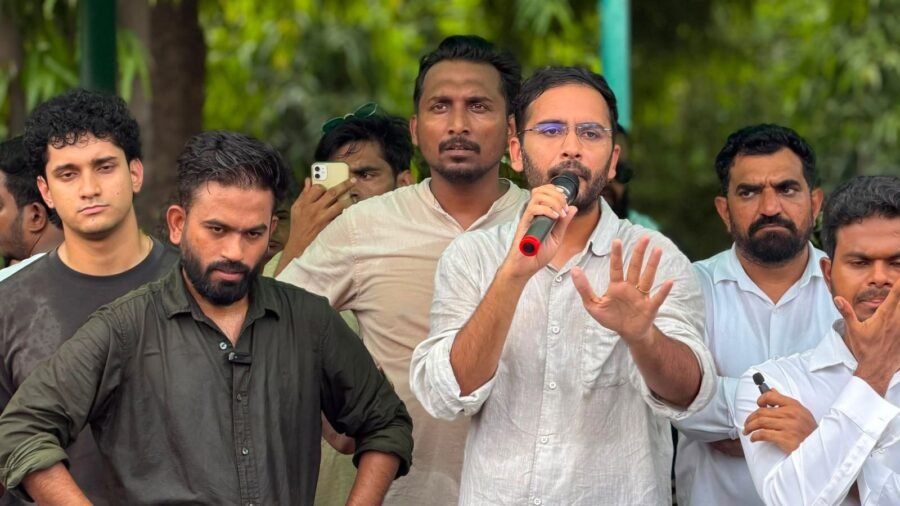
How did the Cockroach Janta Party — a student-led movement formed after Chief Justice Surya Kant’s remark about ‘youngsters like cockroaches’ and fuelled by the leaked NEET-UG 2026 exam paper — galvanise India’s Gen Z into uniting against corruption in the education system?
And how did the CJP-led protest at Delhi’s Jantar Mantar end in the ruling Bharatiya Janata Party being pushed into replacing a union minister – Dharmendra Pradhan – outside of its own schedule – something neither the Congress nor any other opposition party has managed to do, thus far.
In a freewheeling interview with the , CJP spokesperson Ashutosh Ranka offered a few interesting insights, including how much the ‘cockroaches’ had to struggle. He jokingly stated that the Centre accepted their demands because CJP is the BJP’s ‘B-team’.
Story continues below this ad
“But no, I think it is very unfair,” he said of people comparing the CJP to the opposition for what it has done. “People resort to looking at the final result, right? They’ll not go into the process.”
“We know how much we had to fight to arrive at this position,” he told the Express’ Srirupa Goswami, referring to the 37-day Jantar Mantar sit-in in June-July.
“For the last month Saurav Saurav (Das, a CJP co- convener ) and Ratna (Singh, the CJP’s legal affairs head) had relentless discussions with the government… but no one talked about it, no one covered it. We know how much we had to fight to arrive at this position… to announce a protest.”
Story continues below this ad
“And it’s not straightforward to have, you know, a protest organised in Delhi. It takes a lot. It takes a lot of planning, it takes a lot of mobilization, it takes a lot of effort, right? So the struggle we endured for that month, only we know that, right?”
‘They called us virus, terrorists’
“People keep saying ‘your demands were accepted’ [after the government negotiated an end to the Jantar Mantar protest]… but why do they not talk about how, for those 37 days, the government didn’t even bother to engage with us or start a dialogue till July 20?”
Ranka pointed out that during that time ‘they were busy calling us viruses… terrorists… busy meting out violence. That should also be considered when people say we had a smooth ride’.
Story continues below this ad
The CJP’s Jantar Mantar protest – arguably one of the biggest public movements since the 2020/21 farmers’ protest against the government’s ‘black laws’ – began peacefully but quickly devolved into violence; the trigger, Ranka and others from the group have argued, was when Delhi Police launched a crackdown – lathi charges, tear gas and, allegedly, pellet guns that caused injuries.
On July 25 the protest was called off after the government provided assurances, including one that said Pradhan would be replaced as the Union Education Minister and another that police cases against student-protesters – i.e., those without a criminal past – would be scrapped.
Pradhan was subsequently replaced by Pralhad Joshi but the dropping of cases has been a long-drawn process. Irked by the delay, the CJP called for a second march on September 5.
But on September 2 the Supreme Court stepped in and invoked its special powers under Article 142 to drop all cases. Das then told the court the march would be called off.
Story continues below this ad
Does the CJP trust the government and police?
Ranka told the Express the CJP felt the government had ‘either been delaying the matter or was not serious about it’, and that had prompted the call for a second march this weekend. Now, though, he said the movement had been re-assured by the top court, and the fact the government’s assurances – on dropping of cases and compensation to those injured – had become a matter of judicial record.
“I am pretty sure the government will honour what was being aligned in the Supreme Court… let us hope it doesn’t come down to that. There is still very much democracy in the country, and there is respect for the institutions, especially the judiciary,” he said, when asked about future protests.
On why the CJP trusts the Delhi Police, which said that 2,800 “hardcore criminals” had participated in the protests, Ranka said: “The distinction that was made by the the Delhi Police was that these 2,800 criminals are ones who have committed heinous crimes, crimes of extreme gravity like murder and rape… Trust is definitely a big word. There’s a lot that needs to be done to earn that trust. But if if something is being said said in the highest court, we do really hope that the Delhi government and the Delhi Police will do as they say.”

India, Belgium to strengthen defence, semiconductors ties
By Sohail Khan · 3 Sep
CJP’s Ashutosh Ranka: ‘Our political ambition is to change India’s politics’
By Sohail Khan · 3 Sep
Telangana CM drops Forest Minister after daughter’s remarks, reshuffles key posts
By Sohail Khan · 3 Sep
Leave a Reply