How an Ethiopian’s finishing kick outclassed India’s Gulveer Singh in 10,000m

Story continues below.
Subscribe to see fewer ads.
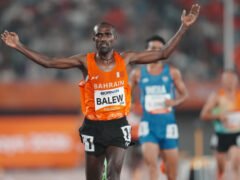
With 250 metres remaining, Balew found something extra. The gap began to open, and Gulveer chased, his body leaning into the effort, legs still turning after 24 and three-quarter laps of the track.
But Balew had one more gear. The Ethiopia-born runner sprinted to the finish in 28:27.51, arms spread wide, with Gulveer taking silver in 28:29.38. The Indian stopped almost immediately, dropped to his knees, bent forward and kissed the track. Then he got up and sprinted out of the stadium.
He will be back on Saturday for the 1,500m heats — the second of the three events he will run in Nagoya. “I won a bronze medal last time (in Hangzhou). So coming into these Games, the plan was to change the colour of the medal,” Gulveer said.
Fine margins
For Gulveer, the silver was both a reward for the work that had brought him here and a reminder of how fine the margins are at this level. Scott Simmons, his coach, believed that the Indian’s best chance of winning lay in turning the race into a quicker affair. “The only way that Gulveer had a chance for gold was, honestly, if it was a 27-minute race,” Simmons said.
Story continues below this ad
The reasoning was straightforward. Balew, the Diamond League 5,000m champion, had demonstrated his finishing speed at the highest level, including a commanding performance in Belgium. Even Gulveer knew what he was up against. “His finish is strong. He is faster than me. But I will try to challenge him,” he said.
A faster race, Simmons felt, might have given Gulveer a better opportunity to challenge Balew over the final lap. Instead, the Indian had to rely on his finishing speed against a runner who had more in reserve. “He finished very well in 57 seconds,” Simmons said, referring to Gulveer’s final lap. “Yeah. But (Balew’s was) 55 seconds.”
Could Gulveer have taken the initiative and pushed the pace towards a 27-minute finish? Simmons was reluctant to suggest that it would have changed the outcome, particularly with the Indian still scheduled to run the 1,500m and 5,000m.
“He has a big menu for the rest of the week,” Simmons said. “And even then… You never know. This is a man who ran under 59 minutes for the half marathon. I mean, Gulveer ran very well under 60 minutes, but he is not at the same level at this point.”
Story continues below this ad
The two seconds that separated them over the final lap were the difference between gold and silver. But Gulveer’s ability to stay in contention against a runner of Balew’s calibre reflected how far he has come.
At the 2023 Asian Games in Hangzhou, Gulveer had won bronze in the 10,000m, having only begun competing in athletics in 2019. Since then, he has rewritten the Indian national records in both the 5,000m and 10,000m, clocking 12:59.77 and 27:00.22 respectively. He went on to win both events at the 2025 Asian Athletics Championships before adding a silver in the 10,000m and a bronze in the 5,000m at the 2026 Commonwealth Games in Glasgow.
Those performances have changed the expectations surrounding him. He is no longer simply an Indian runner trying to keep pace with the leading athletes in Asia. He has become one of the men expected to challenge them, with the national records and international medals to back up those ambitions.
Gulveer, though, resisted making any bold claims. “I have not set any target as such. I haven’t kept a point for me to reach. I just want to keep improving, climb up the ladder one step at a time and not lose any rhythm,” he said.
Story continues below this ad
The silver in the 10,000m was the first of three tests in Nagoya. On Saturday, Gulveer will return to the track for the 1,500m heats, with the 5,000m still to come. The pursuit of a different colour of medal is not over.

Football: India denied a win by Panama
By Sohail Khan · 25 Sep
Why African-born runners reduce India’s long-distance gold count
By Sohail Khan · 25 Sep
Leave a Reply