How a late call-up made Roshibina wushu’s first three-time Asian medallist
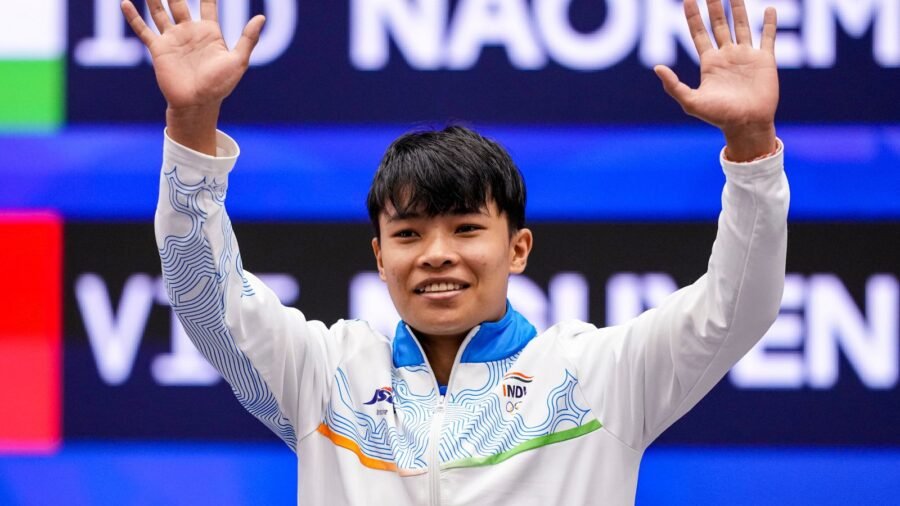
On Thursday, on barely any preparation, the 25-year-old DSP with Manipur Police became the first Indian wushu player to win three consecutive Asian Games medals, taking silver in the women’s 60kg sanda event after a 0-2 loss to China’s Zhang Xiaoyu in the final. “There were disturbances as I did not get much time to prepare,” Roshibina said in Japan. “But then I ignored those distractions as well, and all I was thinking when I sat in the flight to Japan was to win the medal. My aim was to make the comeback after the loss, and this silver medal proves that.”
Story continues below.
Subscribe to see fewer ads.
She was twelve, in the fifth standard, when she first saw a wushu competition in her village and decided she wanted to try it. Her parents, small-time farmers, told her she was too young and needed to focus on her studies. She found her own way around that. “She would take a vest and fill it up with rice husk and practice wushu with other village kids,” her father recalls. A woman in the village eventually told her to apply to the SAI Centre in Imphal. Selection there meant her food and training were finally taken care of. “I would also often visit her, taking home food and vegetables for her,” he says.
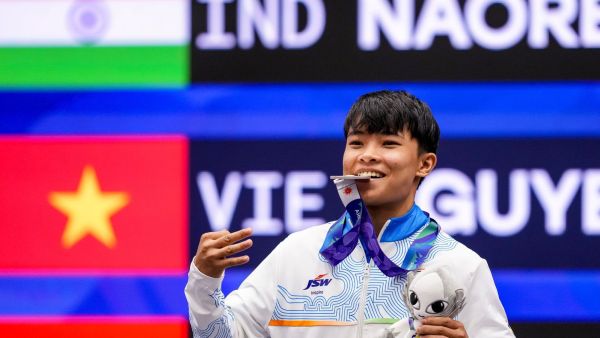 Nagoya: India’s Roshibina Devi Naorem holds the silver medal after the Women’s 60kg Wushu final match during the 20th Asian Games, in Nagoya, Japan, Thursday, Sept. 24, 2026. She lost to China’s Zhang Xiaoyu, 0-2.
She trained under coach Maibam Premkumar Singh, won junior national medals soon after, and took bronze at the 2016 World Juniors in Bulgaria. A year later, chief national coach Kuldeep Handoo moved her into the senior team, and her first Asian Games medal, bronze, followed in 2018, a win over Pakistan’s Mubasjra Akhtar preceding a semi-final loss to China’s Cai Yingying. In Hangzhou, she went further still, beating Kazakhstan’s Aiman Karshyg on points and Vietnam’s Thi The Nguyen 2-0 in the semis before falling 0-2 to China’s Wu Xiaowei in the final.
Handoo has watched her build herself for years around the one thing her body gave her. “As a junior too, she had a stout physique. And she was never afraid of getting punched while she attacked too,” he says. “Since her height was short, we laid emphasis on her utilising her close range kicks and punches. Post the 2018 Asian Games bronze, we worked on her throwing and punches a lot. In 2024, she had suffered a knee injury and it took a long time to recover.”
The Hangzhou silver had arrived months after ethnic violence broke out in Manipur, and Roshibina dedicated that medal to the state’s people at the time. What she didn’t know, while she trained through it, was how much her family had absorbed on her behalf. “Prior to 2023, I had to sell part of our land to support her training. When she won the Asian Games silver, we used some of the prize money and our money to get that portion back,” her father says. “During the unrest in 2023, while Roshibina was in the SAI training centre, we struggled in selling our farm produce with the unrest and all the things happening around. But we did not talk about the issue with her.” Her grandfather died during that same period. She wasn’t told that either. “We wanted her to concentrate fully on her game,” he says.
Story continues below this ad
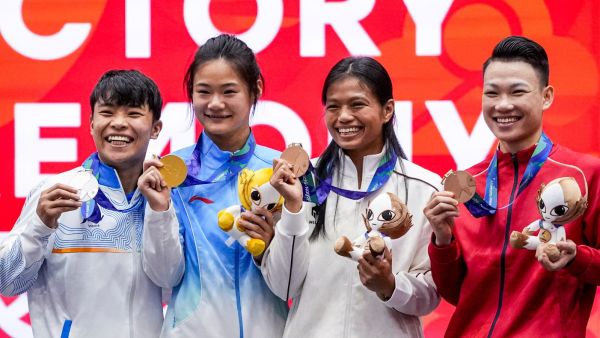 Nagoya: From left, India’s silver medallist Roshibina Devi Naorem, China’s gold medallist Zhang Xiaoyu, and others during the medal ceremony at the 20th Asian Games, in Nagoya, Japan, Thursday, Sept. 24, 2026.
In Japan, before the final, she had beaten Bangladesh’s Shika Khatun, Macau’s Chu Man Sin, and 2023 world champion Nguyen Thi Thu Thuy of Vietnam, before getting past Indonesia’s Thania Kusumaningtyas in the semis. National coach Amit Pal saw a fighter who had barely had time to become one for this tournament. “Roshibina had very little time to prepare, but the way she performed here is commendable,” he says. “We left on September 15, and the key was to put her in a good positive mindset prior to the matches. The win against the Vietnamese was vital, and she will take a lot of positives from it.”
Handoo believes the door to beating China’s best isn’t closed, just not yet open again. “Yes, she lost against the Chinese, but she has it in her to score a win against Chinese players. She did that in her junior days and needs to be injury free in coming years to repeat,” he says.
She almost wasn’t in Japan at all. Three days and a phone call changed that math entirely.

Aakash Chopra on IND vs JAP wide controversy: ‘Lot of people who want to abuse India…’
By Sohail Khan · 24 Sep

Leave a Reply