Hope flows anew with revival of Andhra’s Veligonda project
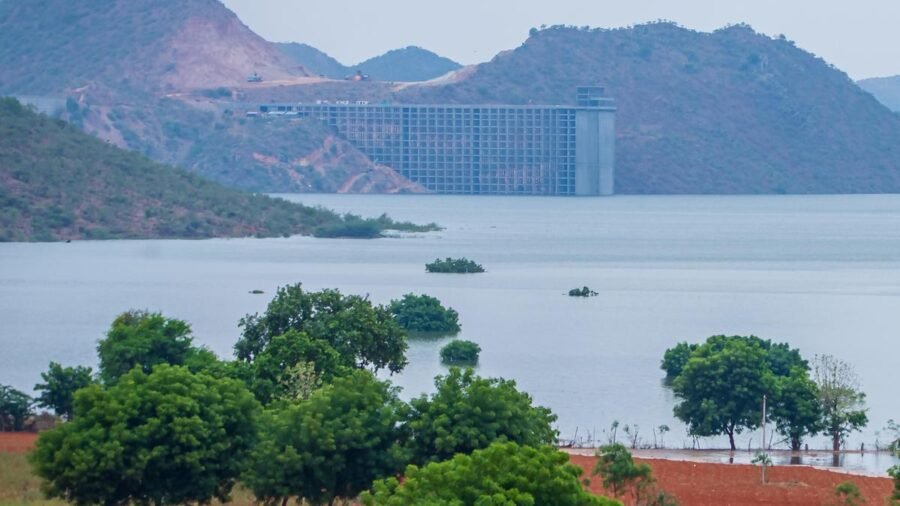
The Poola Subbaiah Veligonda Project (PSVP) gained significant momentum on August 31, 2026, when Chief Minister Nara Chandrababu Naidu released Krishna water into Nallamalasagar through the twin tunnels and feeder canal. The project is designed to draw 43.50 TMC of Krishna floodwater from the foreshore of the Srisailam Reservoir, through Kollam Vagu, and traversing across the Nallamala hills to Nallamalasagar.
Conceived as a long-term response to chronic drought, depleted water resources, and fluoride contamination in parts of the region, the project aims to create a large irrigation network while extending drinking water facilities to drought-prone populations.
For nearly four decades, the people of the region have been battling water scarcity issues, combined with groundwater fluoride levels that are ten times higher than permissible levels. The project has been planned as a permanent water supply intervention, combining irrigation, drinking water provision, and groundwater recharge.
Reflecting the scale of this initiative, the project’s financial framework places the revised estimated cost at ₹10,790 crore, of which a major portion of ₹7,607 crore has already been spent.
According to the official record, the Nallamalasagar Reservoir, formed by closing the Sunkesula, Gottipadia, and Kakarla gaps in the Nallamala hills, has a gross storage capacity of 53.85 TMC, including 43.50 TMC of live storage and 10.35 TMC of dead storage. Its full reservoir level is +244.000 metres, and the minimum drawdown level is +214.300 metres. The water spread area is stated to be 52.40 square kilometres, with a peripheral length of 76 km.
The project identifies 36.57 TMC as the crop water requirement, 1.570 TMC for drinking water and 3.360 TMC towards anticipated evaporation losses. The overall irrigation command is proposed at 4,47,300 acres, comprising 4,32,500 acres of irrigation development ayacut and 14,800 acres of stabilised ayacut.
Another component of the project is that the irrigation network spans four districts and 30 mandals. The district-wise figures indicate 308,700 acres in Markapuram, 27,400 acres in Prakasam, 84,000 acres in SPSR Nellore, and 27,200 acres in YSR Kadapa. The Markapuram component includes 302,200 acres of irrigation development ayacut and 6,500 acres of stabilised ayacut. SPSR Nellore has 77,500 acres of irrigation development ayacut and 6,500 acres of stabilised ayacut, while YSR Kadapa has 25,400 acres and 1,800 acres, respectively. Prakasam has 27,400 acres of irrigation development ayacut.
While at the constituency level, the proposed irrigation coverage includes Yerragondapalem, Markapuram, Giddalur, Kanigiri, Darsi and Kondepi in the Markapuram and Prakasam areas; Badvel in YSR Kadapa; and Udayagiri and Atmakur in Nellore. The detailed allocation gives Yerragondapalem 66,300 acres, Markapur 82,900 acres, Giddalur 59,100 acres, Kanigiri 9,900 acres, Darsi 23,000 acres and Kondepi 4,400 acres. Udayagiri has 63,000 acres and Atmakur 21,000 acres.
The project is divided into two principal stages. Stage I is intended to provide irrigation facilities to 119,000 acres and drinking water to four lakh people in Markapuram, while Stage II covers the remaining 328,300 acres and is targeted for completion by March 2029. It extends the project benefits to the remaining beneficiary areas across Markapuram, Prakasam, Nellore, and Kadapa.
Shashibhushan Kumar, Special Chief Secretary to Government, Water Resources, Government of Andhra Pradesh, says that all head works for Stage I have been completed except 3.05 km of feeder canal lining. The remaining feeder canal lining and distributary network for the Stage I ayacut are scheduled for completion by June 2027, he adds.
However, the launch of the much-awaited project does not mark the end of the work. There are still some gaps that need to be addressed by the government, such as the rehabilitation and resettlement of Project Displaced Families (PDF).
Markapuram Joint Collector Puli Srinivasulu says that the government has identified the land acquisition and rehabilitation and resettlement of 7,321 displaced families, which has been approved by the Gram Sabhas following a socio-economic survey covering 11 affected habitations in six revenue villages across three mandals. All 11 habitations have been relocated, and all 7,321 identified PDFs have been physically shifted.
State Disaster Response Force teams guard the Nallamalasagar reservoir as Krishna river water arrives through the newly constructed twin tunnels.
KOMMURI SRINIVAS
Seven R&R colonies have been proposed for the displaced population. Infrastructure has been completed in Goguladinne, Thokapalli, Idupur-I, and Idupur-II. Work is in progress at Devarajugattu, Vemulakota, and Ondutla, according to sources.
The land for R&R colonies for other affected habitations is, however, another immediate requirement for the government. Against a requirement of 650.96 acres, 608.18 acres have been acquired, leaving 42.78 acres remaining. Awards have been passed for 11.74 acres of assigned land, but payment is pending due to a court case. An additional 31.04 acres still need to be acquired. Furthermore, an additional 16 acres are required for plotting and 20 acres for burial grounds, with the estimated cost for acquiring land for these purposes set at ₹90 crore.
Financial requirements for land acquisition and rehabilitation and resettlement (R&R) together stand at ₹1,920.63 crore. The expenditure incurred was ₹1,298.39 crore, leaving a balance requirement of ₹622.24 crore. Of this, land acquisition accounts for ₹802.30 crore, with ₹406.10 crore spent and ₹396.20 crore remaining. R&R cash entitlements require ₹905.56 crore, of which ₹758.31 crore has been paid, leaving a balance of ₹147.25 crore. R&R infrastructure works require ₹212.77 crore, with an expenditure of ₹133.98 crore and a balance of ₹78.79 crore.
House-site pattas are another part of the rehabilitation process. A total of 2,971 pattas have been distributed, while 990 remain to be distributed. The official assessment identifies the distribution of the remaining pattas and the physical handing over of plots as requiring priority attention. Alongside the physical rehabilitation process, grievance redressal arrangements have also been established. A Command and Control Room at the Markapuram Collectorate monitors grievances and the rehabilitation of displaced families who have been shifted from submerged villages.
Closely linked to the rehabilitation process is the acquisition of the remaining land required for the project. As of September 9, 2026, the total land required was 35,032.94 acres, of which 30,300.17 acres had been acquired, leaving 4,732.77 acres. Awards had been passed for 1,507.26 acres but payment was pending, while another 3,225.51 acres remained at different stages of acquisition.
However, the headworks and submergence land acquisition have been completed. The requirement for headworks was 82.14 acres, all of which has been acquired, while the entire 17,189.69 acres required for submergence have also been acquired. The major balance relates to canals: against a requirement of 17,110.15 acres, 12,420.16 acres have been acquired, leaving 4,689.99 acres. Awards have been passed for 1,495.52 acres of that balance. The remaining canal land includes 1,068.05 acres of patta land, 1,812.99 acres of assigned land, and 313.43 acres of government land.
The acquisition is only part of the larger requirements for the project, which comprises a water conveyance system that is built around the twin tunnels passing through the Nallamala hills. Tunnel-1 has a diameter of seven metres, a length of 18.8 km and a discharge capacity of 85 cumecs. Tunnel-2 has a diameter of 9.2 metres, a length of 18.787 km and a discharge capacity of 243 cumecs.
The Teegaleru Canal, extending 48.30 km, has a discharge capacity of 28.68 cumecs and serves an ayacut of 62,000 acres. The feeder canal extends 21.80 km and forms a critical link in conveying water towards Nallamalasagar. The Gottipadia Canal is 11.44 km long, has a discharge capacity of 5.10 cumecs and serves 9,500 acres.
The Eastern Main Canal (EMC) is another major component, extending 130.825 km. The discharge capacity of EMC 123.62 cumecs and serves a large command area through its network. The system also includes the Udayagiri Branch Canal, Western Branch Canal, pressure mains and smaller tunnel links. The Udayagiri Branch Canal is listed as serving 71,500 acres, while the Western Branch Canal serves 60,300 acres.
Visitors at the Sunkesula Dam, which is one of the three gaps of the Nallamalasagar Reservoir in Markapur district.
KOMMURI SRINIVAS
It may be mentioned here that the project’s engineering infrastructure also includes Sunkesula Dam, Gottipadia Dam, and Kakarla Dam. Their stated dimensions are 378.50 metres in length and 63.65 metres in height for Sunkesula, 587 metres in length and 85.90 metres in height for Gottipadia, and 356 metres in length and 57 metres in height for Kakarla.
Thus, the project now presents two parallel dimensions: the arrival of Krishna water into Nallamalasagar and the unfinished work required to translate the infrastructure into its full intended benefits.
With 5.10 TMC already stored as of September 16, the project has entered an operational phase, while substantial work remains on canal lining, distribution networks, land acquisition, R&R payments, house-site pattas, infrastructure, and relief measures.
For the drought-prone areas that the project was designed to serve, the significance of Veligonda ultimately rests on what happens after water reaches Nallamalasagar.
The project combines a large-scale engineering network with a substantial rehabilitation programme. Its stated objective is to bring irrigation to 4,47,300 acres and drinking water to affected populations, while the project authorities continue to address the land, compensation, resettlement, and distribution work necessary for the full system to function.
The release of water into the reservoir marks an important milestone; however, the project’s broader completion remains tied to the parallel progress of its irrigation infrastructure and the resolution of outstanding rehabilitation and land acquisition obligations.
Hyena gave birth to two cubs at the Thiruvananthapuram Zoo
By Sohail Khan · 20 Sep
SCoR, Vijayawada division, loads first rake of wood pulp to Maharashtra
By Sohail Khan · 20 Sep
Leave a Reply