Gen Z does not belong to the mob
By Neelkant Bakshi
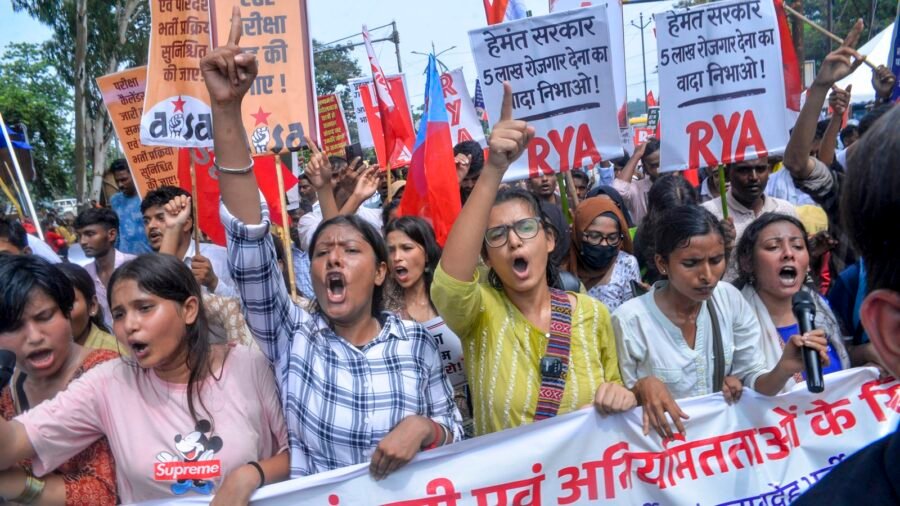
There is a new political fashion in India: Anyone who takes to the streets, abuses opponents, damages public property, or creates disorder is quickly presented as the authentic voice of “Gen Z”. The label is then appropriated by political groups and vested interests eager to give their own agenda the sheen of youth rebellion.
Advertisement
This portrayal does a profound injustice to India’s young generation.
The people who shout the loudest are not necessarily the people who represent their generation. And those who destroy public property, attack institutions, hurl abuse, or turn political disagreement into violence cannot claim a monopoly over the aspirations of millions of young Indians simply because they happen to be young.
India’s Gen Z is far larger, more diverse and considerably more accomplished than the political street theatre through which some of its supposed representatives are being showcased.
Advertisement
Protest is a right, but violence is not a generational identity
In a democracy, peaceful protest is an important constitutional and political instrument. Young people have every right to question governments, challenge policies and demand accountability.
But protest does not acquire moral legitimacy merely because the protesters are young.
Age cannot transform vandalism into democracy and turn abuse into political argument. Nor can a crowd become a representative voice for an entire generation simply because cameras happen to be pointed at it.
The distinction matters because a dangerous narrative is slowly taking shape: That India’s Gen Z is inherently angry, anti-establishment, violent, contemptuous of institutions and incapable of constructive engagement.
When politics hijacks a generation
They may disagree passionately with the government of the day. They may support different political parties. They may be politically conservative, liberal, socialist, nationalist, or politically indifferent.
But political diversity is not the same thing as political disorder.
This is where the “Cockroach Janta Party” phenomenon (political forces that seem determined to crawl into every available social grievance and appropriate it for partisan purposes) needs to be called out.
No political party, whether in government or opposition, owns Gen Z. No ideological group owns the youth. And no handful of activists has the right to define an entire generation through the most disruptive images emerging from a street protest. Neither should India’s Gen Z have its identity outsourced, nor should vested interests be allowed to hijack the label of “Gen Z” and use it to portray an entire generation as angry, anarchic or hostile to the institutions of democracy. There is a profound difference between challenging authority and rejecting responsibility.
Look beyond the noise
Look around India.
You will find young athletes competing at the highest levels, often carrying the Indian flag on international sporting platforms. You will find young entrepreneurs building companies, creating employment and developing products for a global market. You will find engineers, scientists, coders and technology professionals working on artificial intelligence, semiconductors, space technology, biotechnology and other areas that will determine India’s future.
You will also find young scholars in universities and research institutions, pursuing knowledge rather than merely pursuing hashtags. You will find young doctors, teachers, lawyers, artists and professionals building careers through years of discipline and perseverance.
These are not vague impressions. Indian athletes had their best-ever outing at the Asian Youth Games in 2025, winning 48 medals, more than three times the country’s previous best. Months later, they finished second at the Asian U20 Athletics Championships, India’s best result at the event on foreign soil. The startup story looks much the same. Nearly half of India’s two lakh-plus recognised startups are now coming out of tier-two and tier-three cities such as Indore, Kochi, Jaipur and Coimbatore, not just Bengaluru and Gurugram. This year’s list of the country’s most promising entrepreneurs under 30 counted 102 names, up 28 per cent from the year before, running businesses collectively worth close to three lakh crore rupees. Eighty-four per cent of them built their companies from scratch, with no family business behind them.
Most of this activity never makes the evening bulletin. The entrepreneur who spends years building a business does not generate viral footage. Neither does the student who studies for twelve hours a day to get into a premier institution, or the scientist working late in a laboratory, or the young musician and filmmaker adding to the country’s cultural output, or the sportsperson who trains for years before finally winning a medal. Yet these are precisely the people who embody the most constructive possibilities of India’s youth.
The young men and women in uniform
And then there are those young Indians whose contribution is measured not in social-media followers or television sound bites but in courage. They are the young men and women in uniform who guard India’s borders, serve in difficult terrain and, when required, make the ultimate sacrifice for the country. They demonstrate something that is increasingly absent from the caricature of Gen Z being constructed by sections of political activism: Responsibility.
The cost of a distorted image
The danger of such appropriation goes beyond politics. It distorts how India and the world understand its young population.
India is one of the world’s youngest major societies. Its youth are not merely a demographic statistic; they are an enormous productive, creative and strategic resource. If the image of Indian youth is reduced to angry crowds breaking things, abusing people and confronting the police, the country does itself a disservice. More importantly, millions of young Indians who quietly work, achieve and contribute are rendered invisible.
What India needs from its young generation
India needs young citizens who question authority, but who also understand responsibility. It needs young people who demand change, but who know that change requires institution-building. It needs young Indians who are fearless enough to criticise power, but disciplined enough not to destroy what belongs to the public. It needs disagreement without dehumanisation, protest without violence and political activism without the abandonment of basic civic responsibility.
India’s Gen Z deserves better
The real Gen Z story of India is not being written exclusively on the streets. They do not need to hurl abuses to demonstrate courage. They do not need to vandalise public property to demonstrate anger. They do not need political parties to certify their relevance. Their work speaks for itself.
India’s Gen Z deserves better than being reduced to a political prop. Let political parties fight their political battles. Let activists make their arguments. Let governments be questioned and held accountable. But let us not allow vested interests to hijack an entire generation and define it by its loudest, angriest, or most destructive elements.
The real Gen Z of India is not a mob.
It is a generation building, competing, innovating, serving, and achieving.
And that Gen Z is far too large, and far too consequential, to be represented by those whose only claim to represent it is that they know how to make the most noise.
The writer is a communication expert and former Media Relations head, Delhi BJP

This Teachers’ Day, let’s rethink our roles as educators
By Sohail Khan · 5 Sep
Saina Nehwal undertakes a ’29 day plank’ challenge — expert notes core benefits
By Sohail Khan · 5 Sep
UN adopts Equal Earth map: Why no flat map can accurately show the globe
By Sohail Khan · 5 Sep
Leave a Reply