Ganeshotsav’s New Creative Economy: When Bappa Meets Naruto, AI, And Instagram
Ganeshotsav's New Creative Economy: When Bappa Meets Naruto, AI, And Instagram
From anime-inspired idols and viral first-look reels to 3D moulds, sponsorships and AI-generated content, Mumbai's Bappa is entering a new visual age
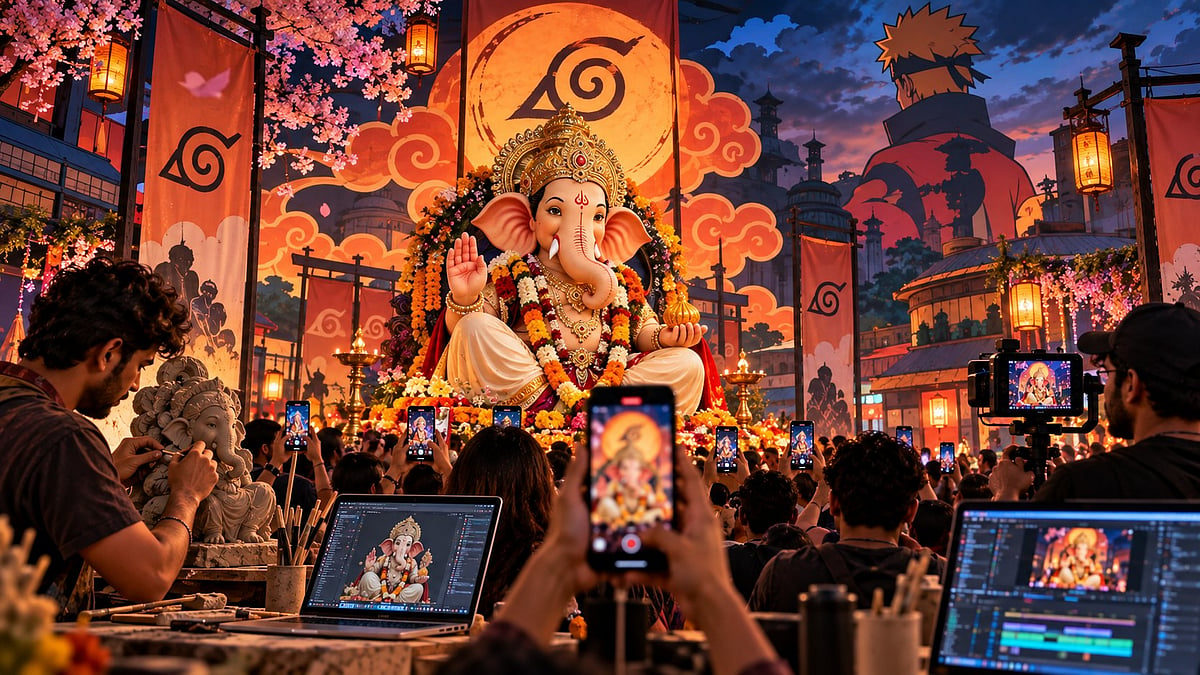
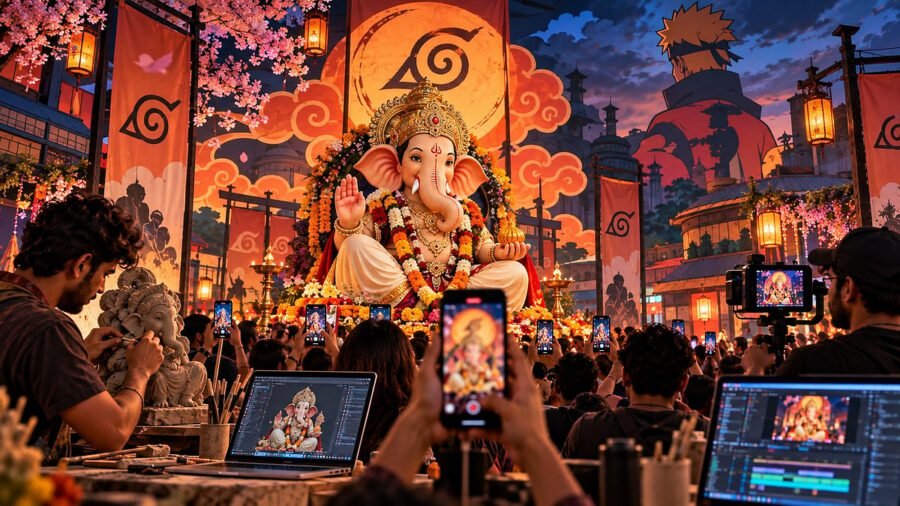
Scroll through Instagram this Ganeshotsav season and Bappa appears in forms unimaginable a decade ago. Alongside the familiar kings, warriors and mythological figures are idols drawing from cinema, anime and fictional characters, including Naruto-style aesthetics, along with cinematic entries, slow-motion aagman reels and first-look videos.
The volume is striking. Some Mumbai reels are already clocking millions of views, #Mumbaiganeshutsav alone shows millions of pieces of content in circulation, and one recent reel featuring Chinchpokli Cha Chintamani crossed 2.5 million views on a social-content tracking platform. Even before the festival peaks, Bappa has become a social-media event.
Younger artists and organisers are absorbing references from digital art and popular culture into a festival historically rooted in tradition. This is the beginning of a new creative economy around Ganeshotsav.
When Bappa enters the pop-culture universe
`;
For generations, idol-making was a family craft, learnt by watching older sculptors work. Today, the process often begins on a screen.
Second-generation murtikar Naresh Kumar Kumawat says digital references have expanded what artists and customers imagine. "Younger customers often come with references, asking for different postures, expressions, colours or themes. Social media has exposed people to designs from different cities, so their expectations are much wider today," he says.
That does not make craftsmanship irrelevant. "An image on a screen is only a starting point," he says. "The face and expression are where the artist's own touch becomes visible."
For 24-year-old Mumbai artist Kartik Agarwal, that combination is what makes the moment exciting. "Earlier you had to imagine how an unusual visual would translate into an idol. Now you can create references, change the pose and see what works. The important thing is that you don't simply copy the screen image, you reinterpret it for Bappa," he says.
3D moulds, digital design and AI-generated images make experimentation easier, but Kumawat believes machines cannot replace the judgement needed once the material is in the sculptor's hands. The future, he argues, is not tradition versus technology but traditional skill using technology intelligently.
The reel becomes part of darshan
At Best Nagar Ganeshotsav Mandal, marketing head Kshitij Shirodkar says social media is now central to how mandals present themselves. "Social media plays a hefty share on mandals standing in today's world. It's certainly how well you present yourself now that makes your chances better," he says.
A mandal once known only within its neighbourhood can now reach viewers across India, and that visibility has commercial value. "A good social media mandal always gets better sponsorship chances than a dormant one," he says. Teams now include a media manager and an editor, with content emerging from a decoration, a celebrity visit or a crowd reaction.
Even darshan is now thought of as content. "Everyone feels they should document things while they do it, not only as memory to cherish but to let people who can't be a part of it enjoy it," Shirodkar says.
AI is also being used for invitations, greeting cards, decoration ideas, music and recipes, while some mandals use technology for crowd management. A video of Mumbai local passengers dancing to the Lalbaugcha Raja song recently went viral, turning a train compartment into a celebration.
From sponsorship to a content economy
Sponsorships now include branded videos, watermarks, promotional reels and brand integrations into festival activities. For 34-year-old Pune resident Smriti Gupta, this follows from how younger audiences consume festivals. "Today, you don't just visit a mandal. You discover it on Instagram, decide when to visit, shoot content there and then watch someone else's version later," she says.
Not everyone is entirely convinced. Rekha Sharma, 56, sees both possibility and concern. "Young people are clearly involved, they are creating, designing, filming, organising," she says. "But sometimes I wonder whether we are becoming more interested in how Bappa looks on the phone than how we feel when we stand in front of him."
Decoration goes digital, and greener
Demand is strong for LED backlighting, artificial flowers and reusable materials such as PVC foam, wood and paper, with eco-friendly makhars replacing thermocol. But Dr Sujit Paul Zota, a healthcare expert and environmentalist, argues a greener Ganeshotsav should not cost artisans their livelihoods. Natural clay and eco-friendly immersion reduce damage, but mean higher raw-material costs, longer drying periods and more labour, so affordable materials, training and fair pricing must accompany the transition.
Tradition is changing, not disappearing
At Best Nagar, new tools serve older purposes. In 2024, residents built a decoration entirely from donated books. In 2025, its MAHA-N-RASHTRA presentation on freedom fighters and responsible celebration won an appreciation letter from the BMC. This year's focuses on sensible tourism. "We have engineers, artists and content creators, but we also want to give a social message that can make the world a better place with the help of Bappa," Shirodkar says.
Pooja Raut, 29, sees this as the more meaningful direction. "Technology is not the enemy of tradition. If AI, reels or digital design help us tell a meaningful story and keep young people connected to Bappa, they are useful. But if everything becomes about getting views, the festival loses some of its soul," she says.
Bappa's new creative economy is not about bigger idols but about the people growing around them: sculptors, designers, content creators, social-media managers, brands and volunteers. The murtikar now works alongside the digital artist. The mandal volunteer is also a content creator. The sponsor wants visibility, the devotee wants darshan.
Somewhere between the clay, the camera and the algorithm, Mumbai is building a new visual language for an old festival. But once the camera is put down, the question remains what it always was: what does Bappa mean to us?

Add As a
Trusted Source 
Expansive art precinct planned in Navi Mumbai
By Sohail Khan · 13 Sep
Beyond Modaks: Discover The Traditional Bhog Offered To Lord Ganesha Across India
By Sohail Khan · 13 Sep
33 years on, metal shrapnel removed from face of man injured in 1993 serial blasts
By Sohail Khan · 13 Sep
Leave a Reply