FPJ Exclusive: ‘Asian Games Gold Was Just The Starting Point,’ Says Indian Equestrian Hriday Chheda On His Olympic Dream
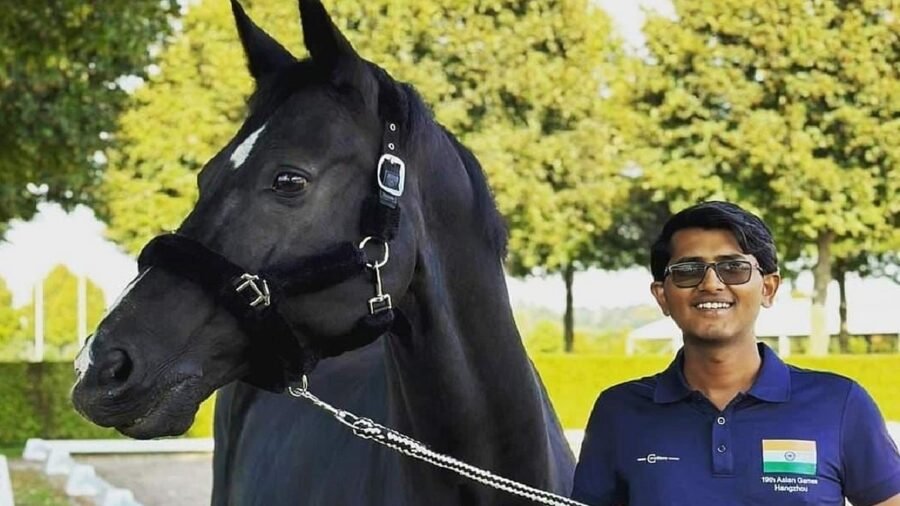
Exclusive: 'Asian Games Gold Was Just The Starting Point,' Says Indian Equestrian Hriday Chheda On His Olympic Dream
Indian equestrian athlete Hriday Chheda reflects on his journey from riding at six to winning historic Asian Games gold in Hangzhou. As he prepares for the 2026 Asian Games with Dono DiMaggio, Chheda discusses building their partnership, improving India’s equestrian ecosystem and his long-term ambitions of competing at Grand Prix level and the 2028 LA Olympics.

Indian Equestrian Hriday Chheda | File Pic
1. Your journey in equestrian sport began at the age of 11 when your father introduced you to riding. What was it about horses and dressage that drew you in at a time when most children were choosing sports like cricket and football?
A: I actually started riding at the age of six, when my father introduced me to riding camps at Japalouppe Equestrian Centre between Bombay and Pune. I was exposed to horses at a very young age, had a great time there, and that experience really got me hooked. While cricket and football were the obvious sports for most children, I never really looked at another sport after that. Over the years, I think I developed a real understanding of horses — learning to communicate with them, understand them and have empathy for them. That relationship is what made equestrian sport so special to me, and ultimately why I chose to pursue it.
2.Dressage is often described as “horse ballet”, but it requires immense technical precision and a deep partnership between rider and horse. How do you build the trust and communication needed to perform at the highest level?
A: For me, it starts long before you enter the arena. Trust is built through the thousands of small interactions you have with your horse every day — training, grooming, travelling, handling and simply spending time together. A good partnership is about understanding what your horse is telling you and adapting your communication accordingly. At the highest level, the aids have to become almost invisible. The horse needs to understand what you are asking without tension or force. The goal is to make two individuals look like one partnership in the arena. That takes time, consistency and a lot of patience.
`;
3: You moved from training at the Amateur Riders’ Club in Mumbai to a more intensive base in Pamfou, France. How has training in an international environment changed your approach to the sport?
A: I didn’t move directly from the Amateur Riders’ Club to Pamfou. I have trained at different centres across India and have been going to Europe for training since I was 13, initially during my summer and winter holidays, and then more permanently after finishing high school. That exposure to international training has changed my understanding of how the sport can be pursued. The quality of trainers, the level of competitions, the infrastructure and the entire ecosystem around the sport are very different. Being exposed to that from a young age has helped me develop a much more professional and international approach to my training and competition.
4. At the 2022 Asian Games in Hangzhou, you were part of India’s historic gold-medal winning dressage team. What did that achievement mean for you personally and for Indian equestrian sport?
A: Winning team gold at the Asian Games was one of the most significant moments of my career. It was particularly special because it was a historic result for Indian dressage, and to be part of that team was an enormous honour.
Personally, it gave me a huge amount of confidence that Indian riders can compete successfully at the highest level in Asia and internationally. For Indian equestrian sport, I hope it showed young riders that there is a pathway to the top of the sport.
But I also see it as a starting point rather than an endpoint. The challenge now is to build on that success and create the conditions for many more Indian riders to reach that level.
5. You are now preparing for the 2026 Asian Games with Dono DiMaggio. How is this horse-rider partnership different from your preparation in 2022, when you had a shorter period to build a connection with Chemxpro Emerald?
A: The preparation is very different. With Emerald, the time available to develop the partnership before the Asian Games was relatively short. With Dono, I have had much more time to understand him — his strengths, his sensitivities, his personality and how he responds to different training. That time is incredibly valuable in dressage. You cannot rush the development of a partnership. Dono is a very experienced horse, and my focus has been on bringing out the best in him while keeping him happy, healthy and confident. We are building the partnership progressively, rather than trying to achieve everything in a short period.
6. You have said that the focus is not on defending the Asian Games medal but on treating it as a new competition. How do you balance the expectations that come with being a defending champion with the need to stay focused on the process?
A: I don’t think you can approach a new competition by trying to recreate the previous one. What happened at the last Asian Games is part of my history, but it doesn’t give you anything when you enter a new arena. Every championship starts from zero. The horse doesn’t know that you won a gold medal previously, and the judges are judging what they see that day. So my focus is on the process — preparing the horse as well as possible, executing our training and going into the arena with a clear mind. The expectations are there, but I try to turn that into motivation rather than pressure.
7. Indian equestrian sport has made significant progress in recent years, but you have also spoken about the need for better infrastructure, coaching and access to quality horses. What changes are most important to create a stronger pathway for young Indian riders?
A: I think the biggest requirement is creating a proper pathway from grassroots riding to international competition. We need more high-quality training facilities, access to experienced international coaches, better competition opportunities and, importantly, access to quality horses. A talented young rider can only progress so far without the right horse and professional environment.
We also need to develop the ecosystem around the athlete — trainers, grooms, veterinarians, physiotherapists, farriers and sports-science professionals. Equestrian sport is a team sport even though there is only one rider and one horse in the arena.
If we can create that ecosystem in India, I believe we will see many more riders capable of competing internationally.
8. Your long-term ambitions include competing at Grand Prix level, Aachen 2026, the FEI World Championships and the LA Olympics 2028. What milestones will you be focusing on as you continue to establish yourself internationally? Looking ahead, what are the key milestones you are working towards as you continue to establish yourself at the international level?
A: The main focus now is to gain more experience at Grand Prix level and continue improving our performances there. With Dono, we will see how he develops both mentally and physically, as he is an older horse, and that will determine how far we can take that partnership.
At the same time, we have another horse in the pipeline that could potentially be aimed towards LA 2028. The Olympics are definitely a goal, but there are many steps between now and then. For now, the focus is on getting more experience, becoming better at Grand Prix level and taking things one step at a time.
9. Having started your journey at Japalouppe near Pune and now training in France, what message would you give to young Indian riders who dream of reaching the global stage in equestrian sport?
A: I would say to start by enjoying the sport and developing a genuine connection with horses. It takes a lot of time and patience, so there are no shortcuts.
I started riding at Japalouppe when I was six, and over the years I have had the opportunity to train in different parts of India and Europe. My advice would be to stay curious, learn from as many people as possible and be willing to put in the work. Coming from India should never make you feel that the international stage is out of reach.

Add As a
Trusted Source 
Navi Mumbai Mangroves Overrun By Plastic & Household Waste, Nearly 1 Tonne Cleared
By Sohail Khan · 20 Sep
Leave a Reply