Flash floods toll may climb as high as 10,000, says Nepalese Finance Minister
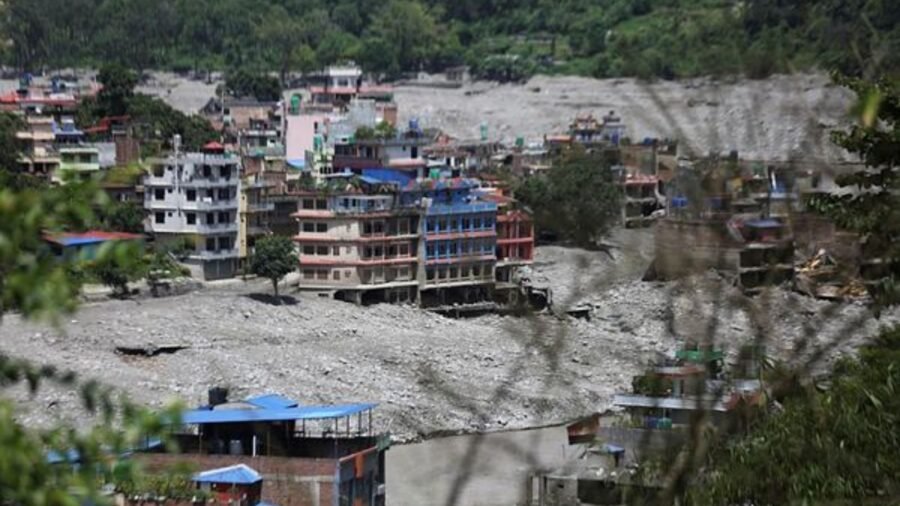
Nepal’s Finance Minister Swarnim Wagle said on Saturday that the final toll from the August flash floods is expected to reach the same as that of the 2015 earthquake at 10,000 deaths.
As of Saturday, Nepal’s disaster management authority puts the death toll at 1,411 and the number of people missing at 5,875.
“The floods were geographically concentrated, but the human toll has been as massive as the 2015 earthquake,” Wagle said. The dead and missing include pilgrims, tourists, traders and small businessmen, he added.
Story continues below.
Subscribe to see fewer ads.
Wagle was speaking at a seminar organised by the Research and Information System for Developing Countries (RIS) in New Delhi. The Nepalese finance minister is on a three-day trip to India for high-level diplomatic and bilateral meetings, including with his counterpart Nirmala Sitharaman and External Affairs Minister S Jaishankar.
He commended India’s prompt relief and rescue assistance following the flash floods, and announced that Nepal Prime Minister Balendra Shah is expected to visit India by the end of the year.
Connectivity, including roads, railways, airways and waterways, between the two countries was one of the major points of discussion with Sitharaman and Jaishankar.
Over the last decade-and-a-half, “we have seen visible changes” on this front, including three world-class highways connecting border towns and integrating the Himalayan country with the Indian hinterland north of the Ganges. “I think it’s been very positive,” Wagle said.
Story continues below this ad
On clean energy, the minister said Nepal had 4,000 megawatts (MW) of capacity, with a lot more in the pipeline. “Our ambition is to go up to 35,000 MW over the next nine years, by 2035, of pure clean energy,” Wagle said.
The floods, however, have hit this sector hard.
In the Trishuli basin, Wagle said that close to 800 MW (or 20% of the total capacity, including both operational and under construction capacity) has been wiped out. Some Korean and Chinese investments have also been hit, he said, adding that “the large Indian-invested projects are in the far east and far west of Nepal, and not in this region.”
The floods also affected 13 hydropower plants, including several under-construction projects, and a solar power plant, Nepal’s Energy Ministry had said in an earlier statement.
At least one hydropower plant — a 14-MW Devighat hydropower plant — that supplies electricity to India was among the power plants affected by the floods, had earlier reported.
Story continues below this ad
Last week, the Centre approved Nepal’s request for early import of electricity from India to offset a generation shortfall caused by the disaster. India will export 654 MW of electricity daily for 18 hours a day (from midnight to 6 pm) from September 13 to December 31. The hours largely cover solar-generation hours.
Wagle also expressed gratitude to India for exporting gasoline and natural gas at a time of upheaval in the world, even as India itself imports them. He said he hoped many of the pending deals on air connectivity, roads and railways would be closed in the near future.
“India and Nepal have an opportunity to renew their partnership by building on the strong ties that already exist,” Wagle said, emphasising on the importance of strengthening connectivity and economic cooperation and realising the considerable potential that the two countries can achieve together.
Munu Mahawar, Additional Secretary (North), Ministry of External Affairs, Government of India noted that the two countries have made significant progress in areas such as connectivity and power, while emphasising the opportunity to advance more ambitious projects and initiatives that have remained unrealised for decades.

Paan’s dark supply chain: How Rs 120-crore khair smuggling network spread its tentacles
By Sohail Khan · 20 Sep
In Pir Panjal, new strategy to keep terrorists from slipping between Jammu and Kashmir
By Sohail Khan · 20 Sep

Leave a Reply