Fishing trip turns 22-day saga of survival
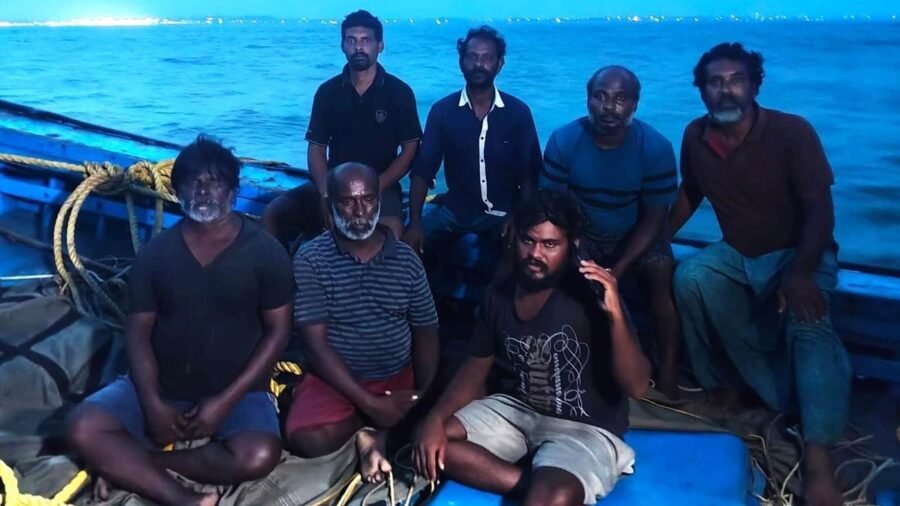
When 49-year-old Koppanathi Ramakrishna set sail into the Bay of Bengal at around 9 a.m. on August 3, 2026, he expected to return in a fortnight with a boatload of tuna, in particular yellowfin tuna (Thunnus albacares). Instead, his maiden deep-sea fishing voyage turned into a 22-day ordeal, leaving him and his six-member crew adrift hundreds of nautical miles from home, with dwindling food and supplies and no way to contact their families.
The journey had begun with hope and careful planning. Ramakrishna, who had only fished in the waters of the Vynateya, a branch of the Godavari River that meets with the Bay of Bengal at Komaragiripatnam in Dr. B.R. Ambedkar Konaseema district, was determined to venture into the deep-sea to catch the tuna, one of the most prized oceanic fisheries resource.
Born into a fisherfolk family, the 49-year-old fisherman was well-equipped with the river and its fishing diversity. But, he had never sailed into the deep sea for fishing. His quest for the deep-sea fishing came at a time when the country was experiencing high exports of tuna. India exported 51,626 tonnes of tuna in 2023-24, worth $87.96 million, an increase of 31.83% from the previous year, according to the Marine Products Export Development Authority. (Source: https://www.thehindu.com/news/national/centre-aims-to-make-andaman-nicobar-islands-a-tuna-export-hub/article68878943.ece)
It was against this backdrop that Ramakrishna decided to venture into the deep sea. He met with the community priest, shared his quest for a voyage, and sought an auspicious time for the sail on his own mechanised boat (IND-AP-E8-MO-135). The boat also carried this faith, as it was painted yellow, representing turmeric, which fisherfolk throw into the sea at the beginning of the annual fishing season on July 14 as part of an auspicious ritual.
Boat owner Koppanathi Ramakrishna.
T. APPALA NAIDU
Alongside ritualistic preparations, Ramakrishna had also taken practical precautions for his sail. He collected a transponder from the local Fisheries Department for his boat. The Government of Andhra Pradesh supplies transponders free of cost for installation on registered fishing boats. These satellite-connected communication devices share the boat’s location with the government and allows the crew to send alerts in an event of emergency.
“I was slightly hesitant to install the transponder on my boat. However, as the auspicious time and date approached for our voyage, our seven-member crew set sail at around 9 a.m. on August 3 from the Odalarevu fish landing point and entered the sea after crossing the calm waters of Vynateya in less than an hour,” says Ramakrishna.
Just like Ramakrishna, the journey was also a first for another crew member, Palepu Santa Rao, who speaks Hindi. This deep-sea fishing expedition was his maiden voyage. The designated boat drivers were 60-year-old Sangani Tata Rao from Brahma Samedhyam and 37-year-old Kollati Srinubabu from Odalarevu. The remaining crew members included Karri Rambabu from Komaragiripatnam, Kollati Yesudasu from Bendamuru Lanka village, and Kataadi Satish Kumar from Pasuvullanka. Led by Ramakrishna, they formed a seven-member crew.
Palepu Santa Rao, one of the seven crew members, with his family members at Odalarevu fish landing centre in Dr. B.R. Ambedkar Konaseema district.
T. APPALA NAIDU
The seven men prepared for a fortnight at the sea. The boat was laden with four tonnes of ice meant for storing tuna, 1,000 litres of diesel, two tonnes of water for drinking, cooking, and bathing, and commodities — rice, oil, and spices — sufficient for 15 days.
“We had three cell phones on board; mine was the most valuable because I had stored notes on locations, including latitude and longitude—beginning from Visakhapatnam to Odisha, Paradeep, and the West Bengal coasts—as a precaution,” says Ramakrishna. He reveals that these notes were shared by an expert driver from Kakinada to help them understand and navigate the nearby coast when matched with the boat’s GPS system.
According to the plan
For a while, the voyage unfolded as planned. The crew enjoyed their first two meals on the boat on August 3. Slowly, the blue waters became invisible as darkness fell. They sailed nearly 35 nautical miles without casting their nets, uncertain about the catch. The first two nights of the voyage passed without even attempting to cast the net. Equipped with a gill net, they tried to target tuna during the night. However, the fish they had travelled so far to catch remained elusive, and on the third day, they noticed that something was wrong.
“On August 5, the third night, we tried our luck for three hours until midnight, casting nets nearly 60 nautical miles parallel to our native coast. But the tuna remained elusive. Suddenly, we noticed an unusual sound from the clutch plates, causing the boat engine to fall silent,” says Palepu Santa Rao from Odalarevu village. By then, not a single school of tuna had been caught. On the same day, they contacted their families for the last time before proceeding further.
Without the engine, the crew could no longer control their course. Santa Rao says, “The next day, we flagged ‘therachapa’ (canvas) to navigate the boat towards the coast, following the wind direction and avoiding any threat of the boat overturning in the sea.”
Fear and survival
By August 7, the boat had been driven by the winds nearly 200 nautical miles away from the Visakhapatnam coast. “In the deep sea, we stopped fishing because we were scared of the giant fish species. We saw one giant fish, believed to be a whale, that came close to our boat. It could have overturned our boat. We were frightened to see the size of the creatures found in the sea,” recall Ramakrishna and the driver, Srinubabu.
Boat driver Kollati Srinubabu, his wife Kameswari and son, offers prayers to the local deity after his safe return.
T. APPALA NAIDU
While the seven men struggled to keep the boat moving, life continued as usual for their families back home. Santa Rao’s family, including his wife Nagalakshmi and sister Sarada, was busy with their everyday chores. Srinubabu, a father of two children studying in Classes VII and IV, hoped for the crew to return home by August 13 or 14 as scheduled.
With rescue nowhere in sight, Ramakrishna realised that keeping his crew hopeful was as important as feeding them. For the next week, Ramakrishna continued to instil hope in his crew members. “I remember telling them to trust me while assuring them that we would not die. Something good will surely happen,” recalls Ramakrishna.
Behind those attempts to keep morale up was a constant fear of collision. The crew members kept themselves busy preparing food and sharing tales from their villages while remaining vigilant for any boat or vessel that might pass by. “I did not sleep during the nights; I kept holding the light to signal our presence in the water to avoid being hit by any large vessel,” says Ramakrishna.
Then came a sighting that briefly raised their hopes. At 116 nautical miles away from Paradeep, a defence or Coast Guard chopper flashed a light on their boat during the night. “We thought it was deployed for our rescue. We responded by flashing our light, but they proceeded without making contact. We understood that it was part of their training session,” recalls Ramakrishna.
Days later another sighting offered a glimmer of hope. By August 20, the boat was sighted by two fishing boats close to Astaranga Beach (Puri district in Odisha), nearly 60 km south of Paradeep. “The crew of the two boats spoke to us in Hindi, gave us a helpline number, and then proceeded to go fishing without hearing our ordeal. We could not reach out to that helpline number due to a lack of signals,” says Santa Rao.
Families seek help
Back home, the disappearance of the fishermen had triggered a massive search operation. The families of the seven men contacted District Collector R. Mahesh Kumar and appealed for help. In response to their appeal, Chief Minister N. Chandrababu Naidu ordered a massive search operation, after which the Eastern Naval Command and the Indian Coast Guard were deployed to intensify the search, covering up to 300 nautical miles.
State Agriculture Minister and Dr. B.R. Ambedkar Konaseema District In-Charge Minister K. Atchannaidu assured the families on August 19 that the State government has alerted the administrations and fishing boat associations in Odisha and West Bengal.
Agriculture Minister K. Atchnnaidu interacts with family members of the fishermen at Odalarevu.
File photo
At least 15 Coast Guard vessels and four helicopters were deployed; electronic surveillance was conducted by the Maritime Rescue Coordination Centre, and Myanmar and Bangladesh maritime authorities were also put on alert, revealed Mr. Atchannaidu. The Indian Navy and Coast Guard were asked to cover a range of up to 300 nautical miles to trace the fishing boat, he added. India’s Exclusive Economic Zone (EEZ), where fishing activity is allowed by Indian boats, extends up to 200 nautical miles from the coast.
For those waiting at home, however, the search brought no answers. In Odalarevu, Kameswari, 34, the wife of Kollati Srinubabu, spent her days at the temples of the local deities, praying for the safe return of her husband, while her two boys played on the banks of the Vynateya, unaware of their father’s ordeal.
“Our hope for the survival of the crew faded as we heard no signs of the missing boat. By August 25, the government stated that the operation was ongoing, but there was no progress in tracing the missing boat,” says Ms. Kameswari, whose family lives in a rented house and ekes out a livelihood through fishing in the river.
At sea, meanwhile, the situation for the seven men was becoming increasingly desperate. “All our food stock was gone by August 22. The leftover ice had melted for drinking and cooking, and we barely caught 14 fish, which we boiled before eating,” says Srinubabu. Except for 60-year-old Sangani Tata Rao, who has a history of low blood pressure, none of the crew members suffered any illness, he adds.
People crossing Vynateya, a branch of Godavari River, at Odalarevu fish landing centre in Dr. B.R. Ambedkar Konaseema district.
T. APPALA NAIDU
‘Wish of God’
After three weeks of uncertainty, help finally found them. On August 26, the boat was sighted by two fishing boats 16 kilometres away from Shankarpur fishing harbour near Digha port in Purba Medinipur in West Bengal.
The crew of one of the two boats rescued the fishermen and offered them food before bringing them to the Shankarpur fishing harbour. Their first priority after reaching the harbour was to contact their families. Ramakrishna called his brother Venkat to inform him of their survival and to spread the word. “I heard my brother Ramakrishna’s voice on a call on August 26 and spread the news like wildfire. I immediately alerted the officials,” says Venkat.
Collector R. Mahesh Kumar says, “Upon being informed about the rescue of our fishermen by West Bengal fisherfolk, we sent a team of officials to bring them back.” The rescued fishermen were kept under the observation of doctors for one day in West Bengal. The entire journey, challenges, survival strategies, sea conditions, and the ordeal of the surviving fishermen have been recorded to formulate a rescue plan to save more lives in the future, the Collector adds.
Back home, their survival prompted both celebration and reflection. The seven fishermen went house to house thanking the families and villagers who prayed for their safe return. Last Sunday, the families of all the survivors offered special prayers to their local deities.
For Ramakrishna, the experience has changed the way he visualises the sea. “My boat is still anchored on the West Bengal coast. If we had not returned, I would have been blamed for the loss of the lives of my crew for the rest of my life,” he says.
The 49-year-old who is survived by his wife, daughter, and son, has decided to quit deep-sea fishing. He began his voyage hoping for a boatful of tuna, instead returned with an experience for a lifetime. “Our survival was the wish of God,” he says.

The dedicated band of district correspondents
By Sohail Khan · 4 Sep
Leave a Reply