Expert explains: Why is Kenyan President William Ruto targeting Indian companies?
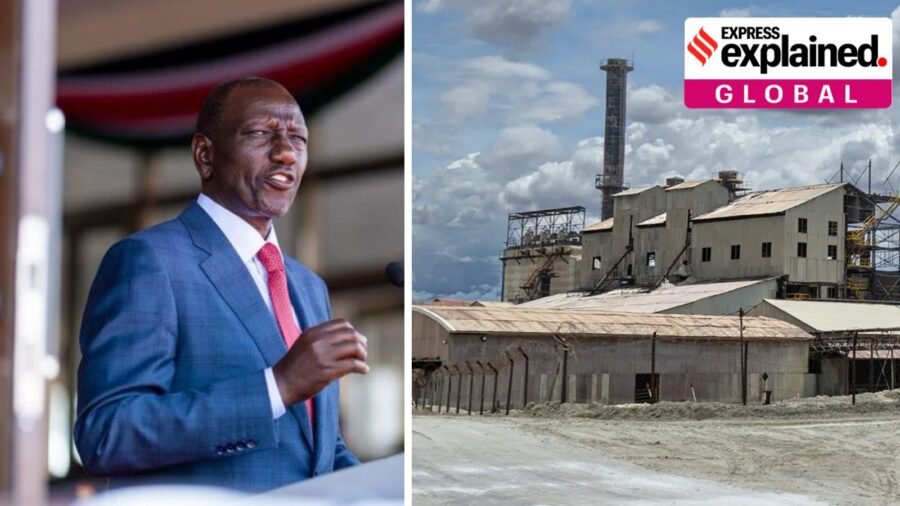
Kenyan President William Ruto’s recent public announcement ordering Tata Chemicals to leave its Lake Magadi soda-ash operation has raised a larger question in India: Why are two major Indian companies, earlier Adani and now Tata, finding themselves on the wrong side of Ruto’s government?
Back in 2024, Ruto cancelled the proposed Adani Group concession for upgrading and operating Nairobi’s Jomo Kenyatta International Airport. So, is Kenya turning against India? And if Tata is being pushed out now, who does Ruto want to bring in?
The short answer is that there is no evidence yet of a deliberate Kenyan policy to replace Indian companies with companies from another country. But there is increasing evidence of a more assertive Kenyan economic nationalism in which foreign investors are expected to deliver much greater local value, employment and industrialisation.
Why Tata?
Ruto’s immediate complaint is clear. Tata Chemicals Magadi extracts soda ash (or sodium carbonate, used in industries such as glass manufacturing) from Lake Magadi in Kajiado County, much of which is exported. It is the largest such plant in Africa. Ruto argues that Kenya has allowed a foreign company to exploit an important natural resource for decades without creating enough downstream industry in the region.
During his visit to Kajiado on September 3, Ruto said Tata had held rights to the resource for about a century but had not built factories or generated sufficient local economic activity. He said Kenya would instead bring in new investors required to establish a large glass factory and a chemical-processing plant in Kajiado. The next day, he said a bidding process would be introduced.
However, Tata Chemicals only acquired Magadi Soda in 2005 from Brunner Mond Ltd., which had held the 1911 concession from 1991 onwards, taking it from the UK’s Imperial Chemical Industries. This timeline is important, in that it shows how Ruto’s target is not simply Tata’s ownership but the broader business model. He wants Kenya to move from extracting and exporting soda ash to processing it locally and capturing more of the value chain.
There is also a regulatory dimension. In July, Kenya suspended Tata’s operations and exports, citing issues including mineral-beneficiation plans, royalty reconciliation, export reporting and community-development obligations. Tata subsequently submitted the requested documentation and says it is fully compliant and awaiting the ministry’s direction. While this is underway, an unverified announcement emerged.
Story continues below this ad
Thus, Tata’s position is that this is a regulatory dispute which should be resolved through due process. Ruto has elevated it into a question of national economic sovereignty.
But why Indian companies?
That two Indian companies have come under the government’s lens of late becomes politically uncomfortable for India.
In 2024, Ruto cancelled the approximately $2.5 billion Adani Group proposal, which became highly controversial in Kenya because of concerns over the concession terms. The new contract with China Communications Construction Co. (CCCC) is nearly 50% more expensive than the original Adani proposal, shifting the financial framework from a private investment-led model to one that depends on commercial loans and future user levies.
The Tata case is different in substance. Tata has operated Magadi since 2005, and its legal rights derive from a much older lease arrangement. The company also points to substantial investment, employment and community programmes, as well as recent investment in a 5-MW solar plant and an electric calciner.
Story continues below this ad
Yet the political optics are striking: within two years, two of India’s best-known corporate groups have encountered major reverses under the same Kenyan president who is otherwise seen as friendly to India. He had a state visit in December 2023. While seeking more Indian Foreign Direct Investment (FDI) into Kenya, Ruto invited Indian companies to ‘take advantage of the conducive and attractive environment to invest in Kenya.’ The events since then naturally raise questions.
Who might Ruto want to favour?
So far, it is not known which companies Ruto wants to bring into Magadi. It would therefore be premature to argue that Ruto is deliberately replacing Tata with Chinese or Western companies. They may well be local interests looking to explore the other critical minerals expected to be found in the Magadi basin.
In the past, Ruto has publicly courted investors from many countries, including Chinese businesspeople, but his investment agenda has been broader: manufacturing, agro-processing, ICT, healthcare, energy and other sectors. In March 2026, he announced more than $2.9 billion in investment deals involving 20 investors.
Kenya’s stated objective now is to find investors willing to undertake downstream industrialisation, rather than simply continue the existing export-oriented model.
What could this mean for India-Kenya ties?
Story continues below this ad
India remains an important economic partner for Kenya, and Indian business has a substantial presence there. Bilateral trade was about $4.31 billion in 2025–26, while Indian companies continue to invest in Kenya. Recent involvement includes major infrastructure and power-sector projects.
But Ruto may be signalling that Kenya’s relationship with foreign investors is changing. For decades, African countries often accepted an investment model in which foreign companies extracted resources, exported them and provided employment, taxes and royalties.
Increasingly, African governments are asking different questions: Why should we export the raw material when we can process it ourselves? Should foreign investors receive long-term access to strategic resources or infrastructure without demonstrating tangible benefits to Kenyan citizens?
For India, the lesson is that its investment in Africa is entering a new political environment. African governments increasingly want investment that visibly creates local industrial capacity, skills, technology, supply chains and jobs. Tata’s may have made substantial contributions by conventional corporate standards, but Ruto is demanding local value addition on a much larger scale.
Story continues below this ad
There is also the matter of precedent. If Kenya can force Tata out after decades of operation, and if the Adani airport concession can be cancelled amid political controversy, Indian companies may reasonably ask whether their contractual rights and long-term investments are sufficiently secure.
India’s answer should probably be neither confrontation nor retreat. It should be a new investment compact: Indian capital and technology, but with deeper local processing, employment, skills and community development; Kenyan access to investment, but with predictable rules, transparent regulation and respect for contracts. And to do this through due process and quietly rather than through public pronouncements.
Rather than a rupture, the Tata-Kenya episode warns that the terms of India’s economic engagement with Africa are changing, and Indian companies may need to adapt.
The author is a former Ambassador to Ethiopia and the African Union.

Good foundation: on India’s strong industrial growth performance
By Sohail Khan · 1 Oct
Bitter pills: on Court’s intervention, drug pricing
By Sohail Khan · 1 Oct
Household debt, financing today against tomorrow
By Sohail Khan · 1 Oct