Expert Explains | How preparing for disasters in the Himalayas can help save lives
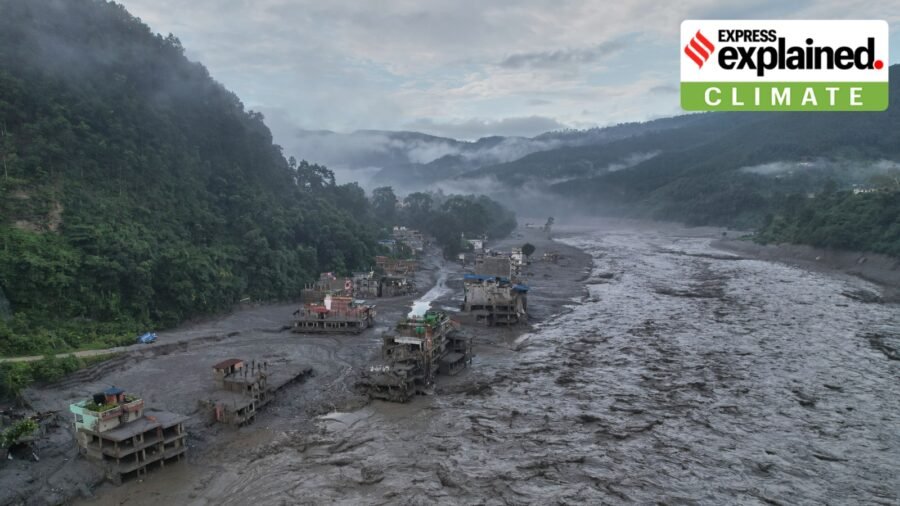
The events in Nepal reinforce a central message: that there is a compelling need to shift from reacting to disasters in the Himalayas to anticipating them, according to Anshuman Bhardwaj, Head of Department (Planetary Sciences) and Programme Director (MSc Planetary Sciences) at the School of Geosciences, University of Aberdeen.
With a warming Himalaya, the conditions that destabilise ice and rock are becoming more widespread, making preparedness increasingly urgent, said Bhardwaj, who co-authored a study published in Nature Sustainability in March titled ‘Rock-ice avalanches in a warming Himalaya indicate pathways toward effective preparedness’.
In that study, Bhardwaj and team compared two events to highlight the importance of preparedness. When a massive wall of ice and rock collapsed into the Rishiganga valley in Chamoli in 2021, it ended up destroying hydropower plants, sweeping away bridges, and killing over 200 people in north India. Four years later, when a large ice–rock avalanche struck Blatten, Switzerland and buried most of the village, there was just one casualty. Edited excerpts from an interview with Anil Sasi:
On the Nepal tragedy
Story continues below this ad
Although the precise sequence and trigger of the Nepal-Tibet event will need to be established through detailed investigation, it is certainly a result of a rock-ice avalanche as you must have seen on multiple platforms. Many scientific groups are working on the assessment. My response… would be focused on relating it with some works which we have published in recent times.
First, this event highlights that we need to think of these as cascading hazards, rather than isolated landslides, avalanches, or floods. A rock-ice avalanche can rapidly entrain water, sediment and boulders and transform into a highly destructive debris flow or flood, with impacts extending many kilometres downstream. The relevant risk is therefore not simply the stability of the source slope, but the entire hazard chain and its downstream exposure. This has important implications for hazard zoning and infrastructure planning, particularly in glacier-fed valleys where roads, settlements and hydropower infrastructure can lie directly within potential cascade pathways.
I am leading a project jointly funded by UK Research and Innovation and the Indian Ministry of Earth Sciences on cascading hazards in the Himalaya, and more such initiatives are needed to harmonise the workflows for enabling systematic mapping, monitoring and modelling of hazardous landscapes in the Himalaya.
Second, we need to strengthen anticipatory monitoring and preparedness. Large-scale satellite observations, particularly multi-year datasets, can help identify progressive deformation and other changes at potentially unstable slopes. They cannot predict every failure, but they can provide an important regional screening mechanism to identify slopes that warrant closer, higher-frequency monitoring. Our analysis of the 2021 Chamoli event demonstrated the potential of this approach.
Story continues below this ad
Importantly, monitoring is useful only when it is connected to action. The lesson from our comparison of Chamoli and Blatten… is that satellite observations and targeted ground-based monitoring need to be connected to clear, site-specific thresholds, rapid scientific interpretation, defined decision-making responsibilities, reliable communication, and pre-agreed response or evacuation procedures.
The objective is not real-time monitoring of the entire Himalayan range, which is neither feasible nor currently possible anywhere, but a staged approach: regional satellite screening, identification of susceptible, vulnerable, and exposed locations, focused field-based monitoring, and actionable warnings.
On cross-border disasters
This also a transboundary risk-management issue. Cryospheric hazards do not respect political boundaries: a failure in an upstream area can rapidly propagate downstream into another country. The Nepal-Tibet event is a powerful reminder of the importance of timely data sharing, joint monitoring and coordinated emergency communication across shared river basins. These should be viewed as essential components of disaster preparedness.
Finally, we should be careful not to rush process attribution while responding to the immediate emergency. A rapid understanding of what happened is essential for assessing further immediate risks, but accurate process attribution requires multidisciplinary and multi-institutional investigation. Our recent work on the Dharali event highlights why this matters: different processes can produce superficially similar downstream impacts but have very different implications for hazard assessment, monitoring and mitigation.
On shifting from reacting to anticipating
Story continues below this ad
Mischaracterising the underlying trigger can shift both scientific investigation and policy responses away from the processes that actually govern disaster risk in Himalayan valleys.
Overall, the Nepal event reinforces the central message of our work: the Himalaya needs to shift from reacting to cryospheric disasters to anticipating them. With a warming Himalaya, the conditions that destabilize ice and rock are becoming more widespread, making preparedness increasingly urgent. The goal is not to predict every avalanche, but to systematically reduce the likelihood that a foreseeable mountain hazard becomes an avoidable human catastrophe.

Don’t buy a lab-grown diamond before checking these 7 things
By Sohail Khan · 29 Sep
Towards a gender just Uniform Civil Code
By Sohail Khan · 29 Sep
Essar eyes $18-billion US steel plant: Why Indian firms are investing in US amid tariffs
By Sohail Khan · 29 Sep