EPFO data: Share of labour-intensive sectors drops as formal workforce grows
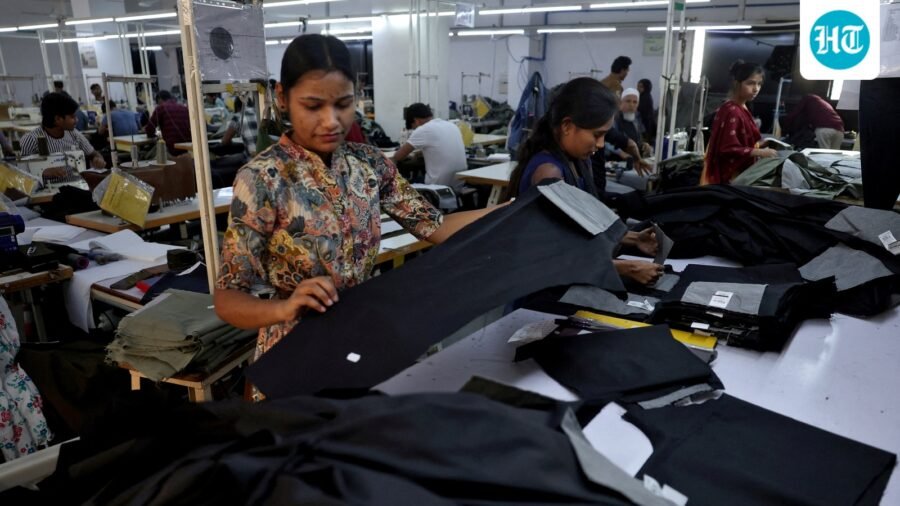
To be sure, EPFO payroll data indicates formal-sector employment and does not capture workers outside the EPFO net, particularly those in the informal economy.
Published on: Sep 23, 2026, 23:20:26 IST
Prefer HTon Google
Share via
Copy link
India’s formal workforce is expanding, but the sectors that have traditionally provided a pathway for workers with limited formal education are losing ground within it, with their share of Employees’ Provident Fund Organisation (EPFO) contributors falling over the past two years, data shared by the labour ministry show.
The number of EPFO contributors in 12 labour-intensive industries — garments, textiles, jute, leather, beedi, tea, tea plantations, brick making, cashew, coir, cotton ginning and diamond cutting — fell 1.3% to 54.64 lakh in 2025-26 from 55.36 lakh in 2023-24.
Their share of total EPFO contributing members fell to 6.87% from 7.58%, even as the overall EPFO-covered workforce rose nearly 9%, from 7.30 crore to 7.95 crore.
Their share of total EPFO contributing members fell to 6.87% from 7.58%, even as the overall EPFO-covered workforce rose 8.97% (or 65.46 lakh), from 7.30 crore to 7.95 crore.
To be sure, EPFO payroll data is an indicator of formal-sector employment and does not capture workers outside the EPFO net, particularly those in the informal economy.
Traditional job-generating sectors lose ground
Among the 12 industries, cashew industry recorded the sharpest percentage decline, with EPFO contributors falling 25.1% from 77,128 in 2023-24 to 57,733 in 2025-26. Tea plantations fell 19.3% to 80,845, jute fell 15% to 1.13 lakh, tea fell 12.5% to 2.17 lakh and brick-making fell 12.8% to 35,578.
In absolute numbers, beedi-making, which had 12.12 lakh EPFO contributors in 2025-26, recorded the largest absolute decline, losing 33,699 contributors, or 2.7%, from 12.46 lakh to 12.12 lakh. Diamond cutting lost 7,693 contributors, an 8.8% decline, to 79,874.
Garment-making declined 0.8% to 11.84 lakh, while leather products were broadly flat, falling 0.5% to 3.24 lakh.
Textiles was an exception, with contributing members rising 3.9% to 20.98 lakh from 20.20 lakh. But the increase was concentrated in 2024-25 as membership slipped marginally from 21.00 lakh that year to 20.98 lakh in 2025-26.
Taken together, the 12 sectors added no net formal jobs and infact, lost 72,076 EPFO contributors over the two-year period.
Broader labour-intensive basket also loses share
The decline is not confined to these 12 industries.
An analysis of the 197 sectors listed in the labour ministry’s EPFO annexure grouped 85 relatively labour-intensive activities into a broader basket, including food and agro-processing, textiles and garments, leather, gems and jewellery, plantations, construction, wood products and traditional manufacturing.
The basket had 1.17 crore EPFO contributors in 2023-24, rising to 1.21 crore in 2024-25 before falling to 1.20 crore in 2025-26. Its share of the total EPFO workforce, however, fell steadily — from 16.04% in 2023-24 to 15.69% in 2024-25 and 15.14% in 2025-26. Over two years, the basket added just 3.34 lakh contributors, or 2.9%, compared with the 65.46 lakh, or nearly 9%, increase in the overall EPFO workforce.
It actually lost 66,368 contributors in 2025-26, even as total EPFO membership rose by 23.73 lakh that year.
Why does this matter?
Employment falling in these sectors matters because they are among the few large-scale employment pathways for workers moving out of agriculture, said Harshil Sharma, a labour economist with a PhD from Jawaharlal Nehru University who has worked with state governments on skilling programmes.
They typically hire workers with class 8-12 education and limited or no English proficiency — a profile that overlaps with a large part of India’s agricultural workforce, Sharma said.
He said the sectors are also important because of their ability to employ women at scale.
The concern, therefore, is not simply that some traditional industries are shrinking within the formal workforce. It is whether workers leaving agriculture have another comparable pathway into formal, relatively stable employment, he said.
The fastest-growing EPFO categories do not necessarily offer that pathway.
Of the 65.46 lakh net increase in EPFO contributors between 2023-24 and 2025-26, the services basket accounted for about 42.32 lakh, or nearly 65%. Contributors in services rose from 5.04 crore to 5.47 crore.
The largest increase came from “expert services”, where membership rose by 20.28 lakh, from 2.29 crore to 2.50 crore. Trading and commercial establishments added 5.31 lakh contributors, financing establishments 3.65 lakh, hospitals 1.33 lakh and restaurants 46,194.
The services basket covers 53 sectors, including professional and financial services, education and health, transport and logistics, hospitality and food services, aviation and rail-related services, media and entertainment, cleaning and other personal or business services, trading and commercial establishments and travel agencies.
But the workers entering these expanding segments are not necessarily the workers losing jobs in labour-intensive manufacturing. “A jute worker in Murshidabad, a mine worker in Odisha or a brick-kiln worker in UP cannot simply be absorbed into expert services, computers or finance,” Sharma said.
Growth is not only in services
The increase in formal employment is also not solely a services story.
A separate basket of 59 industrial, mining and utilities sectors — including mining and mineral extraction, metals and steel, cement and chemicals, petroleum and natural gas, electricity and utilities, and other specialised industrial activities — added about 19.80 lakh contributors, accounting for roughly 30% of the overall increase.
Electrical, mechanical and general engineering products added another 3.13 lakh, with contributors rising from 44.94 lakh to 48.07 lakh.
This shows that “manufacturing isn’t falling; labour-intensive manufacturing is. Capital-intensive manufacturing is growing, but below the overall rate,” Sharma said.
However, a fall in formal employment in labour-intensive sectors does not necessarily mean the workers disappear from the labour market. “These workers need work, so either their contracts shift to informal arrangements without job security, or they move into gig delivery, petty retail or casual construction,” Sharma said.
Sharma said the issue is particularly important because India’s demographic advantage is not indefinite.
The country needs sectors capable of absorbing workers with limited formal education while a large working-age population is still entering the labour market, he said. “The demographic window is expected to narrow in the 2040s, leaving little room for a second employment pathway at the scale once provided by labour-intensive manufacturing.”
Track live Stock Market Today updates and check your NSE IPO Allotment Status Today. Stay informed with the latest business news like N Chandrasekaran, petrol and diesel prices, gold and silver rates, income tax updates, and major economic developments across India and globally.
See Less

FSSAI initiates action against Amazon, Swiggy
By Sohail Khan · 24 Sep
Reliance’s FMCG war chest swells
By Sohail Khan · 24 Sep
Who stands where in the Tata Trusts listing debate?
By Sohail Khan · 24 Sep
Leave a Reply