‘Engineered brain freeze’: How cyber fraudsters exploit fear and stress
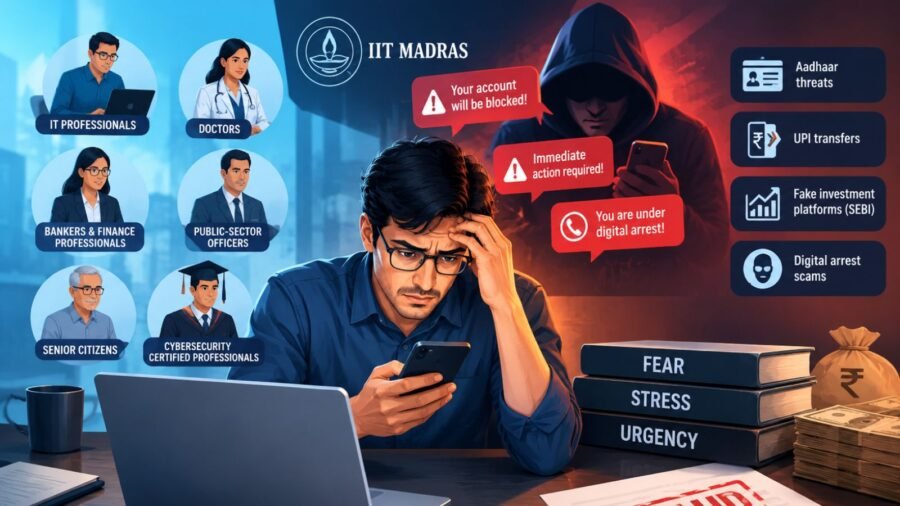
Even highly educated and digitally savvy professionals can fall victim to financial cyber fraud, with scammers exploiting fear, stress, and urgency to impair victims’ decision-making, a study by researchers at the Indian Institute of Technology (IIT) Madras has found.
Based on interviews with 33 victims, the study found that those targeted included IT professionals, bankers, doctors, management and finance professionals, public-sector officers, and people with cybersecurity certifications.
The study interviewed 22 men and 11 women, including 12 senior citizens, across Chennai, Bengaluru, Hyderabad, New Delhi, and Mumbai.
Story continues below.
Subscribe to see fewer ads.
Researchers found that victims were often targeted during periods of heightened vulnerability, such as illness in the family, retirement, job searches or workplace pressure.
Fraudsters used threats, financial incentives and concerns about reputation to create what the researchers describe as an “engineered brain freeze”, leaving victims in a state of “mind arrest” in which they struggled to assess what was happening.
Victims reported financial losses ranging from a few thousand rupees to more than Rs 1 crore. The consequences extended beyond money, with victims reporting shame, insomnia, depression, and strained family relationships.
‘Response must move beyond blaming victims’
The study, led by Professor P Kandaswamy and Professor Nandan Sudarsanam of IIT-Madras, challenges the perception that cybercrime victims are primarily people with poor technological knowledge or those motivated by greed.
Story continues below this ad
The interviews show that fear, family expectations, financial pressure, and a lack of awareness that a crime is taking place can also make individuals vulnerable.
Professor Akanksha Jaiswal, Associate Professor, The University of Western Australia, Chennai Campus, and Professor Ameeta Fernando of Loyola Institute of Business Administration, Chennai, also collaborated. The Wadhwani School of Data Science and Artificial Intelligence at IIT-Madras supported the research.
“Our findings show that financial cybercrime is not simply a problem of inadequate digital literacy. Even highly educated and digitally experienced individuals can become vulnerable when fraudsters exploit fear, stress, and urgency. Understanding these factors is essential to designing more effective prevention strategies,” said Professor Sudarsanam of the Wadhwani School.
“The response to cybercrime must move beyond blaming victims,” Professor P Kandaswamy, also a retired Indian Police Service officer, said.
Call for stronger systems
Story continues below this ad
Kandaswamy said banks and law-enforcement agencies need stronger systems for early detection, rapid intervention, and coordinated response, along with better support for victims.
The researchers identified several India-specific fraud tactics, including threats involving Aadhaar, UPI-based transfers, fake investment platforms claiming SEBI registration, and “digital arrest” scams.
The study also found that institutional responses varied, with some banks and cybercrime cells responding quickly, while others lacked the required technical capabilities and coordination.
The researchers called for stronger systems to detect suspicious transactions early, faster intervention by banks and better coordination among banks, the police, and courts. They also recommended replacing generic warnings to “be careful online” with targeted awareness campaigns based on specific fraud tactics and situations in which people may be particularly vulnerable.
Story continues below this ad
The researchers cautioned that the study is qualitative, metropolitan in scope and largely reflects the experiences of victims who came forward to report fraud.
The team plans to test the findings through a multilingual, large-scale survey and expand future research to tier-II and tier-III cities, the unorganised sector and long-term victim recovery.

Assam Rifles team ambushed by militants in Arunachal Pradesh; 1 jawan killed
By Sohail Khan · 29 Sep
Before Ujjain violence, some local influencers went into rumour overdrive, police say
By Sohail Khan · 29 Sep

Leave a Reply