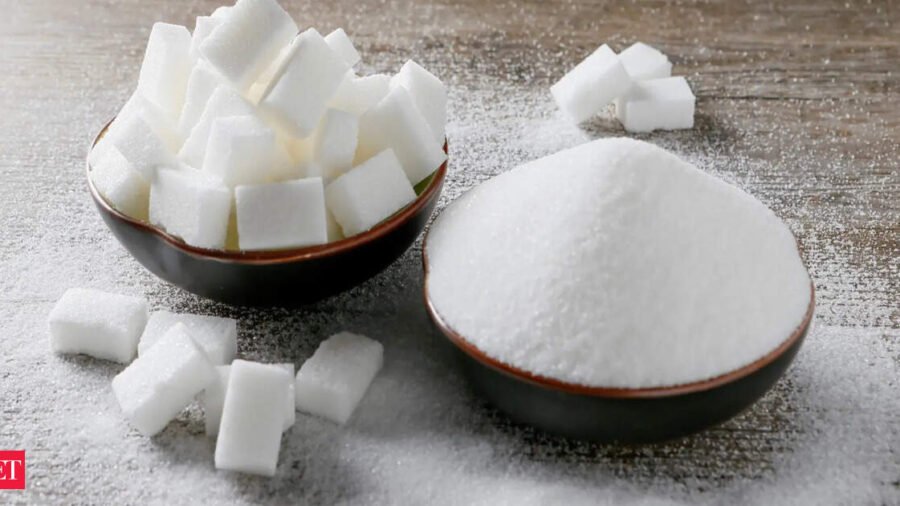
Duty-free imports, other factors raise sugar prices
Benchmarks
Nifty23,897.7024.25
Precious Metal
Gold (MCX) (Rs/10g.)154,978.00-797.0
Enter search text:
Business News›News›International›World News›Adverse weather, lower Brazil output, India's duty-free imports push global sugar prices up 11.9%: FAO
Read Today's Paper
Adverse weather, lower Brazil output, India's duty-free imports push global sugar prices up 11.9%: FAO
Synopsis
Global sugar prices rose sharply in August, driven by adverse weather and El Nino impacts. Lower production in Europe and Asia contributed to the significant price increase. India's decision to allow duty-free raw sugar imports also played a role. Other food commodity prices also saw increases during the same period. These price hikes signal growing concerns over global food supply stability.
 ANI
ANIRelated
New Delhi: Global sugar prices surged 11.9 per cent in August from the previous month due to many factors including lower production in Europe due to adverse weather, impact of El Nino on production in key producing countries in Asia and India's announcement of duty-free raw sugar imports, according to the latest Food Price Index released by the Food and Agriculture Organization of the United Nations (FAO).
"The FAO Sugar Price Index increased by 11.9 per cent in August," the UN food agency said.
Explaining the sharp rise, FAO said, "The surge reflected expectations of lower sugar beet yields in the European Union due to adverse weather, concerns over the impact of El Nino on production prospects in key producing countries in Asia, lower sugar production in Brazil, and India's announcement of duty-free raw sugar imports."
Sugar recorded the sharpest monthly increase among the major food commodity groups tracked by FAO in August.
The broader FAO Food Price Index, which tracks monthly changes in international prices of a basket of globally traded food commodities, averaged 133.3 points in August 2026, up 1.9 per cent from its revised July level and 2.5 per cent from a year earlier.
MORE STORIES FOR YOU✕
How India's below-average September rainfall fuels concern about crops
Retail sugar price drops 3.85% to Rs 62.57/kg in a week: Govt data
« Back to recommendation stories
I don't want to see these stories because
They are not relevant to meThey disrupt the reading flowOthers
SUBMIT
FAO said high temperatures, weather-related risks, geopolitical tensions and disruptions to key trade routes had raised concerns over global food supplies.
"August's increase in global food prices is a warning that the risk premium is returning to food markets: climate shocks, geopolitical tensions and disrupted trade logistics are converging to tighten supply expectations, showing that resilience, open trade and secure input flows are now central to global food-price stability," FAO Chief Economist Maximo Torero said.
Apart from sugar, the FAO Cereal Price Index rose 2.2 per cent from July, while the Dairy Price Index increased 2.3 per cent, the Vegetable Oil Price Index climbed 1.1 per cent and the Meat Price Index rose 1 per cent.
Global wheat prices increased 2.6 per cent during the month and were 15 per cent higher than a year earlier amid disruptions to Black Sea export logistics, weaker production prospects in Europe following hot and dry weather and a weaker US dollar.
The FAO, in its latest Cereal Supply and Demand Brief released alongside the food price data, also forecast global cereal production at 2,980 million tonnes in 2026, down 2 per cent from 2025, though still expected to be the second-largest harvest on record.
Add 

(You can now subscribe to our WhatsApp channel)
(You can now subscribe to our WhatsApp channel)
Read More News on
global sugar pricesFood and Agriculture Organizationsugar productionFAO Food Price IndexBrazil sugar outputEl Nino impactglobal food pricessugar price today


Enter search text:
Stories you might be interested in

NASA’s 50,000-square-foot green office
By Sohail Khan · 4 Sep
Air India terminates Phuket-Delhi flight pilot
By Sohail Khan · 4 Sep
US nonfarm payrolls surge in August
By Sohail Khan · 4 Sep
Leave a Reply