Delhi court allows VanDyke, 6 Ukrainians to travel home after NIA charge sheet
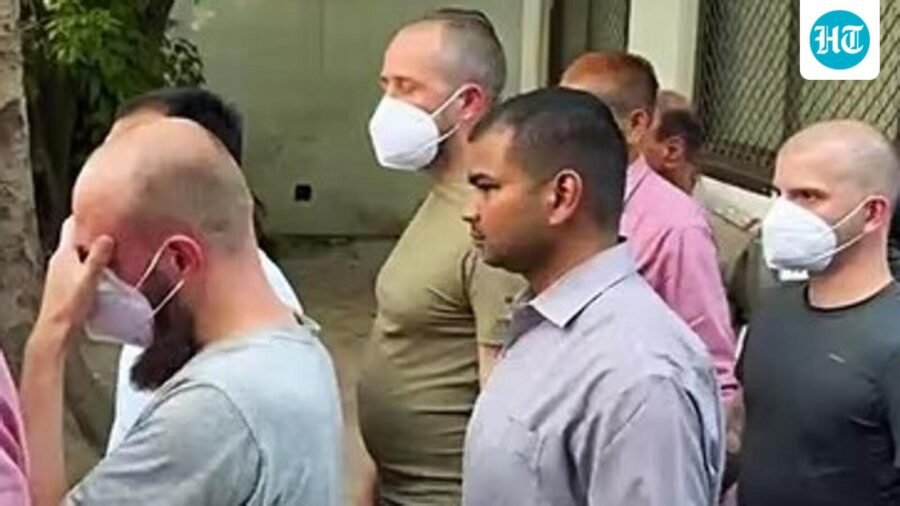
Delhi court allows US national Matthew Aaron VanDyke and six Ukrainians to travel home after NIA charged them only with immigration offences.
Updated on: Sep 24, 2026, 23:34:08 IST
Prefer HTon Google
Share via
Copy link
Court Decision
A Delhi court on Thursday allowed US national Matthew Aaron VanDyke and six Ukrainian nationals to travel back to their home countries, two weeks after the NIA charged them only with immigration offences, leaving out the Unlawful Activities (Prevention) Act, under which they were investigated, sources confirmed.
The order was passed by Special Judge Prashant Sharma of Rouse Avenue Courts, allowing applications moved by VanDyke and others, through advocates Rohit Dandriyal and Rohit Gour, seeking release of their passports and permission to travel to the US and Ukraine.
The development comes after a Delhi court on Wednesday granted default bail to the six Ukrainian nationals and last week to Matthew Aaron VanDyke, holding that the NIA’s charge sheet against them was “piecemeal” and left the right of the accused persons to relief intact.
Sources said that Special Judge Sharma, while allowing their travel applications, granted them 24 hours to inform the NIA about their place of stay abroad and details of a close contact, in case the agency requires the same for investigation purposes.
The court further gave them 30 days from the date of the order to fulfil their travel requirements, including booking flight tickets, the sources added.
Special Judge Prashant Sharma on Wednesday had discharged the six Ukrainians under Sections 21 (penalty for unauthorised entry) and 23 (penalty for visa overstay and general contraventions) of the Immigration and Foreigners Act on the basis of compounding before the FRRO (Foreigners Regional Registration Office). This came after the accused paid ₹5.5 lakh as a penalty for the immigration offences. The court further imposed a cash bond of ₹1 lakh on their release.
The court had also modified the bail condition of the accused persons, allowing them to be released on personal bonds instead of a surety, due to a lack of known persons in the country.
The NIA filed its charge sheet against the seven persons on September 8, charging them only under Sections 21 and 23 of the Immigration and Foreigners Act, 2025, which cover illegal entry and violations of visa conditions, and leaving out the Unlawful Activities (Prevention) Act (UAPA), under which they were arrested and investigated.
“The chargesheet filed by the NIA is piecemeal as it pertains to section 21 and 23 of Immigration and Foreigners Act, 2025, only. In the wake of further investigation being carried out by the NIA with respect of offences under UAPA, at this stage it cannot be concluded that accused is not entitled to default bail,” the court had said in its order, while granting default bail to VanDyke last week. Both the immigration offences are compoundable before FRRO after appropriate payment of the penalty amount.
Default bail accrues to an accused when an investigating agency fails to complete its investigation within the period the law allows. The NIA had 90 days to file its charge sheet against the seven accused and was granted a further 90 days, taking the period to 180 days.
The agency could not circumvent the provision of default bail “by filing an incomplete chargesheet” to deny VanDyke the relief, the court had added.
VanDyke was arrested at Kolkata airport on March 13 under Section 18 of the UAPA, which punishes conspiracy, advocacy, abetment or incitement to commit a terrorist act. The six Ukrainians, Hurba Petro, Taras Slyviak, Ivan Sukmanovskyi, Marian Stefankiv, Maksim Honcharuk and Viktor Kaminskyi, were arrested at Delhi and Lucknow airports the same day. All seven have been in judicial custody at Tihar jail.
The two immigration offences the NIA has charged them with carry maximum sentences of five and three years in prison.
In the charge sheet, the agency said it had completed a substantial part of its investigation into the UAPA offences but needed more time “to ascertain and verify the true and complete facts about the commission of offences under UAPA”. It sought permission to continue investigating the import and recovery of a large quantity of drones and accessories through India, and material seized from digital devices, which it said “may indicate their possible involvement in acts affecting/threatening the unity, integrity, security and sovereignty of India”.
The NIA has alleged that the seven entered India on valid travel documents in December 2025, travelled to Guwahati and Mizoram without the mandatory protected area permit or restricted area permit, and crossed the India-Myanmar border through unauthorised points to reach Victoria Camp, where they were to conduct pre-scheduled training for Myanmar-based ethnic armed groups in drone warfare, drone operations, assembly and jamming technology. They returned to India around March 5, 2026. Some of those groups, the agency has said, are linked to insurgent organisations in India.
Six taxis hired through a car rental company that caters to foreigners took the accused from Guwahati into Mizoram’s protected area, according to the charge sheet. They halted for several hours before crossing into Myanmar by the Tiau river route, reaching Victoria Camp on December 29, 2025. Two people, Abika and Viktor/Kima, arranged the logistics for the crossing, the agency said.
The NIA has maintained that the trip went beyond an immigration violation and formed part of “a larger conspiracy involving Indian insurgent groups, particularly those active in the northeastern states”.
VanDyke, who is from Baltimore, describes himself on his website as a soldier, war correspondent, columnist and international businessman, a veteran of the Libyan revolution and a former prisoner of war there. He founded Sons of Liberty International, a military contracting firm.
Frequently Asked Questions
Powered ByAsk
See Less
GVP College to organise national seminar on NEP-2020
By Sohail Khan · 25 Sep
Role of pharmacists in strengthening healthcare systems highlighted
By Sohail Khan · 25 Sep
Leave a Reply