Corporate America is getting hooked on open-source AI
AT&T turned to artificial intelligence models from Anthropic and OpenAI in recent years to help with customer service, call transcription and coding. The AI models charged fees and were “closed,” which meant the AI companies did not share their underlying code.
This year, AT&T changed course.
As AI costs skyrocketed, Andy Markus, the company’s chief data and AI officer, looked for cheaper alternatives. He landed on “open” models, which can be downloaded and modified without payment or approval.
By May, open models accounted for 20% of AT&T’s AI use. That has since risen to 40% and may jump to 60% in the coming months, Markus said in an interview.
“We believe it could go much, much higher,” he said, adding that AT&T was saving up to 80% on AI costs compared with earlier this year.
Open-source AI has become all the rage in corporate America. Like AT&T, companies such as Airbnb and Deloitte are also turning to open AI models that are easy to customize and cheaper to use. Last month, open models accounted for 58% of AI use, up from 10% a year ago, according to U.S. user data from OpenRouter, a platform that lets people choose different AI models to complete tasks.
On Thursday, chipmaker Nvidia announced it was buying Hugging Face, a library of open AI models, for $12.9 billion, another sign of the technology’s importance.
“Together, we will make AI more open, more capable and more accessible to people and institutions around the world,” Nvidia CEO Jensen Huang said.
Story continues below this ad
Open models come in two flavors. One is an open-source model, which makes its underlying code public. The other is an open-weights model, which makes its “weights” — the numerical calculations that determine how the model reasons — public.
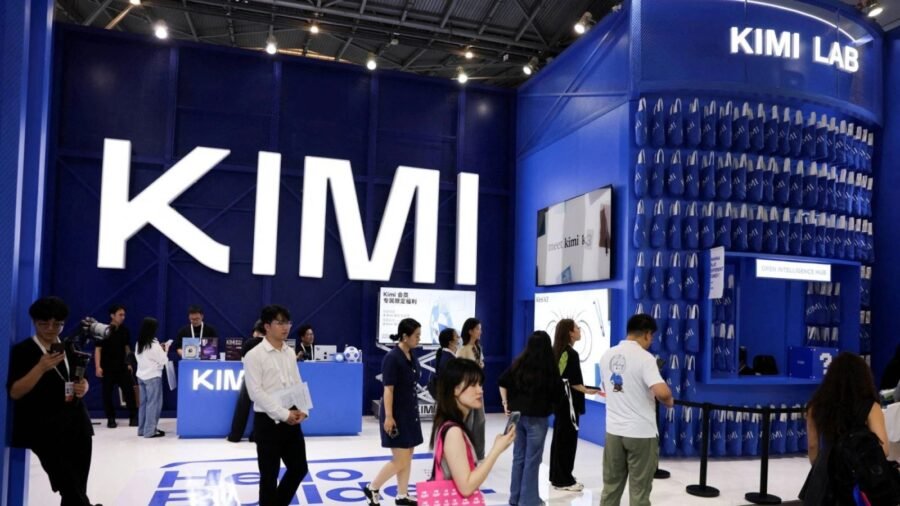
Many of the most popular open AI models are made by Chinese companies like Moonshot AI, DeepSeek and Alibaba. Rather than spending millions in fees to use a closed model, developers can download one of the Chinese systems and build their products on top of it, paying mainly for servers. OpenAI and Anthropic charge for subscriptions and other fees, depending on the job.
Some Chinese open models are now 80% to 90% as powerful as those from OpenAI and Anthropic, while costing as little as 20% of the price, said Jerry Tang, CEO of Atlas Cloud, a startup that provides access to various AI models. He compared the leading models from OpenAI and Anthropic to pricey sports cars — powerful, but not always necessary.
“Mazdas do a fine job getting you where you need to go, and Maseratis are simply not worth the investment,” Tang said. Open-source models, he added, “offer a better bang for your buck.”
Story continues below this ad
The popularity of open models could spell trouble for Anthropic and OpenAI, which are both heading toward blockbuster initial public offerings. The companies have to charge more as they spend billions on research and development and computing power.
OpenAI and Anthropic did not immediately respond to requests for comment. (The New York Times has sued OpenAI and Microsoft, claiming copyright infringement of news content related to AI systems. The companies have denied the suit’s claims.)
The rise of open models plays into a broader debate in Silicon Valley and Washington about control over AI. Dario Amodei, CEO of Anthropic, has argued that AI should be tightly regulated to prevent national security concerns. Other tech leaders such as Huang and Mark Zuckerberg, CEO of Meta, have said open-source technology is crucial for having a democratic, balanced AI ecosystem.
After OpenAI released ChatGPT in 2022, many companies and users gravitated to closed AI models. At the time, open-source models were mainly popular among developers.
Story continues below this ad
The models began gaining favor last year after Chinese startup DeepSeek released one called DeepSeek-V3. It stood out for being nearly as cutting edge as leading closed models, while requiring less computing power. Since then, open models from Chinese companies have increasingly caught up to the performance of closed models from Anthropic, OpenAI, Google and others.
Many open models can now be powered by a phone or laptop, said David Stout, CEO of WebAI, an AI startup. That has made the technology more accessible and even cheaper. Leading closed models are getting more complicated and requiring more computing power.
Most U.S. companies still use a combination of open and closed models. Closed models remain the best for heavy-duty tasks like coding and image and video generation, while open models often excel at simple, specialized tasks, Tang said.
At AT&T, the telecom company is now taking open-weights models and customizing them to make new tools that can transcribe calls and facilitate customer service, Markus said.
Story continues below this ad
Some U.S. firms remain reluctant to use Chinese AI models because of concerns over regulation and data privacy. AT&T researches Chinese models but is not using them, Markus said. Instead, it is working with popular alternatives made by U.S. companies such as the Gemma AI model from Google and the Llama AI models from Meta.
As Chinese models become more popular, some U.S. companies are unveiling new open AI models of their own. Last month, Meta made its leading AI system an open-weights model and said it would offer the model at a lower cost than other top U.S. models.
“I do not believe restricting access to foreign open-source models is an effective solution,” Zuckerberg said in a statement at the time. “Our goal should be for American open-source models to be the best globally.”
What is ASCII smuggling, and how is it helping spammers bypass AI email filters?
By Sohail Khan · 6 Sep
TCS unit to invest up to $7.4 billion in AI data center campus
By Sohail Khan · 6 Sep
Leave a Reply