‘Chii’: Swara Bhasker recalls reacting to Padmaavat’s jauhar scene, open letter to Bhansali
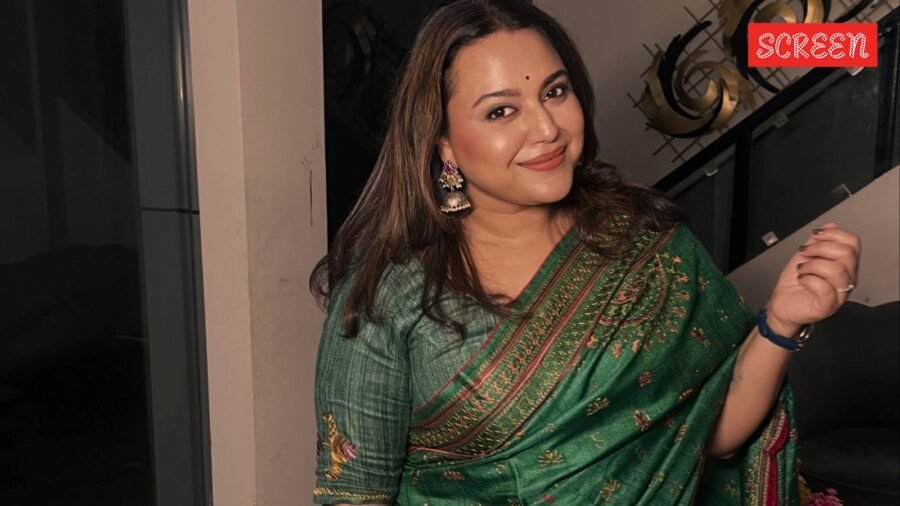
Actor Swara Bhasker has revisited the controversy surrounding her open letter to filmmaker Sanjay Leela Bhansali after the release of Padmaavat in 2018. Speaking at an event hosted by the India International Centre (IIC) in Delhi, Swara recalled why she was disturbed by the film’s depiction of jauhar (collective mass self-immolation by women in medieval India to avoid capture by invading army) and why she decided to write a letter questioning its message about women and sexual violence.
Swara’s comments come years after her 2018 letter became a major talking point, with the actor saying that much of the discussion around it ended up focusing on one phrase rather than the larger argument she was trying to make.
Why Swara Bhasker wrote the Padmaavat letter
Padmaavat, directed by Sanjay Leela Bhansali and starring Deepika Padukone, Shahid Kapoor and Ranveer Singh, released in January 2018 after months of controversy. The film, inspired by Malik Muhammad Jayasi’s 16th-century epic poem Padmavat, revolves around Rani Padmavati and the conflict between Rajput ruler Ratan Singh and Alauddin Khilji. Its depiction of jauhar, particularly in the climax, became one of the most debated aspects of the film.
Story continues below this ad
At the IIC event, Swara recalled watching the climax and seeing hundreds of women choosing jauhar. She said she immediately began wondering what the sequence might communicate to survivors of sexual violence.
Swara Bhaskar speaks about her letter to filmmaker Sanjay Leela Bhansali on the scene of Jauhar in the movie Padmavat pic.twitter.com/6X4Z0SvFtC
— Yeshi Seli (@YeshiSeli) August 31, 2026
“I’m watching this, these 800 women committing jauhar, and I was like, yaar, if I had been, God forbid, if I was a rape survivor, what is this film telling me? I would feel like a coward, that I didn’t kill myself to save my honour. Is that what you want to tell in a society like ours, where I feel like there’s anyway a rape epidemic?” she said.
She continued, “Is this what we want to tell our survivors, that you didn’t deserve to live? That if you actually had been honourable and brave women, you would have killed yourself. Are we saying that rape is the end of a woman’s life?”
Swara also recalled another moment that upset her — a close-up of a pregnant woman during the sequence.
“And then there was that one shot, it made me so mad, I was like, chiii, in the audience loudly. There is a close-up of a pregnant woman’s belly. And she is going, so you’re saying that a foetus that might be female doesn’t deserve to be born, because she might be raped by a Muslim ruler?” she said.
Story continues below this ad
Swara waited five days before writing the letter
Swara said she did not immediately put her thoughts on paper. Instead, she waited for five days to make sure she was responding after reflecting on the film rather than simply reacting emotionally.
“And then I came out and I was like this is terrible. And normally people think that I do these things out of rage. But I waited for five days. And I was like, let me check if I still feel like this. And then at the end of five days, I wrote this letter,” she recalled.
Her open letter, published by The Wire in January 2018, questioned the glorification of jauhar and the idea of tying a woman’s worth to her sexual purity. Swara argued that a woman’s life does not lose its value after sexual assault and that women should not be defined by their bodies or sexuality.
Story continues below this ad
One line from the letter became particularly famous. Swara wrote about feeling reduced to her sexuality after watching the film.
‘I felt like a vagina’ became the headline
Recalling the controversy at the IIC event, Swara said the discussion around her letter became dominated by a single phrase.
“I just want to say that when it got published, there was one line in the letter where I was trying to say that women are more than their private parts. And watching this film made me feel that I’m reduced to a vagina,” she said.
She added, “The publication thought that this would make a great headline. So the headline was, I felt like a vagina. And then you can imagine that nobody in India actually reads beyond the headline.”
Story continues below this ad
Netizens disagree with Swara Bhasker
Swara’s latest comments have sparked fresh debate on X, with several users disagreeing with her interpretation of jauhar and arguing that the practice should be viewed within the historical context of medieval warfare and violence.
One user wrote, ““Jauhar” was a lot of things but, it certainly wasn’t a “cowardly act” Swara Bhaskar is wrong here that much I can say as a student of history. You can debate mass immolation but, you can’t call it cowardice that’s just being malicious”
Another user wrote, “Jauhar was and remains an act of utmost bravery in the face of unimaginable brutality. Swara is using a false equivalence of rape to compare a medieval barbarity and atrocity. Showing stunning ignorance she says that she is arguing that why shall a pregnant women commit jauhar just to protect her foetus. What a wilful intellectual blindness.”
Swara’s original letter had similarly divided opinion in 2018, with critics accusing her of misunderstanding the historical and cultural context of jauhar, while others supported her concerns about the portrayal of women and sexual violence.

Ricky Kej announces ‘Damrooh’ tour
By Sohail Khan · 1 Sep
Korean sci-fi hit ‘Hope’ to release in India on September 25
By Sohail Khan · 1 Sep
Leave a Reply