Chandivali residents audit footpaths to debunk BMC’s ‘Pedestrian First’ claims
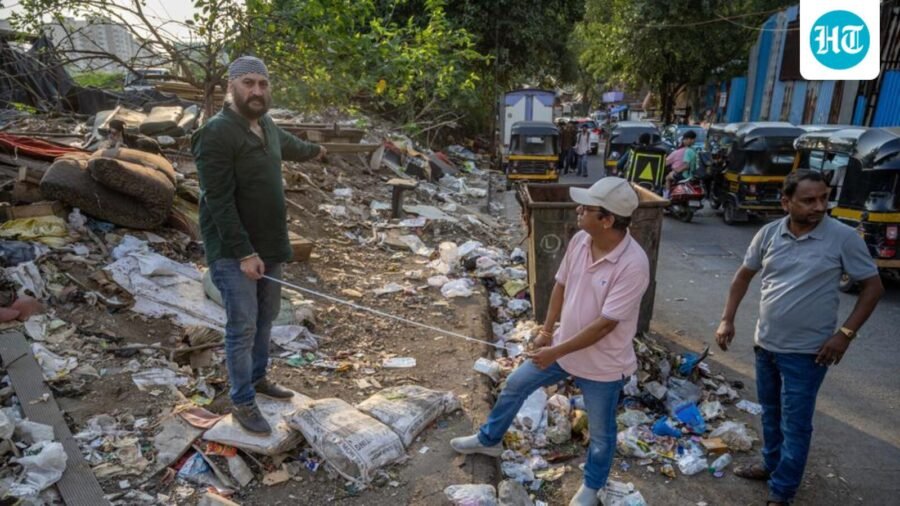
The Chandivali Citizens Welfare Association (CCWA) on Tuesday audited four prominent pedestrian stretches connecting Chandivali Nahar, Lake Homes, Raheja Vihar and other high-rise townships. The roads serve nearly 200 buildings across the neighbourhood, where a rapidly growing population has placed increasing pressure on already congested roads and inadequate pedestrian infrastructure
Published on: Sep 30, 2026, 07:57:10 IST
Prefer HTon Google
Share via
Copy link
MUMBAI: Two months after the BMC relaunched its ‘Pedestrian First’ campaign, claiming to have cleared hundreds of footpaths of encroachments and made walking spaces safer, residents of Chandivali have conducted their own audit, documenting narrow and obstructed footpaths, illegal parking, dumping and other impediments they say belie the civic body’s claims.
The Chandivali Citizens Welfare Association (CCWA) on Tuesday audited four prominent pedestrian stretches connecting Chandivali Nahar, Lake Homes, Raheja Vihar and other high-rise townships. The roads serve nearly 200 buildings across the neighbourhood, where a rapidly growing population has placed increasing pressure on already congested roads and inadequate pedestrian infrastructure.
“We have been suffering because of the condition of these roads and footpaths. After the new BMC commissioner announced the Pedestrian First campaign, we kept reading about hundreds of footpaths being cleared of encroachments. We wanted to see how this drive was actually taking shape in our neighbourhood,” said Mandeep Singh Makkar, founder of CCWA.
Residents’ findings
The audit found footpaths narrowing to as little as 1.4 metres at some locations. Residents said all four stretches had one or more obstructions, including illegal parking, hawkers, stalls, staircases from slum structures, encroachments, dumping and large hoardings that further reduced the space available for pedestrians.
Residents also flagged what they described as poor road design. On some stretches, kerbs were substantially higher than the prescribed standard. One section was measured at around a foot, compared with the 150-mm (15-cm) standard cited under Indian Roads Congress guidelines, the group said.
One of the key stretches audited was IRB Road towards Hiranandani Gardens in Powai, which has four schools and a hospital and is heavily used by pedestrians travelling from Chandivali. Residents found that a roughly 200-metre stretch, including an area near a bus stop, had effectively turned into an open dumping ground, making it difficult for pedestrians to use.
Makkar said inadequate pedestrian infrastructure was also contributing to traffic congestion by forcing residents to depend on private vehicles.
“There is no pedestrian infrastructure, so people take out their cars. When they do that, it leads to more traffic. Making footpaths better and walkable will not just help pedestrians but also traffic,” he said.
The group also audited DP Road No. 9, where footpaths exist on both sides. On one side, residents measured a kerb at about a foot, while dumping had made portions of the footpath uneven and difficult to negotiate. On the other side, a slum settlement had several staircases opening directly onto the footpath, while shops had extended their merchandise onto the road, the group said.
Khairani Road presented another set of problems. Residents said hawkers and stalls, including fish sellers, had occupied portions of the road, while a large hoarding was also obstructing pedestrian movement.
The residents also pointed to the stretch in connection with a previous fatal incident in which a pedestrian, forced to walk on the road because of inadequate pedestrian infrastructure, fell into an open manhole and died.
“Despite this stretch getting so much publicity, no attention was paid to the most basic need of this road — pedestrian infrastructure,” the group said.
The audit also covered Chandivali Farm Road, where residents found stalls and other obstructions. A stretch outside a commercial hub was also found to have inadequate space for pedestrians, they said.
Residents stressed that the problem could not be reduced to hawkers or small establishments alone. They said illegal parking, dumping, hoardings and poorly designed or inadequate footpaths collectively made pedestrian infrastructure unusable.
The CCWA also called for greater coordination between the BMC and Mumbai Police, particularly to deal with illegal parking and other obstructions. The residents said the effectiveness of the ‘Pedestrian First’ campaign would depend on enforcement by multiple agencies. “These are the lifelines of high-rise townships and this is their condition,” residents said.
The CCWA said it would submit photographs and observations from all four stretches to the municipal commissioner and the L Ward officer, along with recommendations for improving the implementation of the ‘Pedestrian First’ campaign. “We expect the BMC to pay heed to the audit and make things right,” Makkar said.
When reached out to BMC, assistant commissioner, L ward Annil Jadhav said, “We are continuously removing encroachments and working to make footpaths more walkable. If the CCWA audit has identified any remaining encroachments, we will take note of them and remove them.”
Catch every big hit, every wicket with Crickit, a one stop destination for Live Scores, Match Stats, Infographics & much more. Explore now!
Stay updated with all the Breaking News and Latest News from Mumbai. Click here for comprehensive coverage of top Cities including Bengaluru, Delhi, Hyderabad, and more across India along with Stay informed on the latest happenings in World News.
See Less




Leave a Reply