Centre’s Ladakh proposal: No statehood or legislature, but new model needing Parliament’s vote
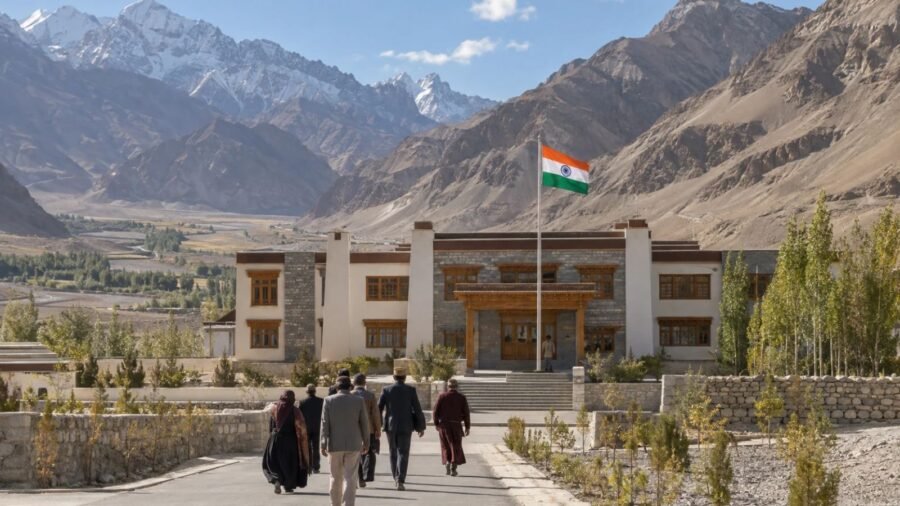
The Ladakh administration said Thursday that the new governance arrangement for the Union Territory will neither be statehood nor a UT with a legislature but a special constitutional amendment that will need the approval of Parliament.
A day after the meeting between representatives from Ladakh and officials of the Ministry of Home Affairs (MHA) in New Delhi, Ladakh Chief Secretary Ashish Kundra said that the agreement reached with the leadership here “is that a sui generis model, which does not exist anywhere in the country, will be crafted for Ladakh, where a legislative body will be created”.
“It is not going to be a state, for sure. It is not a UT with legislature, but it is some other body which will have these (executive, legislative, financial) powers. The nomenclature of it is yet to be finalised, but that is why the discussions are underway,” he said.
Story continues below.
Subscribe to see fewer ads.
A key demand of the Ladakh region since agitation began after the UT was carved out of the former state of Jammu and Kashmir was its inclusion under the Sixth Schedule of the Constitution, which provides for the administration of tribal areas in the northeastern states of Assam, Meghalaya, Tripura and Mizoram under Article 244(2).
However, Kundra called the Sixth Schedule a constitutional construct largely in the North East, “where certain districts within a state are, let’s say, minority tribes. Those minorities deserve protection from the majority, and therefore you create a separate district council which is a Sixth Schedule council.”
He said that it was explained to the members of the sub-committee that this model has its limitations and that the central government is “willing to go ahead and offer something more and that will come from Article 371. Once these constitutional safeguards are embedded in Article 371, then it is cast in stone,” Kundra said.
Kundra said that the framework proposed for Ladakh is a constitutional amendment and not the enactment of an “ordinary law”. For this, he said, a two-thirds majority is needed “and that requires political consensus across parties.” After this, he added, a detailed regulation to implement this decision will be needed. “These things have been transparently shared with the leadership yesterday.”
Story continues below this ad
However, the legal crafting of the bill will be possible after both sides have agreed on certain basic principles. “For this, we have shared a set of questions with the leadership with the aim of creating consensus on the way forward,” he said, adding that legal drafting requires in-principle consensus.
On Wednesday, the representatives of Kargil Democratic Alliance and Leh Apex Body, who form part of a sub-committee that is in deliberations with the Centre, said they were “not satisfied” with the talks, since they were hoping to see a draft from the Centre as both sides returned to the table for negotiations after four months.
The Centre has offered the addition of a constitutional provision of ‘Article 371(K)’ in a bid to extend additional protections to Ladakh at the sub-committee meeting on Wednesday.
Kundra emphasised that the Government of India and the administration of Ladakh are making “every effort” to address the aspirations of the people of Ladakh.
Story continues below this ad
He clarified that any draft will be put forth after consultations and will go through a process that includes going to Parliament. Adding that the “foundational aspects” of this movement — protections being sought by the people of Ladakh, including protection of its land, jobs, mineral resources, culture and environment — will be constitutionally protected, he remarked that, “It is also the responsibility of the leadership to create an atmosphere of positivity among the people, when things are really moving forward.”
The next meeting of the sub-committee will take place in October.

To help rescued orangutans beat stress, Odisha zoo turns to music therapy
By Sohail Khan · 10 Sep
Cancer leaves tiger Nandu unable to eat, euthanised at Thrissur zoo
By Sohail Khan · 10 Sep

Leave a Reply